
Rule of law and governance: Alumni of the Konrad Adenauer Foundation assess Senegalese democracy
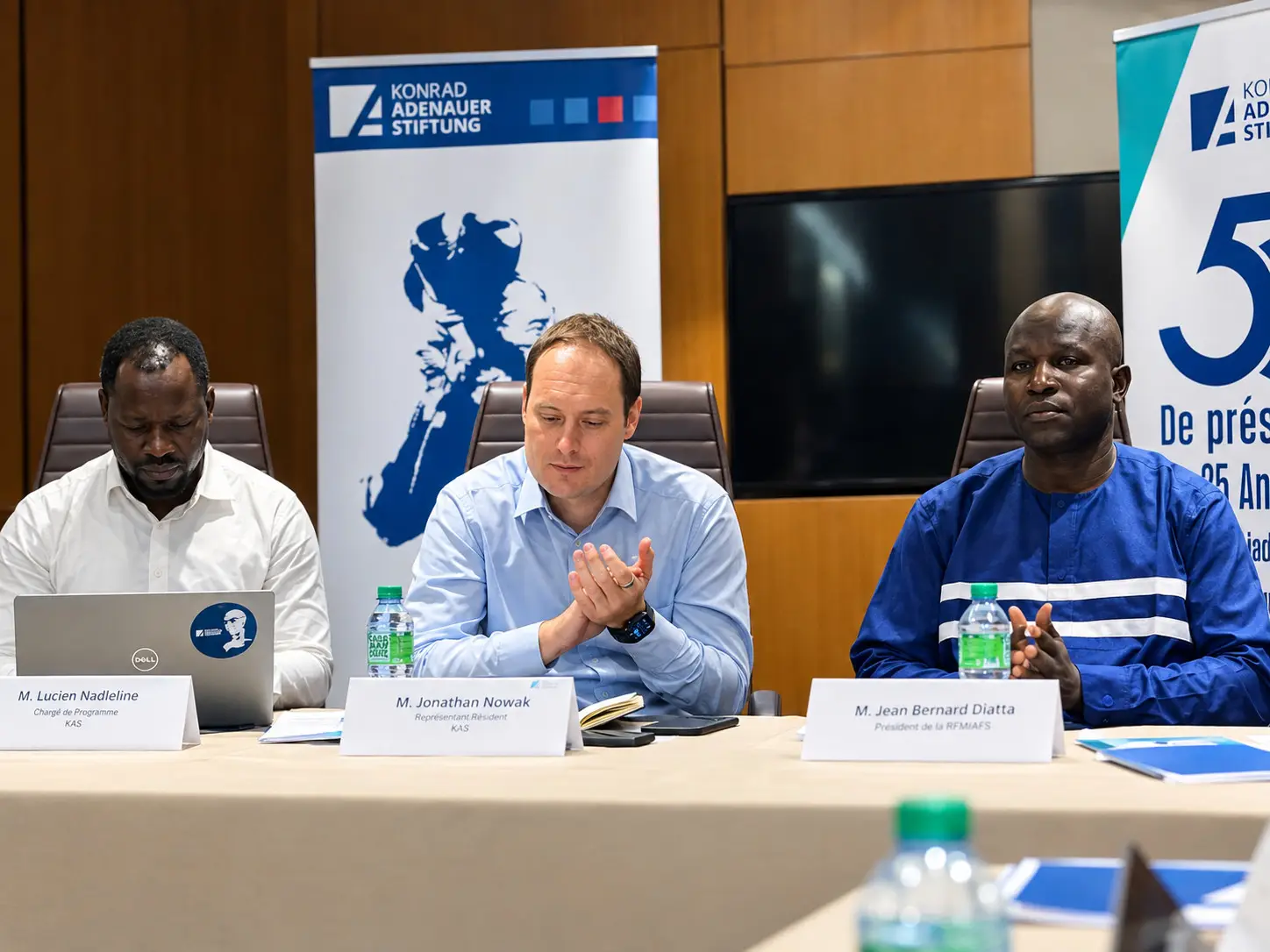
As part of the forum of the National Alumni Network of the Konrad Adenauer Foundation on the theme “Democratic leadership, rule of law and governance”, its members met on Saturday September 12, 2026 in Dakar to examine the state of Senegalese democracy. The discussions focused in particular on the functioning of institutions after the 2024 crisis, justice, the fight against corruption, public freedoms and the emergence of new political leadership, particularly among youth.
The Alumni Network of the 2020 class of the Konrad Adenauer Foundation took a closer look last Saturday, during a panel in Dakar, at the state of democracy and governance in Senegal. For the national coordinator of the network, Dr Jean Bernard Diatta, the choice of this theme responds to an observation of “progressive weakening of the rule of law and governance in Senegal”. He also insisted on the need to bring about “youthful leadership”, in a context where youth occupy a growing place in political life. During the panel “Leadership and the rule of law: state of play”, the speakers particularly insisted on the need to evaluate Senegalese democracy beyond the formal existence of institutions and the regular holding of elections. For the political scientist and researcher at Gaston Berger University in Saint-Louis, Djiby Ndiaye, this assessment must also take into account the trajectory of the country and the real functioning of its institutions. The institutional crisis of 2024, marked in particular by the postponement of the presidential election, was thus mentioned as revealing the solidity of institutional mechanisms. The decision of the Constitutional Council and the holding of the vote showed, according to the researcher, the importance of control mechanisms in resolving political crises. But this sequence also reminds us that democratic achievements are never definitively guaranteed. “Senegal is in perpetual search of democracy,” summarized Djiby Ndiaye, believing that regular elections and alternations are not enough, on their own, to ensure a fully consolidated democracy.
“African malaise”
Justice, the fight against corruption, public freedoms and freedom of the press were also mentioned as indicators of democratic vitality. The speakers called in particular not to reduce the evaluation of governance to international rankings alone but to focus on the concrete functioning of institutions and the capacity of the State to guarantee rights and freedoms. The discussions also opened up a reflection on the political situation on the African continent. Alassane Dione, temporary teacher in political science at Ugb, spoke of an “African malaise”, marked in particular by the growing protest against certain regimes and the mobilization of young people who are increasingly present in the public space. He particularly highlighted poor governance and strategies for perpetuating power in several African states, as well as the persistent dependence of many countries on external partners. In this context, the question of youth leadership appears to be a major issue: it is now a question of transforming this mobilization into a force capable of contributing to the strengthening of institutions and the consolidation of the rule of law.
It is in this perspective that the National Alumni Network of the Konrad Adenauer Foundation intends to formulate recommendations for the attention of public decision-makers, around the strengthening of democracy, the rule of law and governance in Senegal.
Yaya SOW (Intern)
