
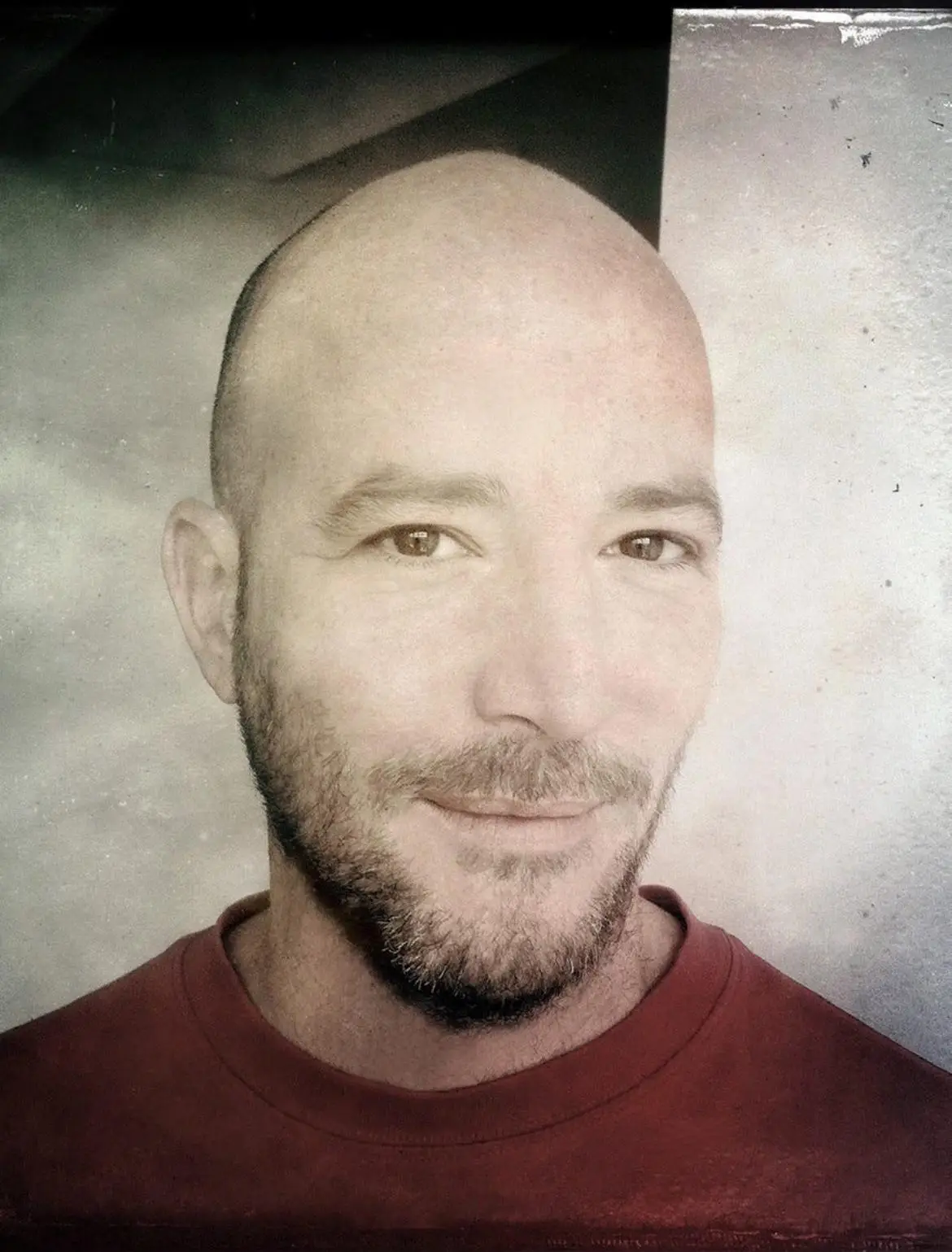
“Room 207”: when photography tries to repair a broken memory September 21, 2026
Forty-three years after a tragedy that turned his childhood upside down, French photographer Jean-Michel André returns in the footsteps of his missing father. Through “Room 207”, an exhibition presented at Galerie Le Manège (Editor’s note: Emblematic exhibition space of the French Institute of Senegal located in the heart of Dakar-Plateau) from September 25 to October 31, 2026, the artist transforms photography into a tool of memory, reconstruction and repair. Senegal, where he lived part of his childhood, occupies a unique place in this intimate quest.
There are memories that fade in order to survive better. And others who return, decades later, in fragments, in images or in places. For Jean-Michel André, memory stopped for a long time in a hotel room in Avignon. On August 5, 1983, when he was only seven years old, his father was murdered with six other people in a hotel in the city. The child, who was sleeping in a neighboring room, is deeply affected by the tragedy and loses some of his memories.
Thirty years later, the photographer sets out to reopen the doors to this story. He searches for documents, collects archives, returns to the scene of the tragedy and reconstructs, as much as possible, the routes he could have traveled with his father. Avignon, the Arles region, Corsica, Germany, but also Senegal become the stages of an investigation which gradually goes beyond the search for judicial truth.
Reconstruct what memory has erased
In “Room 207”, Jean-Michel André does not seek to show the horror head-on. He chooses instead to bypass it, to disperse it in landscapes, objects, old photographs and press archives. The exhibition thus mixes contemporary photos, investigation documents and family objects to question memory, mourning and the possibility of repair.
The room then becomes much more than a place. It represents the breaking point of a childhood and the beginning of a long quest. “The children’s bedroom was number 207: I left my memory and my childhood there,” writes the photographer in the extracts accompanying the project.
But “Room 207” is not just the story of a family drama. By revisiting the places and landscapes linked to its history, Jean-Michel André gradually shifts his gaze. Photography allows him to work on what is missing, on what remains invisible and on what words cannot always say.
Senegal, territory of memory
In this reconstruction, Senegal occupies a special place. Jean-Michel André spent part of his early childhood there with his parents, notably in Dakar-Plateau. Years later, he returned to photograph some of these spaces: Saint-Louis, Yoff and even Siné-Saloum appear in his journey as so many fragments of a memory to be rediscovered.
The photographs taken in Senegal are therefore not simple landscapes. They participate in an attempt to reconnect with a personal history. “I go back in time, in the footsteps of a vanished memory,” explains the artist in the exhibition file.
In Dakar, a photograph from 1980 shows him as a child with his father. In Saint-Louis, a fisherman. In Siné-Saloum, “Deliverance”. In Yoff, the beach. So many images that create a dialogue between the present and a past whose contours have become uncertain.
A photograph far from spectacular
The exhibition thus takes the opposite view of the spectacular. Jean-Michel André questions the limits of the image: what to show about trauma? How to represent it without falling into pathos? And how can we make the intimate an experience capable of touching on the universal?
His work is constructed in this in-between, on the border of documentary investigation and autofiction. Archives become clues, family objects traces and landscapes projection spaces. A watch that belonged to his father, suitcase keys, a drawing made for Father’s Day and even press clippings from 1983 are thus integrated into the photographic story.
“Words do not necessarily exist to reveal wounds, flaws,” confides the photographer. In this work where modesty remains central, the image then becomes a language of substitution, a way of approaching the unspeakable without claiming to reveal everything.
From investigation to delivery
Presented at the Le Manège Gallery of the French Institute of Senegal, the exhibition is curated by Mohamed Amine Cissé. It is co-produced with the Mediterranean Center of Photography in Bastia and the Hospice Comtesse museum in Lille.
Curator and actor in the contemporary cultural scene, Mohamed Amine Cissé places this project in a reflection on the capacity of art to transform a personal experience into a shared story. For him, “Room 207” goes beyond individual trauma and questions the way in which art can help soothe the wounds of history.
Already presented in several places dedicated to photography, the exhibition accompanies the release of the book “Chamber 207”, published by Actes Sud and awarded the 2024 Nadar Prize.
In Dakar, the public is thus invited to enter this room without necessarily looking for the exact reconstruction of a tragic night. Instead, he will discover the traces of a man who, for years, tried to find a missing father and a part of himself. A story where photography is no longer content to show: it becomes a path to look at the past differently and, perhaps, learn to live with what can never be entirely rediscovered.
YEAR
