
Recovery of the economy: CNES relies on the alliances of its companies and industries
Accelerating cross-sector synergies to build a highly competitive local offer, throughout its value chain remains an imperative for the recovery of the national economy. This was underlined by the National Confederation of Employers of Senegal (CNES), following a meeting held on November 10.
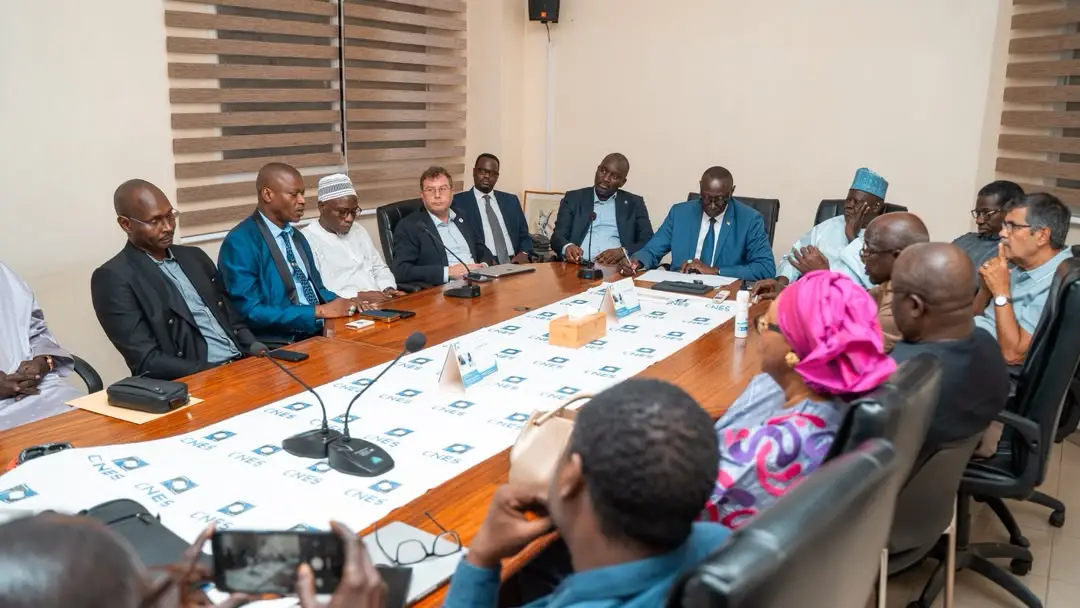
Faced with a national and international economic situation considered difficult, the National Confederation of Employers of Senegal (CNES) chooses the offensive and institutional innovation. The employers’ organization held its back-to-school cocktail party on November 10 at its premises in Dakar.
Also read: General workers’ strike on October 21: CNES pleads for continuation of dialogue
“This new strategic meeting brought together its presidents of federations and professional organizations (around thirty) around an imperative: to accelerate intersectoral synergies to build a highly competitive local offer, throughout its value chain,” reports a press release from the Confederation received on Wednesday.
Having chaired this meeting, the president of CNES, Abdel Kader Ndiaye, defined this unprecedented meeting as an operational implementation of the confederation’s 2026-2029 Strategic Plan. The stated ambition is, according to him, to break with the isolation of sectors and move towards a logic of grouping, co-investment and concrete business partnerships.
A cumulative turnover of 450 billion FCFA by the Jubanti Construction consortium
Thus, Abdel Kader Ndiaye welcomed the rise in power of national capital alliances, citing the Jubanti Construction consortium as an example. This group of 14 members has a cumulative turnover of 450 billion CFA francs and a total balance sheet of 1,000 billion CFA francs, illustrating the capacity of local companies to align themselves with major public and private markets.
“The dynamic also extends to energy with the Jubanti Énergie group which produces nearly 450 MW (approximately ¼ of national electricity production) and has been able to mobilize nearly 500 billion CFA francs in investments, and to education via the Federation of Education and Training (FEF), which manages to pool players from the Catholic private sector, the Franco-Arab secular sector, private universities and health schools,” he noted.
Heading towards the Economic Days of 2027
As a perspective, the president of CNES announced the official return of the Economic Days of the confederation for the first quarter of 2027. Focused on the theme “Senegal’s trajectory in development: Assessment & Perspectives”, these meetings aim to take stock of Senegal’s development before drawing up the outlook.
“The economic days will be placed under the high presidency of the Head of State. He will take part in a high-level panel with private sector actors, economic theorists and public decision-makers, thus marking the employers’ desire to consolidate a strong public-private partnership and to remain an essential force for proposals for the development of Senegal,” we read in the press release.
It should be noted that for this great first, three flagship organizations were in the spotlight. These are the National Federation of Industries of Senegal (FNIS), represented by its president Alla Sène Gueye and its secretary general Mr. Sahili, the Chamber of European Investors in Senegal (Eurocham), led by its president François Cherpion accompanied by its secretary general Jeanne Makhlouf, and the National Federation of Electric Energy of Senegal (FNEES), represented by presidents Mor Kassé and Mamadou Saliou Sow.
Mariama DIEME
