
Publishing plays a role in the face of artificial intelligence October 25, 2026
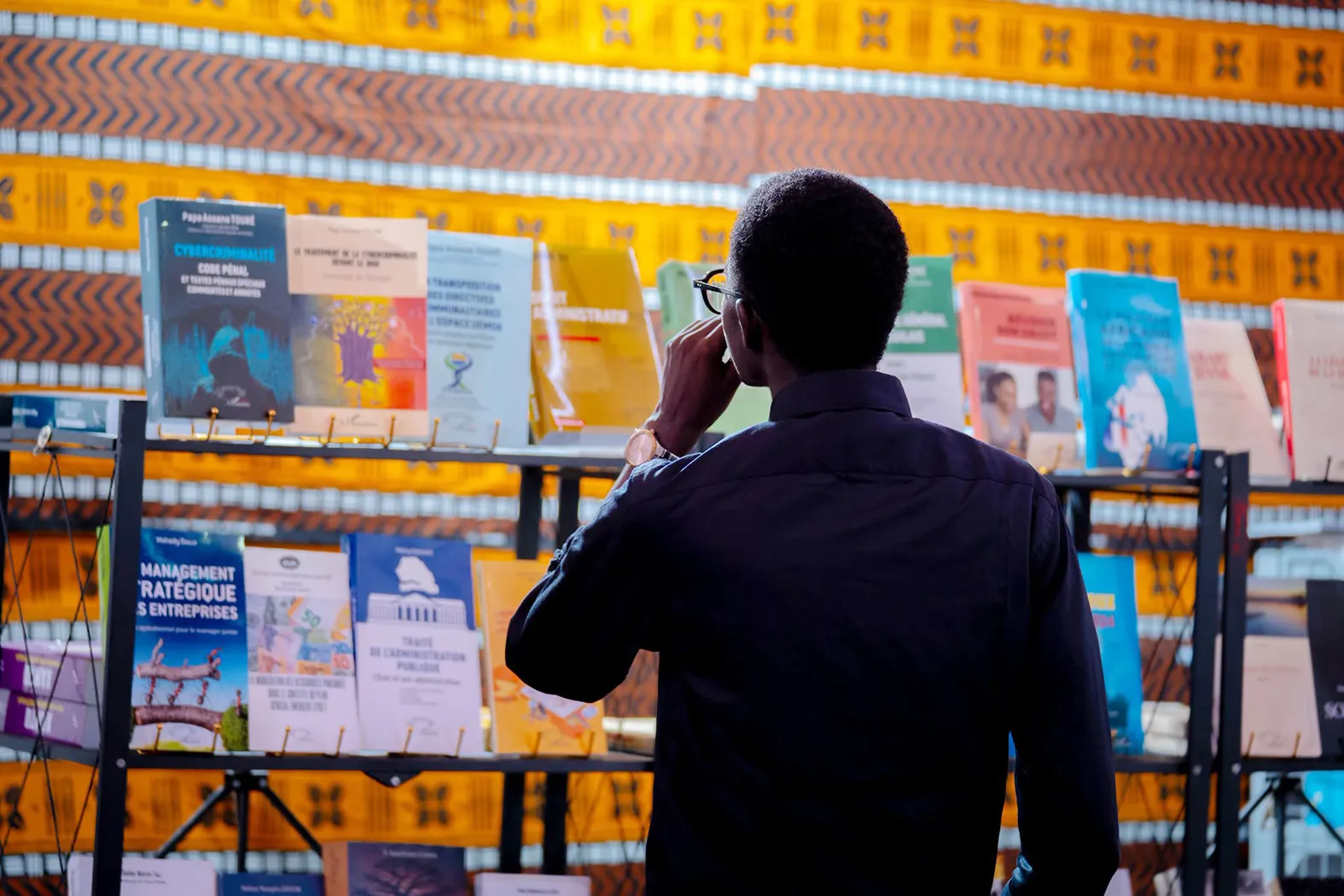
Each revolution has its share of questions. Inevitably. The world of books is no exception to the rule. Back after seven years of absence, the 18th edition of the Dakar International Book and Teaching Materials Fair (Fildak) offered a glimpse. The literary meeting, hosted at Cices from October 15 to 19, was strongly concerned with artificial intelligence. What happens to their job in the face of this technology? Are they reluctant? Do they use it internally? Is there a need for more transparency in its use? Publishing professionals warn and launch the debate.
9 out of 10 texts are written by AI.” The grim statistic comes from Mame Ngoné Faye, director of the women’s publishing house Le Fil d’Ariane. She sends chills down her spine by maintaining that nearly 90% of the handwritten texts she receives are produced by artificial intelligence.
Creation is therefore absolutely no longer human. She is more and more robotic. The effort of reflection is destroyed by the simplicity with which technology designs the text.
The director, herself an author, continues: “What I find unfortunate with AI is that there is no longer the blank page syndrome. How many times have we wanted to write something, nothing comes. Now, this pain is beautiful, the fact of searching deep in your guts, in your imagination. But here, it’s automatic.”
Ms. Coly admits that she prefers to receive a text that is imperfect but human, rather than perfect but artificial.
Present at a conference organized on the second day of the event, with the theme “Reinventing the book chain in Africa: artificial intelligence, circulation of works and new financing models”, the founder and director of the publishing house L’Harmattan Senegal, Abdoulaye Diallo, was also critical of the use of artificial intelligence in the process of creating the book.
“AI cannot create. Creation results from intention. This means that there must be a human who has this intention,” maintains the publisher.
Also questioned during this panel, the founder of the Plumes du Monde bookstore, Souleymane Gueye, warns of the dangers that AI can generate within the world of publishing. It indexes a “levelling down”, caused by a “standardization” of artificially manufactured works.
The latter takes the example of the Chat-Gpt style advertising posters which abound in the Senegalese capital and are absolutely no longer distinguishable. Souleymane Gueye speaks of a technology that “threatens the profession” and warns of the dramatic consequences of the speed with which a book can be produced when it is created robotically.
He explains: “AI, at some point, will win a battle because the people who use it will be able to produce books much more quickly, at a lower cost, and will sell them less expensively. Due to the financial dimension, the public will therefore favor these works and resistant publishers will no longer be able to economically compare with those who use them.
A leveling down will be inevitable.
Furthermore, the presence of artificial intelligence in literary works is particularly observable. Some Senegalese publishing houses know how to recognize it thanks in particular to their own methods.
Regarding L’Harmattan Sénégal, Abdoulaye Diallo claims to “know if it is a text simply corrected by AI, if it is a text generated by AI, or if it is a text co-produced by AI”.
AI, far from perfect and invisible
He insists on the fact that it is a know-how that results from a human profession, publishing, “that no machine can take from us”.
Another simpler tool is the telephone interview. The founder of L’Harmattan Sénégal exchanges with the author and, during the conversation, manages to directly discern whether his text was constructed by human creation or robotic creation.
For her part, Mame Ngoné Faye identifies certain characteristic features of artificial intelligence which are not misleading, namely the two small dots, the dashes or even specific words that she systematically uses such as the verb “to function”.
A way of saying that AI is far from perfect and undetectable. Before admitting that she does not use any anti-plagiarism or anti-AI software supposed to disentangle the authentic from the fake, which she considers “not really reliable”.
The director of Fil d’Ariane Éditions illustrates her point by proving that anti-AI software sometimes even manages to find an AI percentage through the words of a Hugo or a Baudelaire. Quite impossible, obviously.
Mame Ngoné Faye then states, “that with the human eye, when we are used to working, we automatically guess”.
In other words, for these editors, no machine still replaces the eye of the editor as well as his know-how acquired over the years and transmitted by veterans of the profession.
A tool rather than a substitution
However, publishing houses are not only pessimistic and alarmist about this technology. Publishing professionals qualify by showing its effectiveness internally for subsidiary tasks which previously took a lot of time.
Dissemination, sales and even the production of reports are the main examples put forward by the latter.
The founder of L’Harmattan Sénégal relates “that no serious company today can do without this artificial intelligence in the context of improving its productivity”.
Therefore, editors are calling for more awareness of the fact that AI must be used as a tool and not as a replacement. Man must, under no circumstances, submit to this machine in the creative process, but must rather use it wisely to guide his thinking.
Abdoulaye Diallo warns his colleagues in the profession of the need for “awareness, caution and vigilance” that they must have when receiving texts.
For Abdourahmane Sy of Éditions Feu de brousse, Fildak can be a means of raising awareness in the book industry as well as its readers. “It’s an opportunity that allows us to discuss, to exchange on certain questions that challenge the future of the book so that we know the danger that lurks,” he assures.
Transparency, controversy, mutation
But the debate also opens through the prism of transparency. Should authors clearly admit that their work is modified or made using artificial intelligence? Should it be mentioned? Will there be a clientele who will accept the fact? Editors are asking questions.
“For some, it’s a shame to say it because it’s not creation. For others, it’s nothing at all. Now, are readers ready to accept? I see that with this young generation, they have no problem saying that they have used AI. So, perhaps, one day, writing with the help of AI will not be a problem, as long as the authors recognize it and are sincere,” says Mame Ngoné Faye.
For the director of Saaraba Éditions, the machine is fully capable of producing consumable works that people can buy and be satisfied with. He pleads for total transparency: “When you buy a book, you have the right to know if it is a human who wrote it or if it is an artificial intelligence. Then you consciously make your choice.”
Returning to the Thélyson Orélien controversy, accused of having written his novel “It was that or to die” with the AI, a work consequently withdrawn from Goncourt, Souleymane Gueye still defends transparency by explaining that the real relevant reflection is to know what he can do alone and what the AI has done.
Even if he wrote it using the machine, you need to know how much he used it and communicate it so that readers know.
Tomorrow, will the words “written with the help of AI” appear on book covers, like a label on a cover? A new page in the history of books may be turning.
By Antoine BOITTIAUX (Intern)
