LFR and 2027 budget: Ousmane Sonko calls for preserving households and social spending
The amended finance law and the initial finance bill for 2027 give rise to differences between the government and PASTEF, the majority party in the National Assembly.
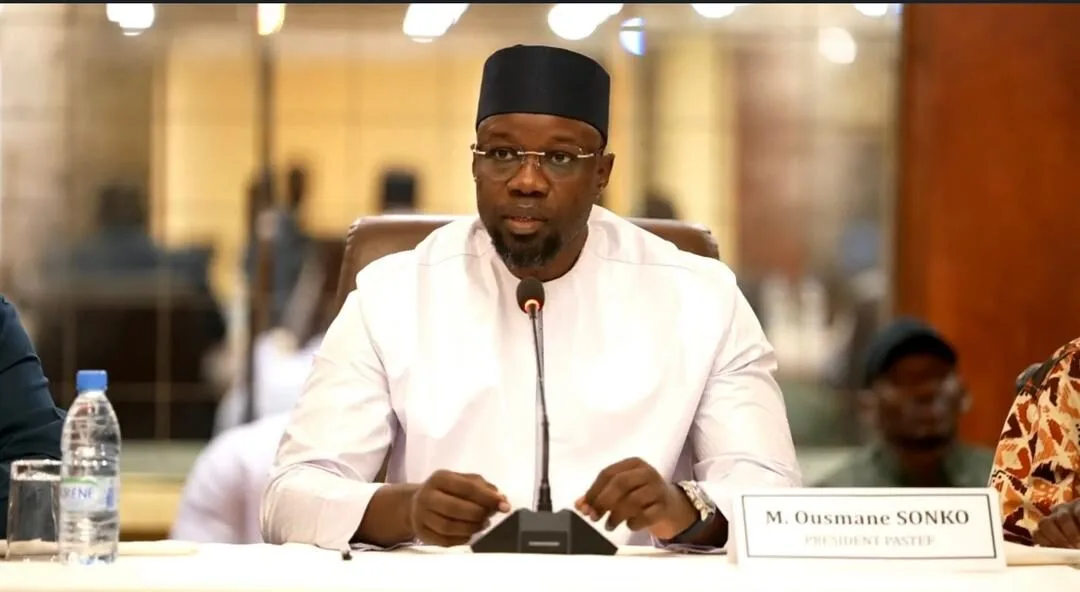
During a press conference, party leader Ousmane Sonko notably mentioned subsidies for petroleum products, taxation, social spending and the supervision of special funds. The party leader defends adjustments intended, according to him, to reconcile recovery of public finances and preservation of purchasing power.
Hydrocarbon subsidies: the price debate
The gradual reduction of subsidies for petroleum products constitutes one of the main points of disagreement raised by Ousmane Sonko. According to the figures he presented, the envelope devoted to these subsidies would be reduced to 552 billion FCFA in 2026, compared to 790 billion initially expected, a drop of 237 billion FCFA. For 2027, it would stand at 479 billion FCFA.
Based on these projections, the leader of PASTEF estimates that the price of a liter of diesel could increase from 755 to around 867 FCFA in 2026, then reach 910 FCFA in 2027. He also mentions a price of 976 FCFA in the hypothesis that subsidies would be limited to 1% of gross domestic product.
To limit the effects of a possible increase in prices on households and economic activities, he proposes to act simultaneously on subsidies and taxation. In particular, it recommends a reduction in VAT from 18% to 15%, accompanied by adjustments to certain specific taxes and customs duties.
According to him, this approach would reduce the burden of subsidies on public finances while limiting the impact on prices at the pump. It particularly highlights the role of diesel in transport and production, two sectors whose costs influence those of many goods and services.
Ousmane Sonko also questions the capacity of social compensation mechanisms to protect the most vulnerable households. He believes that family security grants would not be enough, on their own, to offset the indirect effects of an increase in hydrocarbons and calls for better targeting of support measures.
The DEKKAAL plan, an alternative to evaluate
The DEKKAAL economic and social recovery plan constitutes another aspect of the reservations expressed by the leader of PASTEF. He claims to have taken the initiative for its development when he was Prime Minister. He considers that this program can help mobilize additional resources without placing most of the effort on households.
According to the figures he put forward, the plan would have generated more than 312 billion FCFA during the year, despite implementation difficulties. He estimates that revenues could reach at least 700 billion FCFA per year if all the planned measures were applied.
Among the levers cited are taxation on certain products, money transfers, games of chance, operator licenses and land regularization. Ousmane Sonko wants these different sources of revenue to be fully evaluated before considering new tax measures.
In particular, it requests a detailed assessment of the provisions already adopted concerning money transfers, before any additional modification. This approach aims, according to him, to assess their performance and their impact before reviewing the system.
Social spending and investment: trade-offs discussed
The budgetary guidelines also raise questions regarding social spending and public investment. Ousmane Sonko reported budget reductions affecting in particular the ministries responsible for National Education, Family and Solidarity as well as Vocational Training.
He also noted what he considers to be a discrepancy between the objective of reviving investment and the reduction of 555 billion FCFA which he attributes to investment expenditure in the amending finance bill.
On the tax front, the leader of PASTEF supports the principle of tax marking, which can help to better monitor the production of certain goods and improve tax collection. However, he would like the products concerned to be defined by law, rather than left to the sole discretion of the Minister of Finance by decree. He thus pleads for a framework allowing the National Assembly to examine the list of targeted products.
The issue of special funds is also among the points raised. Ousmane Sonko recalls that their supervision is part of PASTEF’s commitments and announces that the party’s parliamentary group intends to defend amendments aimed at strengthening their control.
He conditions his party’s support for budgetary texts on taking into account provisions relating to these funds. This position could weigh on the parliamentary debates devoted to the amending finance law and the 2027 budget.
Relations with the IMF: a technical agreement still pending
Addressing discussions with the International Monetary Fund (IMF), Ousmane Sonko recalled that a technical agreement had been reached with the institution. He stressed, however, that this agreement remained provisional and must still be submitted to the Fund’s board of directors to become final.
He called for the search for solutions to reorganize debt maturities while preserving Senegal’s economic decision-making margins. He also expressed reservations about the use of certain international financing mechanisms, calling for reflection on the role of regional monetary institutions, notably the Central Bank of West African States (BCEAO) and UEMOA.
In his argument, the leader of PASTEF insists on the need to reconcile the restoration of budgetary balances with the protection of purchasing power and the maintenance of social spending.
Decisive parliamentary discussions
Despite his reservations, Ousmane Sonko affirms that PASTEF remains open to dialogue with the government. The party intends to examine the budgetary texts and propose amendments, without excluding an unfavorable vote if its main demands are not taken into account.
Parliamentary debates should thus make it possible to clarify the choices made in terms of subsidies, taxation, investment and social spending. They will also give an indication of the ability of the different parties to reconcile their positions around Senegal’s budgetary trajectory for 2026 and 2027.
Sheikh Gora DIOP
