
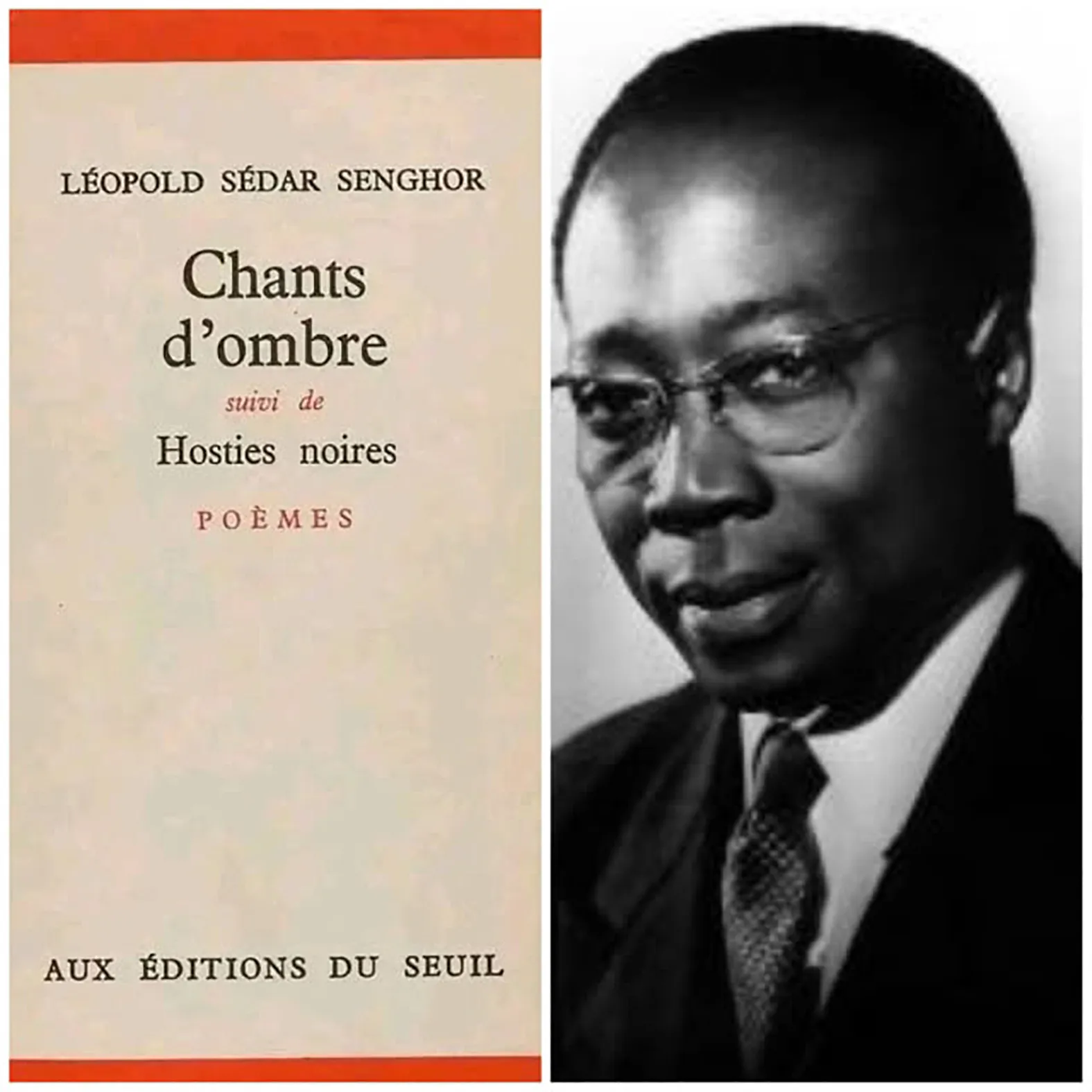
“Joal”, poem by Léopold Sédar Senghor: Memories of the kingdom of childhood, symphony of liberated verse
Published in 1945 in the collection Chants d’ombre, the poem “Joal” stands out as the intimate manifesto of Négritude. Behind the apparent simplicity of a nostalgic cry punctuated by the famous “I remember”, the academician-president, Léopold Sédar Senghor, deploys a poetic mechanism of surgical precision, reinventing French versification to the beat of the African tom-tom.
It is a clamor that crosses the Atlantic and breaks the Parisian frost. When in 1945, a young grammar school teacher named Léopold Sédar Senghor published Shadow Songs, Europe was still healing its war wounds. However, in the midst of the ideological rubble of the West, a voice rises to sing of a shore of fine sand, lined with palm trees and green shade: Joal. This small coastal counter in Senegal constitutes the center of gravity of a personal mythology that the poet would later call his “Kingdom of Childhood”. The following article proposes to dissect this textual monument, revealing how the goldsmith of the French language broke the chains of classical metrics to make the African soul pulse. The poem opens abruptly: “Joal! I remember. » The initial exclamation point is a gong. This proper name, projected at the head of the sentence, functions like a magic formula, a sesame opening the floodgates of memory. Joal! I remember. But you have to go to Mbine Diogoye (at Senghor’s father’s house) to understand the verse which follows “I remember the signares in the green shade of the verandas”. The overall structure is based on the principle of the decreasing poetic leash. The poem unfolds according to an irregular strophic swing alternating quatrains, couplets, tercets and isolated verses. This textual skeleton follows the movements of a memory tide: first the disorderly influx of luminous images, then the painful reflux towards the reality of exile.
The anaphora of the first person singular (“I remember”) recurs six times. Far from being a simple stylistic redundancy, it is similar to a liturgical incantation or the responsorial chant of the griot.
A reinvented versification
But to understand Senghor’s technical genius, we must observe his management of verse. As the first African grammar teacher, Senghor mastered traditional Alexandrine like the back of his hand. If he chooses free verse here, it is not out of ease, but out of an aesthetic and political choice.
The poem refuses regular rhyme and fixed counting of syllables (isochronism). We move without transition from a short verse to a full verse. For example, the verse “I remember the splendors of the Sunset” (a hendecasyllable) rubs shoulders with the verse “Where Koumba N’Dofène wanted to have his royal coat cut”. The absence of rhymes at the end of the verse is compensated by a complex system of internal rhymes and assonance and alliteration. We must also understand that Senghor’s verse constitutes a “verse”, inherited from the poetry of Paul Claudel and biblical options, but deeply reinvested by African rhythm. The rhythm is no longer dictated by the eye or by the artificial rule of the silent e, but by pulmonary respiration and percussion. The poet uses syntactic cuts (commas and dashes) to mark pauses that correspond exactly to the accents of a drum: “The fighting choruses – oh! the final dance of the young men, bust / Leaning slender…”. But the analysis of the versification of “Joal” cannot ignore its sonic and cultural dimension. Joal’s Child achieves a major stylistic coup by bringing together elements of Western Catholic culture with traditional African paganism. The most famous verse in this regard is undoubtedly: “I remember the pagan voices punctuating the Tantum Ergo”. The rhythm of the verse has a metronomic regularity. The poet uses the language of the colonizer, his religion and his meter, but he subverts its stiffness by injecting African syncopation. Moreover, the vernacular words inserted in the text (Koumba N’Dofène, Kor Siga) play the role of voluntary tonal breaks, identity markers impossible to smooth out by classical French diction. The end of the poem also marks a sudden break in the scansion. The memory journey is interrupted to bring the poet back to his sad reality of being uprooted. “I remember, I remember… My head rhythms What a weary walk along the days of Europe where sometimes An orphan jazz appears which sobs sobs sobs. The rhythm, once vigorous and associated with young men’s dances and struggles, is fading. The ellipsis materializes the running out of memory. The verse lengthens monotonously (“What a weary walk along the days of Europe…”), reflecting the heaviness of European time, linear and gray. The final triple repetition of the verb “sob sob sob” functions as an agonizing wail, but also as the final rhythmic cell of a blues or jazz piece. “Jazz”, a modern and urban term, arises to echo the “rhapsodies of the griots” of the beginning, uniting the sufferings of the black diaspora in the same musical momentum.
We must also measure the historical significance of this memory. In 1945, talking about Africa in French poetry did not only consist of introducing a few exotic landscapes into European literature. Senghor reverses his gaze. He does not ask Africa to timidly enter French literature as a picturesque object. It makes Africa the subject of a sovereign word. The gesture is considerable. The poet writes in the language learned at the colonial school, but he installs the cadences, images, names, characters and values of an African universe. This tension runs through the entire work. French is neither rejected nor accepted as it is. It is worked, inflected, musicalized. Senghor makes it resonate differently. It forces it to welcome realities, sounds and imaginations that its traditional academic use was not enough to contain.
From Joal to the universal
The poem does not choose between rootedness and openness. He makes one the condition of the other. The more Senghor plunges into his childhood kingdom, the more his poetry broadens. The particular becomes the gateway to the universal. The small coastal town becomes a scene where Africa and Europe, childhood and adulthood, paganism and Christianity, oral tradition and scholarly writing, the singing of the griot and the modern sounds of jazz meet. The poem is therefore also a text of circulation. Circulation of languages, memories, rhythms, beliefs and imaginations.
The sea which borders Joal also takes on a symbolic value. It separates, but it also connects. It is the border between the native country and elsewhere, between childhood and adulthood, between the African continent and Europe. The poet is on both sides of this water line. His body is far away, but his memory remains anchored in the native sand. “Joal” then designates one of the most accomplished expressions of this poetics of memory. Senghor makes childhood a land of resonance, exile a fertile wound and the French language a material capable of welcoming other breaths. The poem does not simply restore a lost past. He recreates it in a new language, French enough to be heard beyond Africa, African enough to never lose the cadence of its origin.
By Adama NDIAYE
