
In the Medina, the washerwomen hold on November 22, 2026
On the sidewalk of rue 31 corner 20, they work with the strength of their wrists. The actions are rough and the days weigh heavily. However, the activity supports entire families. Faced with dry cleaners and washing machines, proximity remains an asset. Many customers continue to trust them.
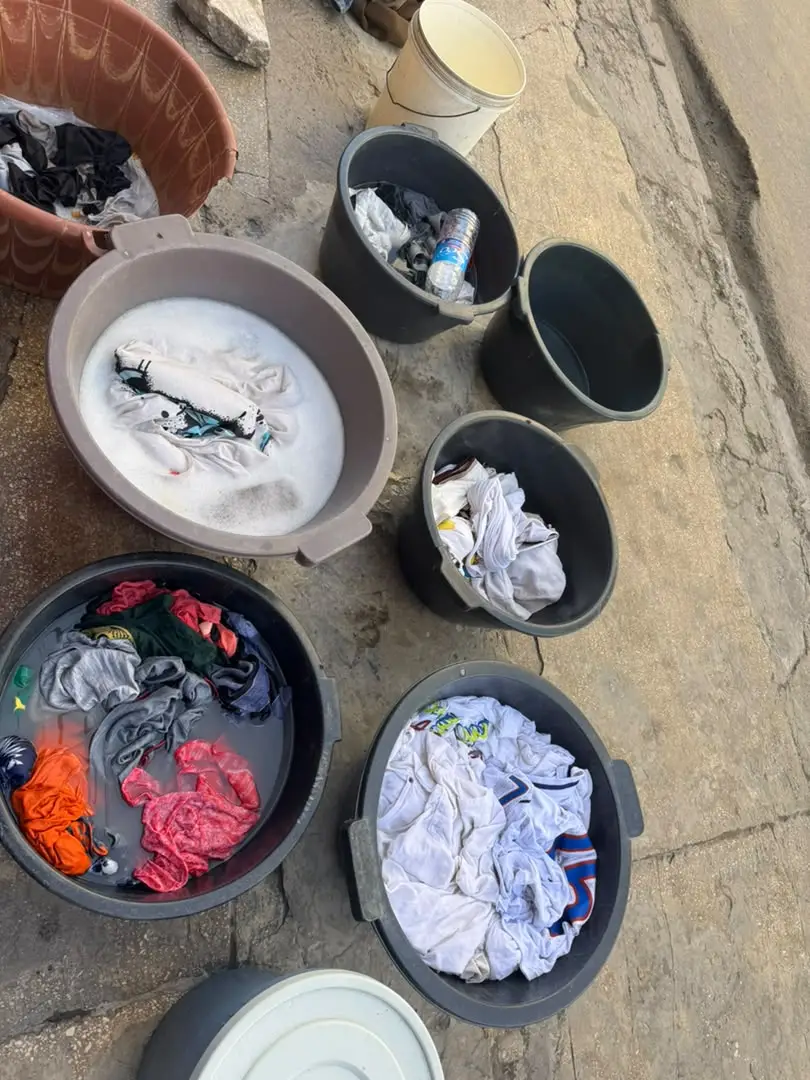
Lined up along the sidewalk, colorful plastic basins overflow with foamy water and waiting laundry. Here, there is no electric drum or automatic spin: everything is done using the strength of the wrists, in a regular back and forth where the fabric rubs against the skin until its stains give way.
Among the washerwomen installed at this nerve center of the Medina, profiles cross paths without looking alike. Some are in the prime of life, others already have the years on their shoulders, but all share the same hunched posture above the water.
Dressed in a light top and a loincloth, Fatou Faye, in her late fifties, confidently excels in what is her livelihood. “I’ve been doing this work for a long time and I plan to hang up soon to let the younger ones continue,” she confides. Unlike dry cleaners who set their prices per kilo, washerwomen assess the volume at a glance. “The price depends on the number of clothes: you can even wash a single item of clothing at 200 FCfa and pants at 300 FCfa. We are there for everyone,” explains Fatou Faye. With her hands immersed in the basin, she defends the superiority of manual action over mechanization: “Washing by hand is different from that of machines, it is much cleaner. »
A few meters away, Sokhna Faye, a young woman in her thirties, takes a short break in front of her basin loaded with boubous, a piece of bread in her hand, her clothes still damp. She is concerned about the future of the business given the rise of washing machines and dry cleaners, while noting that some customers are turning back: “The machines are starting to complicate our work, even if some come back after having used them. »The break over, Sokhna Faye resumes the rhythm, grabs the soap, rubs it on jeans and attacks the fabric with her hands whitened by the foam. “We are there for everyone, as long as we agree on a price,” she confides.
A profession that washes
There are dozens of them, lined up in front of the concessions, sharing the same language, Serer. Coming from different regions like many, Sokhna Faye is there to provide for the needs of her family. However, the activity is not without risk. “I’m thinking of stopping one day to devote myself to other things, but what’s still holding me back is that I have children at school: I help pay for their studies and household expenses,” explains the laundress.
Despite this work which allows them to ensure a better future for their family, it is not without risks. The physical exertion is constant: long hours spent bending take a toll on the back and joints, while repeated exposure to bleach and detergents puts strain on the skin.
Fatou Faye, for her part, stays the course with pragmatism. “We are aware of the health risks. We spend long hours bent over our bedpans, and wringing out heavy clothes tires us enormously. The only solution to limit the damage is to work within our capabilities and not take too much laundry at once,” she explains.
However, despite the arduousness and hazards of the job, demand does not weaken. In a daily life where every expense is counted, many customers continue to prefer these workers to dry cleaners, guided by a logic of organization and affinity. This is the case of Ms. Gueye, a regular here. Returning from the market, a yellow bucket filled with condiments in hand, she stops by to check the progress of her laundry. “We grew up with them; out of familiarity, we entrust them with our clothes and they do a very good job. Personally, I prefer them to dry cleaners,” she explains.
In the Medina, the machines are gaining ground and fatigue is accumulating, but at rue 31 corner 20, the basins remain there, faithful to their appointment, carried by the obstinacy of those who refuse to let go of the thread of their livelihood.
Fatou NGOM
