
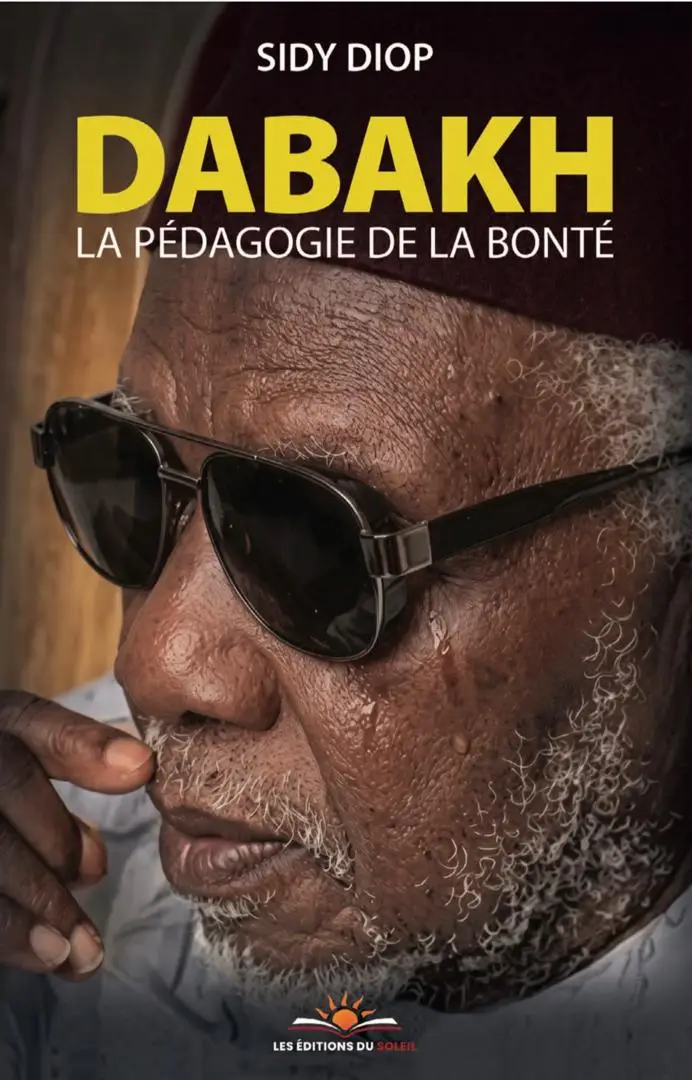
Good leaves I Dabakh, the pedagogy of kindness (1/5) September 14, 2026
At a time when public debate is hardening and social divisions are multiplying, the thoughts of Serigne Abdoul Aziz Sy Dabakh are once again surprisingly relevant. “Dabakh, the pedagogy of kindness”, the book by journalist Sidy Diop which comes out on September 18 by Éditions du Soleil returns to this ethic of speech, forgiveness and living together. We offer you, exclusively, these good sheets which give an overview of the contents of the book. This is the first of five parts of this publication.
In 1904, a new breath swept through Tivaouane. The holy city, already bathed in the light of scholars and the murmur of prayers, welcomed a child whose birth seemed inscribed in the continuity of a divine promise. That day, within the sober walls of the home of El Hadj Malick Sy, Abdou Aziz Sy was born, the one who would later be called “Dabakh”, the gentle, the conciliator, the servant of good.
His birth coincided with the full flowering of his father’s spiritual school. In Tivaouane, study circles multiplied, poets sang their verses of love for the Prophet, and sacred science was taught as an offering. The air itself seemed charged with a particular density. There we breathed faith, rigor, elevation. It was in this atmosphere that the child opened his eyes. A world where knowledge was not an ornament, but a way of loving God. (…)
When Serigne Babacar Sy, his older brother, came from Saint-Louis to greet the birth, he found their father holding the infant in his arms. The holy man murmured with meditation verses which seemed both praise and supplication:
“O my help in my distress,
Who will save me from perdition,
Who will unify my descendants,
If not you?
You are the author of the good deed…”
These words, barely audible, reflected the gratitude of a filled heart. For El Hadj Malick, this birth was more than a joy. It was a sign. He already saw the child he carried close to him as a continuity, a living extension of his work.
Dabakh or the art of shaping souls
Dabakh. The word seems to float in the air like an ancient fragrance. It is sometimes believed that it was born from a pious song, offered by a disciple amazed by the goodness and spiritual depth of El Hadj Abdou Aziz Sy. Many Senegalese are content with this and imagine a spontaneous tribute, modeled by admiration. However, history says something else. The nickname does not come from popular fervor but from the thoughtful choice of his father, Seydi El Hadj Malick Sy. He had given it in memory of a master of Tassawouf, a scholar and leather craftsman, named Abdou Aziz Adabakhi.
This man amazed his time with a lively intelligence and a late vocation. It was at the age of forty that he began learning the Koran, as if wisdom had called him at the precise moment when maturity gives another weight to the revealed words. But he never abandoned his profession. His hands knew how to soften the most rebellious skins to make fabrics or clothes that seemed almost inhabited by an inner light. In his gesture matter and spirit, earth and sky, mingled. His writings, collected in a book called Ibriz, bear witness to this rare alliance between mystical knowledge and daily life. Maodo saw in him a model of harmony, a figure where intellect, kindness and mastery of gesture responded to each other with natural humility.
It is from this source that the nickname given to Abdou Aziz Sy comes. Dabakh. The best of tanners. Not to celebrate manual skill, but to highlight a deeper vocation. Like his illustrious predecessor, he would know how to polish souls, soften hearts, make malleable what sometimes freezes in us. The Wolofs, by dragging it towards Daa baax to say “he is generous”, only revealed the intuitive truth of this name (…).
DIOP Sidy, Dabakh, the pedagogy of kindnessÉditions du Soleil, Dakar, 2026.
