
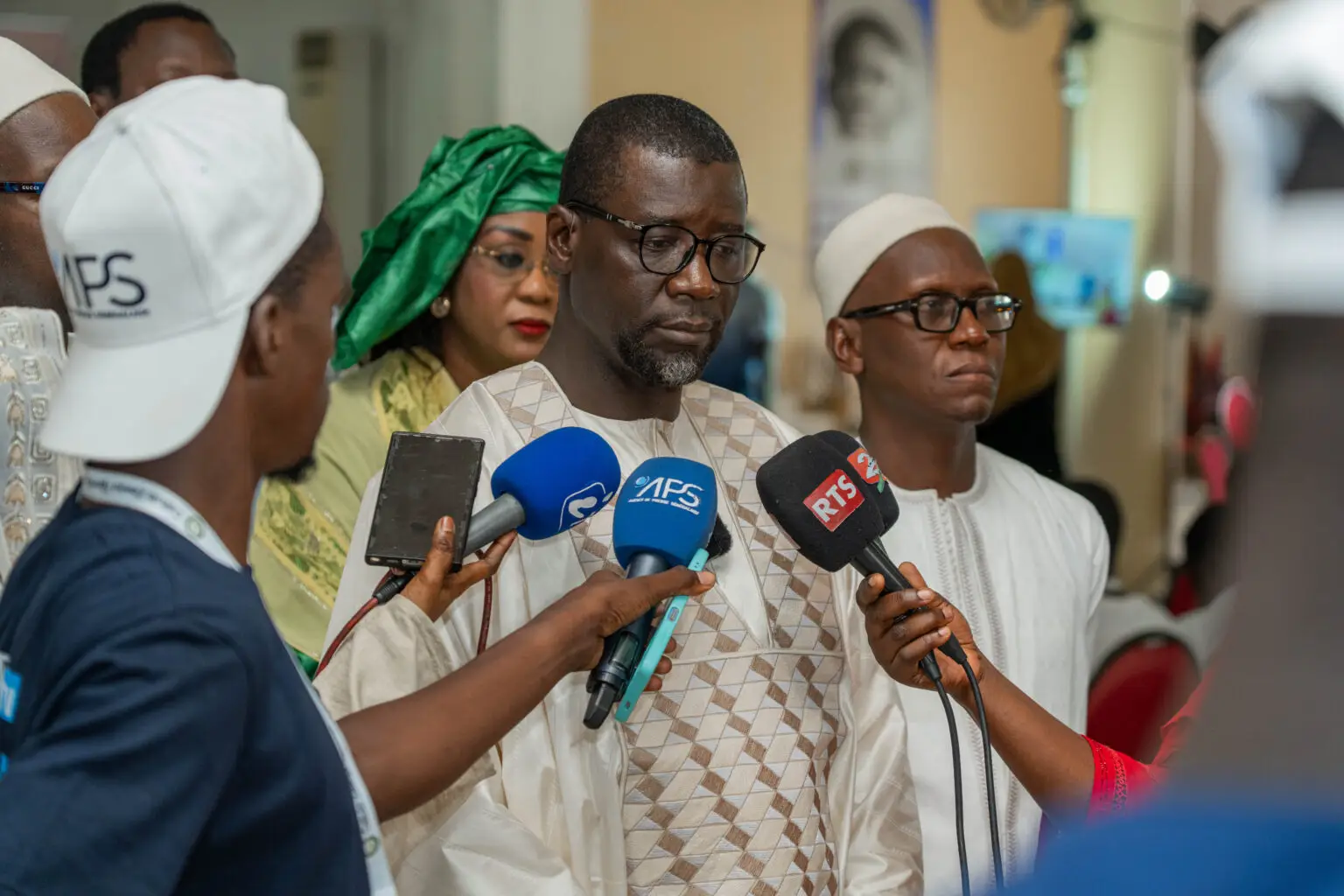
Gamou 2026: Minister Alioune Dione wants to make Dahiras levers for wealth creation
On the occasion of Gamou 2026, the Minister of Microfinance and the Social and Solidarity Economy, Alioune Dione, wants to give a new economic dimension to grassroots community organizations. Speaking on Sunday in Tivaouane, during a panel organized by the Entrepreneurship Commission of the Zawiya Tidiane Cell, he called for better valorization of the social, human and organizational capital of the Dahiras to make them spaces for incubation of SMEs, job creation and production of local wealth, without calling into question their spiritual vocation.
What if the Dahiras became more actors in the economic development of the territories? This is one of the avenues put forward, Sunday August 23, in Tivaouane, by the Minister of Microfinance and the Social and Solidarity Economy, Alioune Dione. Taking part in a panel devoted to the theme “How can grassroots community organizations become incubators of SMEs and local wealth?” The case of the Dahiras”, he, according to RTS, pleaded for a better transformation of the formidable social capital available to these organizations into productive capacity.
For the minister, Dahiras should not be considered only as spaces of spirituality, gathering and solidarity. They also constitute structured networks based on trust, skills, resources and a strong capacity for mobilization. So many assets which, according to him, can contribute to the creation of value, employment and the economic empowerment of community members.
The choice of Tivaouane, on the occasion of Gamou, is not fortuitous. For Alioune Dione, this major religious event offers a concrete illustration of the capacity of communities to organize themselves and pool their resources. The influx of pilgrims, but also the activity of traders, craftsmen, transporters, women and young people, reflect an important economic dynamic around the event. “When trust, organization and solidarity come together, a community is capable of producing tremendous collective energy,” noted the minister.
The challenge now is to sustain this energy. However, he clarified, it is not a question of transforming the Dahiras into businesses or of calling into question their religious vocation. The approach rather aims to use their social capital as an additional lever for economic empowerment. A development summarized by the minister in one formula: moving “from solidarity which supports to solidarity which empowers”.
To realize this ambition, Alioune Dione mentioned the establishment of a model of Productive Solidarity Cooperatives (CPS-Dahiras). The system should make it possible to identify the needs of members, but also the economic opportunities available in their territories, in order to organize them around activities that generate income and jobs.
This orientation is part of the actions already undertaken by the ministry around religious philanthropy and its potential for the social and solidarity economy. The consultations carried out with several religious families made it possible, according to the Minister, to measure the importance of the human, financial, organizational and relational resources available within the communities.
To support their transformation into sustainable economic activities, several instruments could be mobilized. These include municipal social and solidarity economy incubators, support and financing mechanisms dedicated to the ESS and solidarity boutiques, intended to facilitate access to markets.
In this dynamic, Tivaouane could constitute a first laboratory of community entrepreneurship. The minister wishes to identify promising sectors, existing initiatives, entrepreneurs and community needs, before setting up the first CPS-Dahiras.
The experience should then be evaluated in order to identify its strengths and difficulties and, if necessary, adjust the model before its extension to other religious centers in the country. In this perspective, the Department of Microfinance and Social and Solidarity Economy says it is willing to work with the Zawiya Tidiane Cell to conclude a partnership agreement.
This should in particular make it possible to structure the CPS-Dahiras, to support the incubation of young people and women, to facilitate their access to suitable financing, to strengthen their skills and to promote their digitalization as well as their access to markets.
The ambition goes beyond national borders. The minister also insisted on the potential represented by the Senegalese diaspora organized around Dahiras abroad. He cited, as an example, an experience carried out in Bilbao, Spain, with the local Dahira Tidiane, which allowed him to discuss the possibilities of developing the social and solidarity economy within the diaspora.
For Alioune Dione, this approach fully participates in the territorialization of development. It must make it possible to build an economy less concentrated in large urban centers, by giving territories the means to produce, undertake, transform and create jobs.
“A community is not just a group of people who need to be supported. It is also a set of skills and resources that must be organized,” he summarized. The stated ambition is therefore to make Dahiras real levers of wealth production and job creation, while preserving their identity and spiritual vocation.
For the minister, the challenge is now to transform social capital into productive capital, “without losing the soul and the values which made it possible to build it”. Tivaouane could thus serve as a starting point for a model of community entrepreneurship to be tested, evaluated and then extended to other religious centers in Senegal.
