
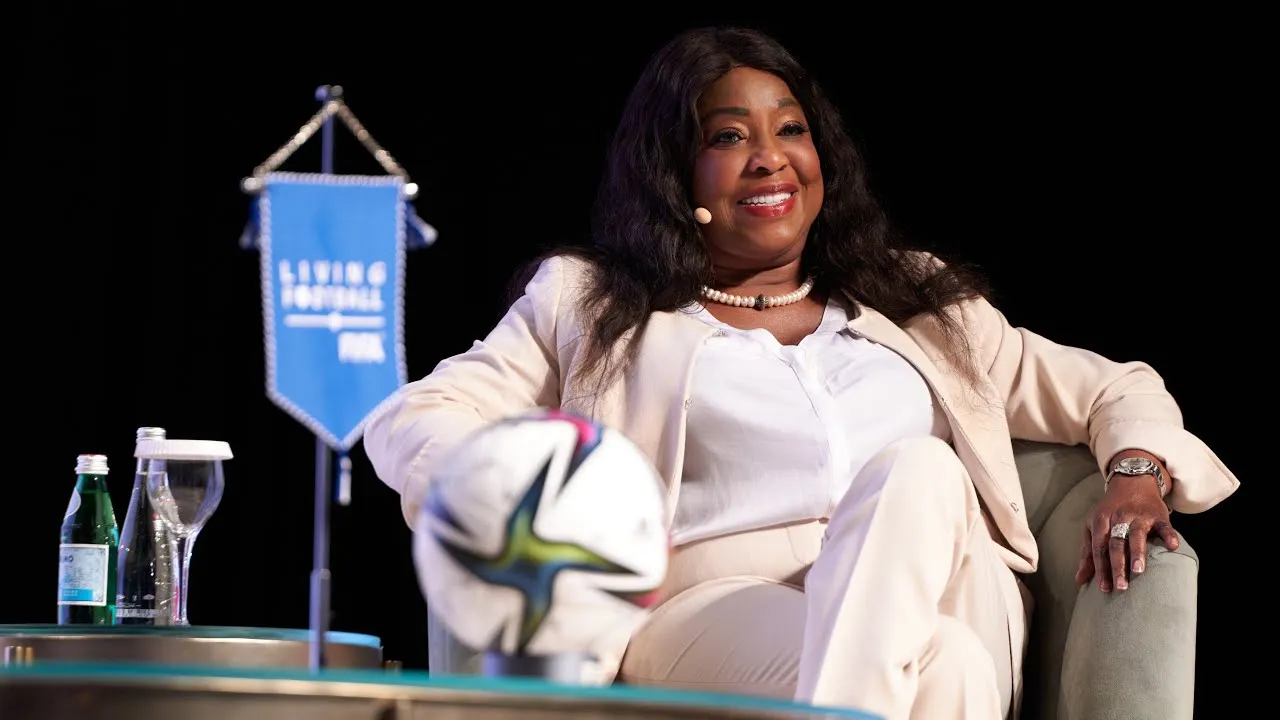
Fatma Samoura: “African sport must move from a cost center to an economic sector” September 21, 2026
After more than three decades at the United Nations and FIFA, Fatma Samoura continues her commitment to African sport. Member of the advisory board of the African Collaboration Group (Acg), she defends a new vision: making sport a real economic sector, creating jobs, investments and opportunities. Through the Victory District concept, it wants to transform sports infrastructures into engines of growth for the continent.
What convinced you to join the African Collaboration Group (Acg) advisory board and how does the Victory district concept differ from large traditional sports infrastructures?
What convinced me was first of all the vision: no longer considering sport solely as an activity or an expense, but as a real economic sector capable of creating value, jobs and opportunities. After more than three decades at the United Nations, then in the world of football, I have seen that Africa lacks neither talent, nor passion, nor ambition. What is still lacking is an ecosystem of infrastructure and services enabling this potential to be transformed into sustainable economic activity.
The Victory district concept interests me precisely for this reason. It is not simply a question of building an additional stadium, but of creating an ecosystem that operates 365 days a year: sport, hospitality, commerce, conferences, entertainment, training, offices and housing. The idea is to make sports infrastructure the anchor point of a real local economy. In summary: a stadium is an infrastructure; a district can become an economy.
What will be your concrete role within the Acg advisory board?
My role is above all strategic and not executive. I will not be in the day-to-day management of Acg’s operations. I will be there to advise, ask the right questions and put my experience at the service of an ambitious, realistic and sustainable vision. My career at the United Nations and FIFA taught me to work at the intersection of governments, sports federations, international institutions and the private sector. I can therefore help to better understand the expectations of these different stakeholders and to ensure that projects are structured according to standards capable of reassuring investors and financial institutions.
Acg speaks of “bankable” ecosystems. How to convince investors to bet on African sport?
Investors should not be asked to “believe” in African sport. We must present them with projects that they can understand, evaluate and finance. The capital exists. The real challenge is to have sufficiently structured projects, with a clear economic model, solid governance and good risk management.
A Victory district does not rely solely on revenue from sports competitions. It diversifies its income through hospitality, commerce, conferences, entertainment, residential and other activities allowing it to operate all year round. It is this diversification that can transform a sports infrastructure into an economic and financial asset.
What benefits can these projects bring to local economies?
The economic impact is one of the aspects that interests me the most. A project of this scale creates jobs during construction, then permanent jobs in hotels, restaurants, commerce, security, maintenance, events, sports sciences, media and administration.
But I think especially of youth. Infrastructure of this nature can become a place of training and learning, with academies, sports science centers and career paths that go well beyond being an athlete. It can also contribute to tourism by attracting international competitions, concerts, conferences and other major events.
Can Africa move from the role of spectator to that of actor in the organization of major sporting events?
Yes, absolutely. Africa has never lacked talent or passion for sport. What it has often lacked is the infrastructure capable of regularly hosting international competitions in good conditions.
I deeply believe that Africa must move from the role of spectator to that of organizer and owner of its own sporting agenda. The fact that Morocco is hosting the 2030 FIFA World Cup shows that we can organize events at the highest level. The challenge now is to multiply this capacity across the continent so that more countries can host, produce and derive economic benefits from major sporting events.
After more than three decades between the UN and FIFA, what still pushes you to engage in new projects for African sport?
I consider that the work is not finished. I could choose to remain in an observer position after the responsibilities I have held at the United Nations and FIFA, but that is not in my nature. Throughout my journey, I have learned one thing above all: the most sustainable solutions for Africa must be thought of with Africans, based on our realities and our priorities, and not simply imported from outside. This is what speaks to me in Acg. This is an initiative driven by an African vision, with the ambition to respect the international standards necessary to attract the financing and partners these projects need.
Can you summarize in one sentence your ambition for African sport in the next ten years?
I would like to see African sport definitively move from a cost center to an economic sector in its own right, capable of creating jobs, generating income, training our youth and contributing to the development of our territories.
As a Senegalese, would you be in favor of welcoming a Victory district to the country?
I would naturally be very proud to see my country host a Victory district. Senegal has many assets: a deeply rooted sporting culture, a passionate youth, a strategic geographical position in West Africa and an already demonstrated desire to invest in infrastructure and major sporting events. Regarding possible discussions with the Senegalese authorities, I prefer to remain cautious and not comment on exchanges which still fall under confidentiality. What I can say is that Senegal undeniably presents several of the characteristics necessary for the success of such a project.
Senegal has already invested in major sports infrastructure, notably the Stade Abdoulaye Wade and Dakar Arena. How could such a project complement these investments?
Senegal has already made significant investments with the Stade Abdoulaye Wade and Dakar Arena. These infrastructures constitute solid foundations. The challenge is therefore not to replace what exists, but to think about how to better integrate it into a sports economy that operates all year round.
The Victory district model can complement these investments by creating an ecosystem around sports infrastructure combining hotels, commerce, training, catering, entertainment and events. The objective is to maximize their use, their attractiveness and, ultimately, their capacity to generate income and jobs.
What is your view on Senegal’s current sports policy and its ability to structure a real sports economy?
Senegal has clearly demonstrated a strong sporting ambition, both through its infrastructure and its capacity to organize major events. The “Dakar 2026” Youth Olympic Games constitute, in this regard, a historic milestone and a tremendous opportunity. The next step, in my opinion, is to transform this sporting ambition into a real sports economy. We need to think about the entire value chain: infrastructure, events, training, tourism, media, technology, entrepreneurship and employment. Senegal already has many of the necessary foundations. We must now build the economy around these foundations.
Sport is still often seen as a public expenditure rather than an economic sector. How can we change this outlook?
We need to change the paradigm. When a stadium is designed as an isolated infrastructure, financed by public money and used only a few days a year, it is normal that it is perceived as an expense.
The logic is different when sports infrastructure becomes the anchor of an ecosystem capable of generating revenue, attracting private investment, creating jobs and supporting tourism. In this case, sport becomes a productive economic sector.
Above all, we must not try to convince decision-makers solely through speeches. We must present them with concrete, well-structured, transparent and financially credible projects. The results will then speak for themselves.
Comments collected by Oumar Boubacar NDONGO
