
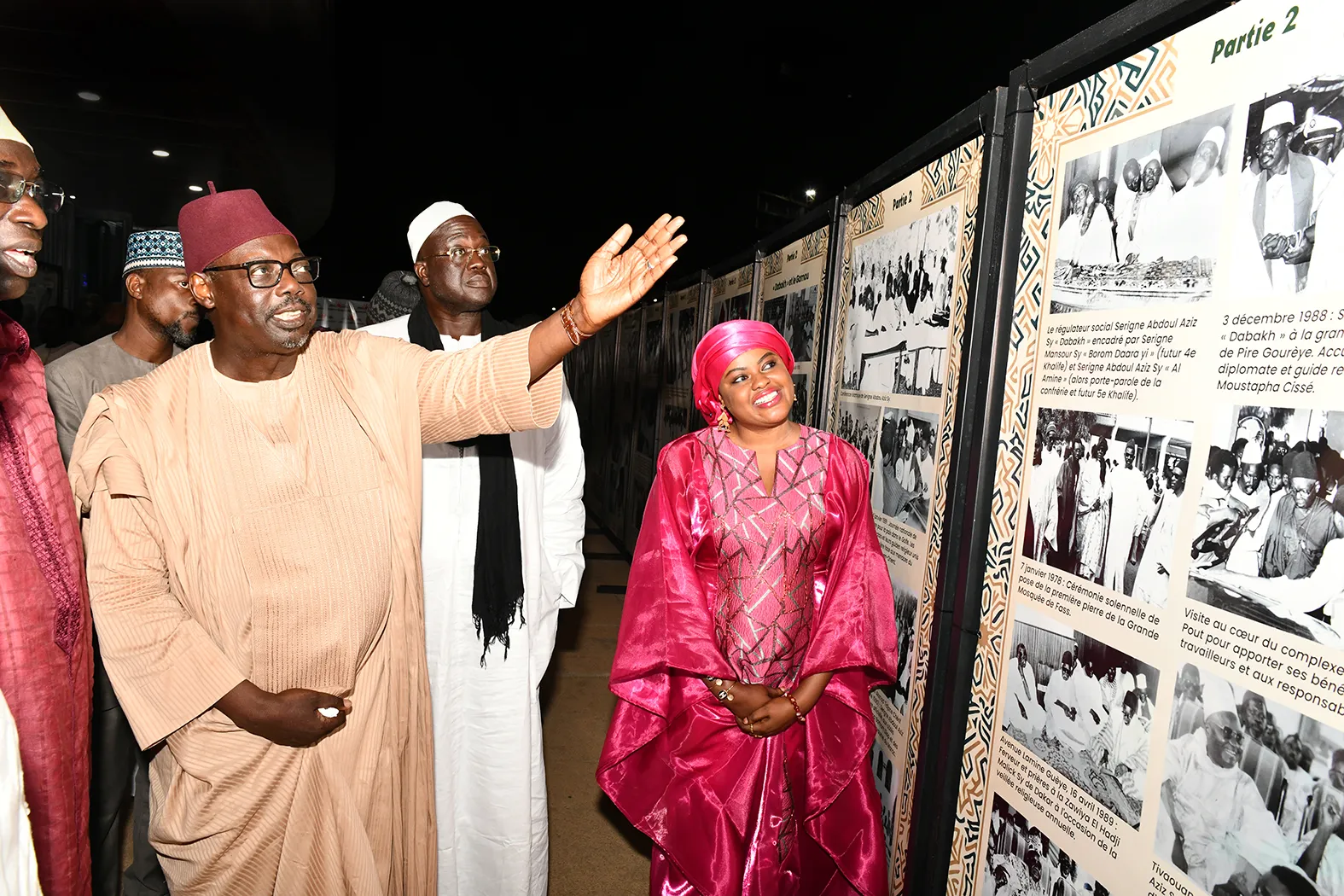
Exhibition “Dabakh, the timeless”, at the museum of black civilizations: Sermon in images of a memory of the nation
At the presentation of the book “Dabakh, the pedagogy of kindness” by Sidy Diop, Tuesday October 6 at the Museum of Black Civilizations, it would simply not have been necessary to tell through the text this ocean of excellence that the holy man symbolizes. The images of Serigne Abdoul Aziz Sy Dabâkh also seemed necessary, especially since he is a figure who is a postcard of Senegal. From a collection provided by the archives of the “Soleil” Documentation service, the exhibition “Dabakh, the timeless” tells the story of a sacred human adventure.
Imperial posture, meditative gaze, hands behind his back, Serigne Sidy Ahmet Sy Dabakh solemnly visits the exhibition “Dabakh, the timeless”, installed on the west passageway of the Museum of Black Civilizations. Presented by “Le Soleil”, the journey of 20 panels of archive images and press clippings tells slices of the life of his revered and late father, Serigne Abdoul Aziz Sy Dabakh. Alongside Dabakh’s son, his nephews Serigne Habib Sy, son of the Caliph Serigne Babacar Sy Mansour and Serigne Abdoul Ahad Mbacké Gaïndé Fatma are just as attentive and respectful. These august visitors, with the CEO of “Soleil” Lamine Niang and a host of high-profile personalities, follow the explanations of the archivist and curator of the “Dabakh, the timeless” exhibition, Khadija Dioh. Suddenly, as if by a happy spell, Serigne Sidy Ahmet Sy unties herself.
His smile no longer hides any of his joy. In front of the image of his father with King Faisal, taken during the famous Islamic Congress in Mecca in 1965, the son looks so happy that he infected the entire audience. “But how did you get this photo?!” Ah, this episode truly established the international aura of Dabakh. The Islamic world was absolutely dazzled by so much wisdom, knowledge and mastery of the Arabic language by a black man,” exclaimed, affectionately moved, Serigne Sidy Ahmet Sy.
The banality of the moment and the spontaneity of the gesture reveal a simple pride of a son towards a father whom he shared with an entire nation. A nation that Dabakh, this consensual light, has guided as much by example as by precept.
Dabakh, a guide. A real one.
In this chapter of the first part of the journey, we recall, in fact, how Dabakh, a national of Senegal independent for only 5 years, placed his country in an enviable rank on the map of the Islamic world and, thereby, enhanced its emerging diplomacy. In this World Islamic Congress in Mecca, beyond his eloquence and his presence, Dabakh provided religious authority which combines mastery of Islamic sciences, moral probity, call for unity and commitment to the community. Suffice to say that the holy man revealed himself there, in the scent of a declaration of general policy. In the following chapter, Serigne Sidy Ahmet still recognizes his father, this religious man who elevates work to the level of an expression of faith. In a photo dated 1955, Maodo’s honorable son received the Agricultural Medal from the colonial authorities for his commitment to land cultivation and rural development. Continuing his father’s legacy, Dabakh has always considered work as a source of dignity and freedom. The income from his agricultural operations was used in particular to maintain his Koranic schools, to accommodate his students and to help the poor.
However, as the First Part always tells us, Serigne Abdou Aziz Sy inherits the caliphate in a succession marked by mourning. The gaze of Serigne Habib Sy becomes more concerned, in front of the obituary of Serigne Babacar Sy (died on March 25, 1957) and Serigne Mansour Sy (the following March 29). The first is the namesake of his father, the current Caliph, and the second his paternal grandfather. It was after their death that Dabakh inherited the caliphate and established his aura which still survives today. Dabakh had to position himself as a worthy continuation of his family’s tradition of excellence. The exhibition shows how he was introduced to it. By birth, first, with his venerable ancestry (Seydi El Hadj Malick Sy and Mame Safiatou Niang). Then, through training. The exhibition thus introduces us to his trainers: his father, then Serigne Médoune Cissé, Serigne Hady Touré and Serigne Birahim Diop. A culture that he forged and subsequently promoted with conviction and priesthood.
The exhibition shows the literary work of Dabakh, collected in “Diwâan”, with no less than 12,112 verses, distributed across 358 pieces and 110 stanzas made up of panegyrics, orations, exhortations, etc. Still with the same admiring child’s eyes, Serigne Sidy Ahmet Sy continues the journey contemplating her father’s photo album. From younger Dabakh. From his descent from the liner at the Port of Dakar, to his arrival from the pilgrimage to Mecca in the company of Thierno Seydou Nourou Tall. The wise man surrounded by his nephews Serigne Mansour Sy Boroom Daara Yi, Serigne Cheikh Tidiane Sy Al Makhtoum and Serigne Abdou Aziz Sy Al Amine, during a Gamou. Dabakh, with the King of Morocco Hassan 2, March 27, 1964, at the inauguration of the Great Mosque of Dakar.
The religious guide in the days of prayer that he often organized for the benefit of the country, Muslim countries in conflict, etc. Dabakh facing the heads of state and government, he who has gone through 4 decades of the socio-political life of the country as a protective leader. Mawlanâ Abdoul Aziz Sy Dabakh is also told in this exhibition, naturally, by his cordial relations with other maraboutic families. We see him in a frank complicity Baay Seydi Thiaw Laye, Serigne Saliou Mbacké, El Hadj Barro Ndiéguène, Serigne Fallou Mbacké or even Seyda Mariama Niass whom he cherished like his own daughter, among others. What can we say about his poem dedicated to Sheikh Ibrahima Niass Baay, whom he considers “the sun of religion which illuminates all communities in Islam…”. Dabakh will certainly have gone through his time with simple or fruitful words, quiet authority and constant attention to others. This is how the holy man was naturally a mediator and an agreed social regulator. The “Diacksao method” was labeled in this sense, notably during the university crisis of 1988, when he set up his village of residence as a platform for active dialogue between students, unions, opposition and power.
Dabakh, a common Senegalese denominator
The exhibition also recalls its essential role in resolving the crisis of 1993 which saw the assassination of Mr. Babacar Seye, the unrest after the Sakho-Loum austerity plan, the conflict between Senegal and Mauritania in 1989, etc. “Regarding this crisis with our brothers in Mauritania, I remember how my father mobilized us to say prayers. I remember that, at the height of the crisis, he left Diacksao to the road which leads to Saint-Louis on the right and to Dakar on the left. He meditated, confided that the situation unfortunately degenerated before ordering the driver to go to the Palace of the Republic. The mediation work that he subsequently undertook was crucial for the return to peace,” revealed Serigne Ahmet Sy ibn Dabakh, who expressed his gratitude to the “Sun” for having so well honored the memory of his father through this exhibition, but also through the publication of Sidy Diop’s book, “Dabakh, the pedagogy of kindness”.
By Mamadou Oumar KAMARA
