
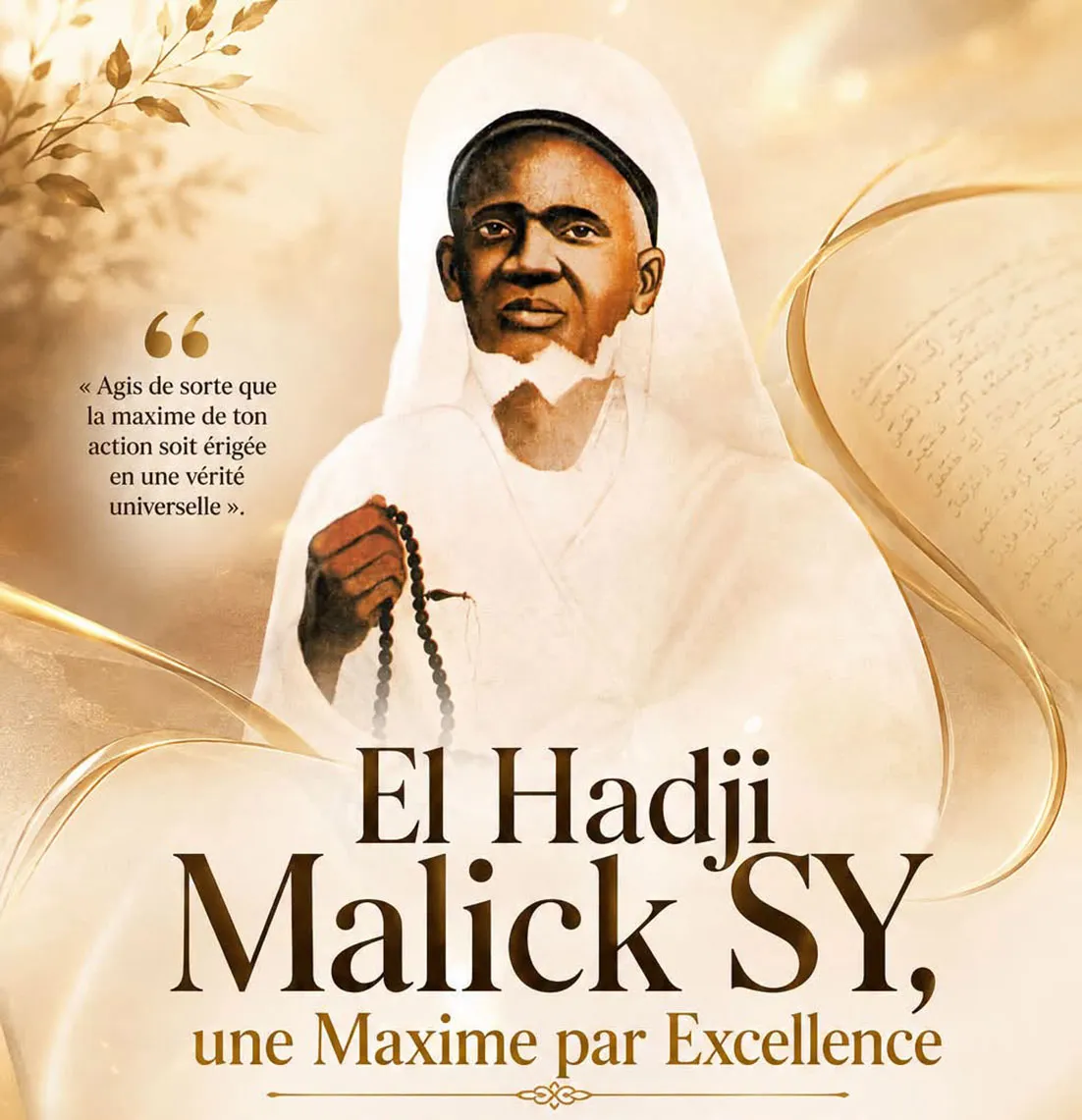
El Hadji Malick SY, a Maxim par Excellence (by, Baye Dame MBENGUE Agent at the Consulate of Senegal in Paris)
“Act so that the maxim of your action is established as a universal truth.” This Kantian assertion reasons like a qualifier which perfectly defines El Hadji Malick Sy (Rta). So much did the holy man mark history through his position as a guide, but also a model who continues to inspire and mark the masses whose perpetual evolution of society can be disorienting.
Its Guidance model marks the support of all social strata thanks to a strategy like Bourda. These sessions of contemplation and piety rock the social climate through panegyries in honor of the Prophet (Psl). All minds rush to Tivaouane which lives like an eponym because the name of the Founding Father is so present.
This craze, as a moment of identity regeneration, mobilizes young people throughout the national territory. This imitation is explained by the need that young people have to find a model.
In this sense, it is appropriate to focus on: how his life and work generated universal values which continue to inspire Humanity.
Knowledge as a prerequisite for the Spiritual Journey
“O son of this era, I call you to the revivification of Islam through Science.” This call from El Hadji Malick Sy to youth is a perfect illustration of the place he gives to young people in his spiritual project and in his vision of co-construction. But also an invitation to responsibility for the involvement of young people through Knowledge, the cult of Work and model behavior.
The triptych of Knowledge, Know-how and Being is the basis of Maodo’s Thought and Action. The Holy Man considers that the most effective remedy against ignorance is education and the most voracious enemy is ignorance.
In its transmission strategy, Knowledge, culture and knowledge occupy a special place in its guidance method. Spirituality as advocated by El Hadji Malick Sy must be carried by Gnosis.
For Him, Knowledge is the boat by which the Aspirant must embark to migrate towards the domains of Divinity. Knowing pushes us to understand, when we understand we end up loving (God): the quest for God is consubstantial with knowledge.
Maodo made it a chimera or even an identity of his spiritual deployment. Overcoming Obscurantism through the light of Knowledge has been his leitmotif throughout his life.
This is why very early on, he formed an elite which he deployed throughout the territory for the training of the masses, especially the young section. Youth must be the first bulwark of religious, spiritual, but also economic and social development.
To learn is the first act on which everything is based, in particular the Love of Religion, which is why he maintains: “To love your religion, you absolutely must have knowledge”.
Indeed, in the tupid ancient societies where the imperfections linked to the wanderings of the Soul were law, the only light emanated from Knowledge and Knowledge according to Maodo.
Knowledge undeniably leads to Know-how.
Know-how for social integration
El Hadji Malick Sy does not have a passive conception of religion. For him, the latter must be carried by a socially active subject. Religion cannot be a cover for idleness or laziness, but an accompanying moral censor.
He carried within Him, an ethical conception of Sufism which excludes any dependence on Materials, the refusal of work and subordination to patrons.
Work is central to one’s spiritual project because it allows one to integrate the social pattern, but also a means of prevention against all the scourges linked to the vicissitudes of the Soul.
This connection between spirituality and work finds its source in the life of the Prophet of Islam Mouhamed (Psl), whom he holds up as a model.
He was a trader coupled with a farmer who was not only based on a (messianic) status, but an active and useful citizen to the Society in which he evolved.
The Prophet had an influence in his Clan due to his autonomy, but also a disinterest in anything related to Material.
However, it is appropriate to mark a dichotomy between Material and Materiality which is none other than the minimum conditions for subsistence.
The spiritual project of El Hadji Malick Sy is a rupture which marks the history of the brotherhoods in Senegal: he carries a Sufism which is based on economic activity which can promote a certain autonomy necessary so as not to make the subsistence of his disciples the condition of his religious activity.
This is why he practiced agriculture to make a living from his activity, but also to participate in his own way in the effort of national construction and thus provide a model of co-construction.
The disciples are no longer seen as subjects subject to a Leader, but part of a collective effort.
Soft skills or the ethics of social responsibility
The finality of the journey remains the behavior of the Aspirant, it is the balance which allows him to act on the “human condition”.
In the spiritual principles of Seydi El Hadji Malick Sy, interpersonal skills occupy a preponderant place. The disciple is above all a social subject condemned to evolve in Society.
His relationships with his peers must obey a logic of interaction. This explains the reorientation of its method of resistance against Colonialism.
Indeed, Maodo understood very early on that armed decolonization was irrelevant in the face of the armed power of the Colonist. He advocated a return to cultural and religious wealth to face the Occupation.
This ability to adapt is a marker of social intelligence in the holy man whose approach is based on allowing plural expression to successfully live together: “the right to be different, the duty to be together”.
In the spiritual project of Seydi El Hadji Malick Sy, shaping the aspirant so that he is able to hold his place in the social organization is a part of his (spiritual) structure.
The aim here is to create harmony between determinism (human nature) and social achievements.
It bases its postulate on values which make up our collective memory: humility, self-effacement, detachment, work, dignity, tolerance, harmony, but also Spirituality through the Adoration of God and the Love of the Prophet (Psl).
The know-how in the thought of El Hadji Malick Sy revolves around humanism and conscience, all of which is carried by a Sufism disconcerted by any fanatical and obscurantist actions.
Faith and Exemplarity are its main components.
For El Hadji Malick Sy, Knowledge is inseparable from moral rectitude. Without Morality, knowledge cannot be beneficial as long as good behavior conditions the sharing of Knowledge.
Maodo was above all a scholar who mastered the issues of his time. In a process of Detachment, he lived in Society while protecting himself from the vanities that it can carry as stigma.
In his fellow students, he instilled the spirit of surpassing himself by helping his neighbor, by working for the unity of the Community, especially by moving away from divisions and personal quarrels.
The Sufi path proposed by El Hadji Malick Sy advocates respect for the establishment and the rules which allow good neighborliness between local authorities and citizens.
It establishes respect for the order preestablished by the colonial authority as a posture while preserving cultural and religious beliefs.
A strategic struggle which favored the awakening of consciences and not weapons: this was his perspective, the reason why he succeeded in establishing Zawiyas or theological centers everywhere in the heart of the centers of the Colonial Administration (Dakar, Saint-Louis, Tivaouane).
In the immense work of El Hadji Malick Sy, we can note a spiritual offering which rests on Humans.
The Faith is not incompatible with the principles which govern life in Society. On the contrary, it is beneficial for the latter since it can endow its subjects with ethics.
The holy man is not part of a process of separation, but a correlation between knowledge to form active citizens capable of meeting the challenges that promote the Development of the City.
The ideal of the accomplished man in the thought of the holy man is based on instruction to live in his time, spirituality to protect oneself from the wanderings of the soul, morality to not deviate from one’s responsibilities and action as a contribution to participating in the desire to reform.
In a context marked by the crisis of values, Maodo’s work continues to inspire youth.
His life is a model that he will carry proudly as a Senegalese because of his high sense of patriotism which he invigorated through education so that he could be a bulwark against assimilation and the inferiority complex: a sovereignist before his time.
His legacy goes far beyond the boundaries of an era; he inspires new and future generations by inviting them to take an interest in Knowledge.
His thinking is not only based on Knowledge, but also on Becoming.
The spirituality of El Hadji Malick Sy can be summed up as an impactful Faith whose springs are Knowledge, Know-how and Know-how.
Baye Dame MBENGUE, Agent at the Consulate of Senegal in Paris
