
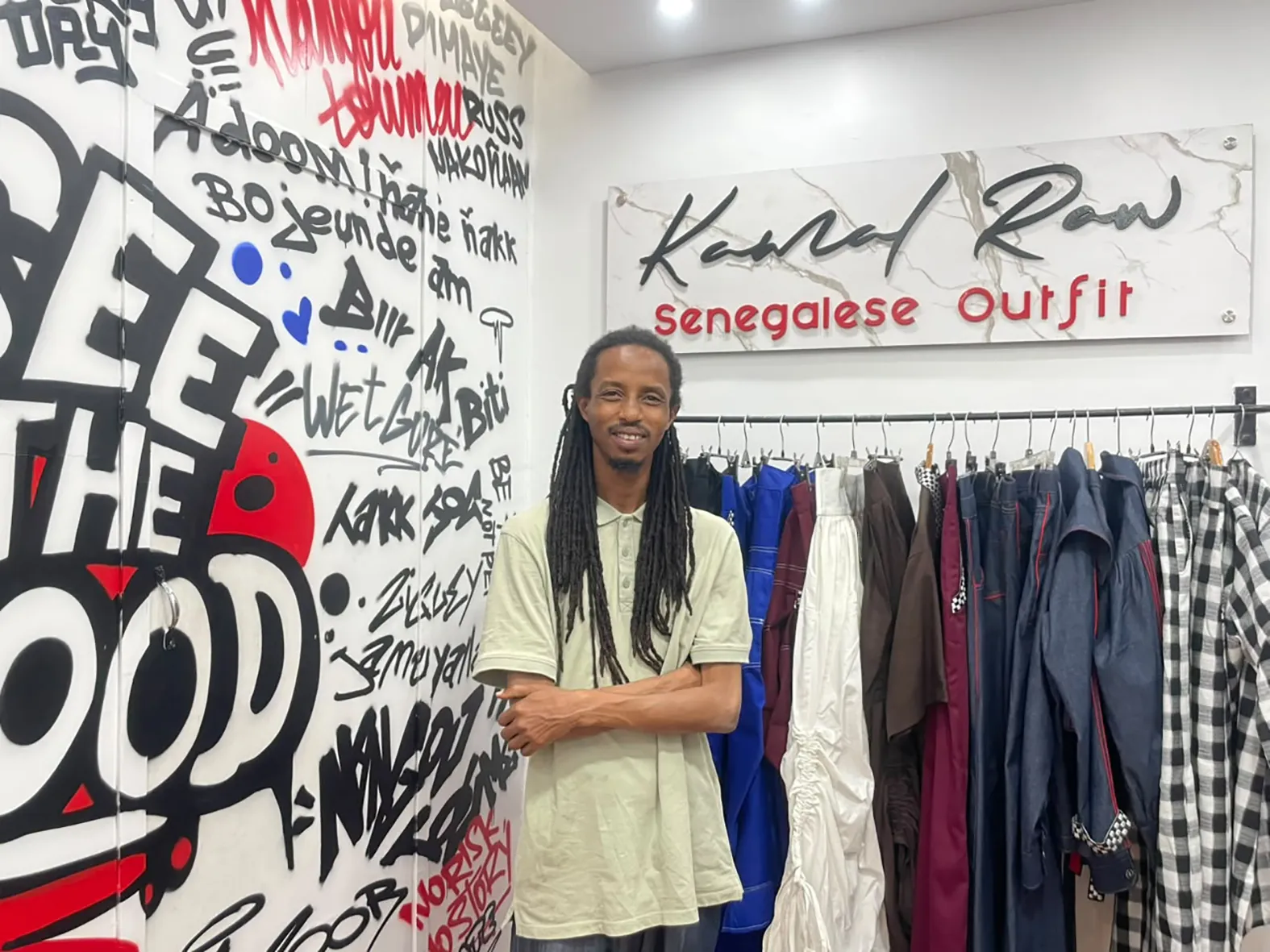
Design – Consuming local: Kamal Raw, the art of sewing an identity
If the Kamal Raw brand enjoys so much respect from fans of the “Made in Senegal” design option, beyond the respect for Kamal himself, it is because he carries a well-felt identity and humanity on every thread. Kamal, a graphic designer and decorator by trade, Baay Faal at heart, became a designer. A brilliant designer. His new workshop, the Kamal Raw Lab, is presented as a…, laboratory of ideas and sensitivities, belt of memories. Kamal’s leitmotif: transmit know-how and encourage the writing of a truly Senegalese creative industry.
In his genius lair, located at Castors above the Carrefour Pharmacy, Kamal certainly designs works of art. At Labo Kamal Raw, a “Made in Senegal” sewing workshop and design laboratory, the master of the oceans doesn’t just dress the body. It gives substance to an identity, an authenticity, and values through clothing.
At Kamal, the clothes bear a signature that has a soulful value and runs through the collections. The black and white checkerboard returns as a graphic juxtaposition, the touch of red appears as a regular imprint, textured fabrics, the right cut, the almost always ideal finish. This is Kamal.
It is these “sewing facts” that make his clothes identified, and which justify both the particularity and the notoriety of Kamal Raw: wherever you appear in the world with a Kamal Raw designer outfit, you immediately know the brand. Its regulars can even detect immediately if it is plagiarism. An artist’s mark.
“The black and white checkerboard refers to the pillars and values of Mouridism, the white symbolizing Serigne Touba and the black, Cheikh Ibra Fall. The “nàat” fabric, whose patterns recall the plumage of guinea fowl, has a protective, almost talismanic value in Wolof cosmogony. I also chose red because it is one of the colors that all humans have in common, through our blood,” explains Kamal, whom we found in his new Kamal Raw Lab workshops, launched last May 1.
A condition nourished by experiences and faith
For the creator, this iconography responds to a double fidelity. First, the Baay Faal are among the most recognizable and original Senegalese images throughout the world. This responds to his idea of authenticity, determined by the inscription “Senegalese outfit” which he adds to his designer card. Then because the Baay Faal ideology belongs to its own history.
Kamal’s creations tell less about fashion than an inner trajectory. Labo Kamal Raw is a living workshop, a place where ideas circulate as much as fabrics. An address where the visitor discovers six years of creation, but above all a way of thinking about clothing as a language.
“I also have a practical objective: I want my client to be able to wear the same outfit to go to the office, to a gala evening as well as to go shopping, without throwing away too much or being underestimated.”
Kamal shares the premises with Fatima Zahra Rootsy, founder of the Doxalin brand, a rising figure noticed during the last edition of Jaba. His approach is a manifesto of his conviction. He believes that a cultural industry is never born from isolated talent, but is built through workshops, schools, exchanges and generations who interact.
“We didn’t have the chance to grow up with places to learn together. Today, if our work begins to be recognized, we have a responsibility to reach out to those who are arriving. Labo Kamal Raw, I see it in the near future as an academy, or a school. A lit candle is used to light others. We must assert our know-how and launch a real industry together.
Also read: Dakar Station, epicenter of fashion
Today, you can travel 10 km in Dakar and not see anyone wearing “Made in Senegal”. It takes collective work for a real chain and accessibility on prices,” professes Kamal, whose quality-price ratio of his store is often praised by customers.
Precisely, the designer indicates that the opening of this workshop is also an act of recognition “towards his clients who have followed (him) since the beginning in this still evolving artistic adventure”. To understand this vision, we must go back to childhood.
Before Kamal, there was another name: Poulo. Mouhamadou El Lamine Diallo, in civil status, is the son of a Koranic master. His childhood was then divided between the daara and the modern school, which his father was just as keen for him to attend.
“He wanted us to be in the dynamic of our time, to keep our minds open to the world,” he says. In this double education, the balance that will characterize all of his work is already taking shape: rootedness without withdrawal.
Poulo has also been behind the counter of the family’s retail store; perhaps he found his business sense there, which is not fundamentally opportunistic. A fault with him, some believe. When the art virus began to get the better of him, his vocation was received with suspicion. His father steered him toward electricity, hoping to keep him away from the world of the arts. Chance decides otherwise.
On the advertising billboard construction sites, he meets Magueye Ly, his boss who is an electrician by day, painter and musician in the evening at home. This discovery acts as a revelation. “He was the first to make me believe that I was an artist,” says Kamal, who pays tribute to his former foreman. What follows looks less like a career than a succession of metamorphoses.
Decorator. Graphic designer. Designer of advertising panels. Then, in 2005, Pullo became co-founder of Mbedd Jolof with his friend Juan. The duo quickly imprinted their aesthetic on Senegalese urban culture, accompanying the hip-hop movement, then major citizen mobilizations like Y’en a marre. Then, in 2016, the shift.
Three years of silence. Three years spent on spiritual retreat in Mbacké. When he returns, he no longer wishes to be the same man. A new name emerges almost naturally before becoming a marker, a brand, an identity: Kamal.
Kamal Raw was born in 2020, in the middle of the Covid-19 pandemic. Kamal means accomplishment, and Raw is the acronym for Revolution African Wear. A rebirth more than a rebrand. “My friends often say that I am a phoenix,” he says, smiling. The brand’s other slogan is “unite people through clothing”.
At Kamal Raw, each color has a memory. Each motif tells a story. The eye of the graphic designer, his profession before fashion. For years, Kamal imagined visual identities, composed logos, built graphic charters. This first professional life is currently shaping his outlook.
The clothing then becomes a visual identity worn on the body. He doesn’t just seek to create beautiful pieces. It builds a vocabulary. A print. Meditation and his Sufi practice nourish his search for coherence. Creating is a slow conversation with yourself, never an impulsive gesture.
By Mamadou Oumar KAMARA
