
Commercial transactions: when the QR code dethrones cash
Scanning becomes a commonplace gesture. No more need to queue at multi-service counters or wait for change: electronic wallets are transforming everyday commercial exchanges and simplifying transactions.
A large building still bears the inscription “Ouakam Municipal Stadium”, but the enclosure no longer hosts any sporting activity. Just behind this building, a stone’s throw from Brioche Dorée, there is a lively market. In this square, the sellers sit on imposing cement tables.
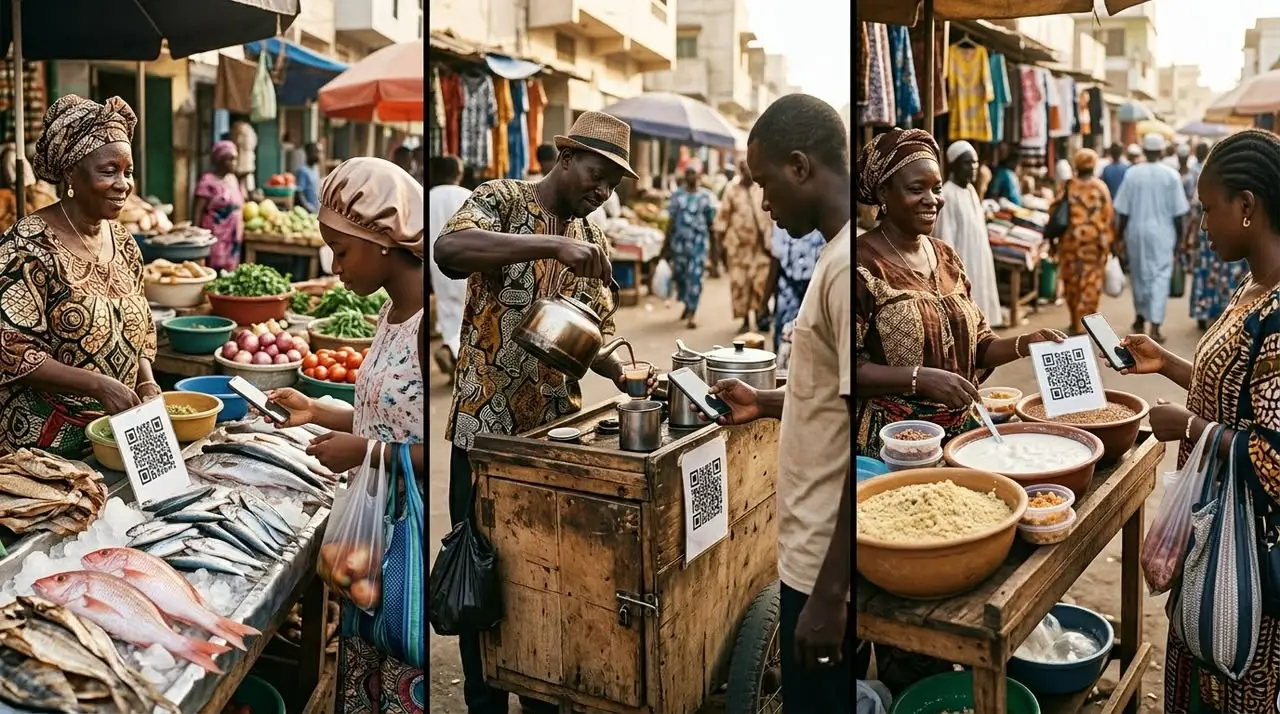
Meat, fresh fish, vegetables and condiments: you can find absolutely everything that makes up the housewife’s basket, to the rhythm of the daily exchanges of local residents. Here, the smell of damp earth mixes with those of fresh fish and meat. During this winter period, this place, which is not the most healthy, nevertheless attracts a crowd of faithful. Their only objective: to fill the basket for the family lunch. To profit from their sales, merchants are complying with new customer payment methods.
New technologies, with their share of innovations, have emerged in the daily lives of many Senegalese. With electronic payment methods, you no longer need to have cash to make your purchases. All it takes is a simple combination: an internet connection and money in your electronic wallet, and that’s it. Scanning has become the simplest way to do your shopping without hassle.
Adapting to technological changes
Merchants and customers, everyone benefits from it: a saving of precious time and less worry about change for top-up. Here, at the Ouakam market, it’s impossible to take a step without your eyes coming into contact with a merchant code posted on a wall or placed on a display. If each customer knows exactly what they are looking for, each merchant has their own secret to building customer loyalty.
Behind one of the many tables arranged in single file, stands Abibatou Ba, seller of fish products and dried fish. Dressed in an outfit whose apron was not enough to protect her from the residue of scales, she holds a large knife in her hand. Abibatou works with precision in what she does best: serving the few customers forming a semi-circle in front of her table where various goods are scattered. On the products, a blue badge catches the eye: the merchant code.
Despite the crowds, she agreed to interrupt her gesture to answer our questions. “Today, everyone uses electronic wallets, we just conform to these innovations,” she replies. With a controlled gesture, she cuts a slice of smoked fish which she slips into a customer’s basket.
Combining action with words, Abibatou does not fail to launch a friendly jab at the awo (first wives): “When their husbands send them money for daily expenses, the awo are too lazy to go to the multi-service points to make a withdrawal. So, they come directly here, and that suits us well! “.
The main thing is to sell, regardless of the payment channel. Generous in her explanations, she adds: “Most of my clients pay me via their phone. » Then, she interrupts to address a waiting customer: “Luma laay jaay yow? » (What do I serve you?).
You just have to wait a few minutes to see another customer arrive, smartphone in hand and bags filled with vegetables and fresh fish under her arm. Fatou Dione, a satin bonnet on her head and dressed in a tank top, gives the impression of having just woken from sleep. As a good Serer, the weight of his bags does not prevent him from holding a baguette with his fingertips.
When digitalization facilitates transactions
“Electronic payment is more convenient. Sometimes I’m too lazy to go and make a withdrawal at the multiservice, so I come straight here. Today, almost every seller has a merchant code,” she says.
But practicality is not its only motivation: “It’s mainly for problems with giving change. Sometimes, at multiservices, they don’t have change. Here, I don’t have that problem. I just scanned 100 francs,” she explains, showing the screen of her application.
A few meters from the market there is a table where two enormous insulated barrels containing the famous “cafe touba”, a drink very popular with the Senegalese, are placed. Khalifa Ababacar Diémé, the owner of the place, tells us: “I accept electronic payments because it’s a good way to keep money aside without going to the bank again. »
Also read: “Bank to wallet”, a revolution without limits? (1/2)
He readjusts his glasses and adds: “When you misplace your wallet, you risk losing everything, whereas with money stored on the phone, you avoid this kind of disappointment. » Khalifa also specifies that it was the strong demand from his customers that pushed him to take the plunge: “A cup of coffee costs 100 francs, and three out of five customers pay by scanning. I had to adapt. »
It’s 10 a.m., breakfast time for many. While some prefer bread, Cheikh Sarr opts for thiakry and curdled milk. Leaning against the counter, he places his order while explaining: “I pay by electronic transfer because I rarely go out with cash. I avoid attacks as much as possible, and today, with a simple click, we can carry out all our transactions. »
With the new services offered by digital advances, Senegalese society is reinventing its daily consumption habits. Merchants and customers, everyone benefits from this.
Fatou NGOM (Intern)
