
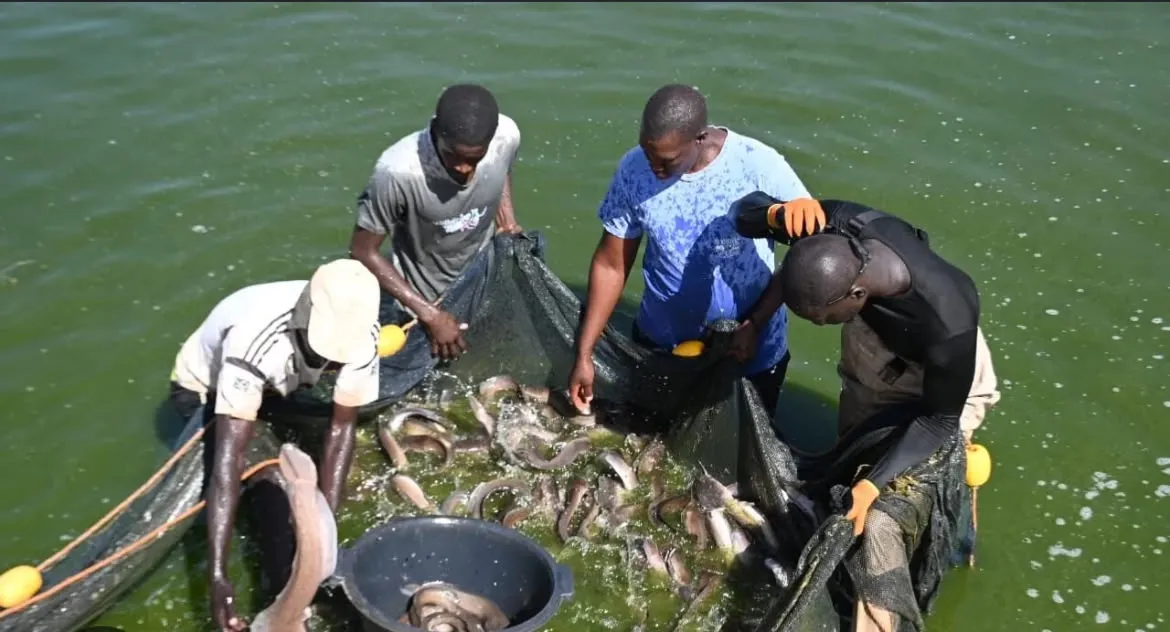
Aquaculture: The foundations of renewed governance
One year after its installation, the Advisory Commission for Aquaculture met on Tuesday, November 17, 2026, to lay the foundations for renewed governance. With a recently modernized legal arsenal, the Senegalese state hopes to make fish farming a real source of growth in the face of the decline in traditional fishing.
The second session of the Consultative Commission for Aquaculture (Cca) opened yesterday, Tuesday, November 17 in Dakar. Organized by the National Aquaculture Agency (Ana), this meeting takes place one year after the installation of the body. It constitutes a new time for discussion on the directions to be given to the aquaculture sector. State delegates and industry stakeholders want to lay the foundations for renewed governance, essential to establish fish farming as a growth driver in the face of the decline in traditional fishing. As soon as the work began, the Director General of Ana, Cheikh Ahmadou Tidiane Camara, representing the Minister of Fisheries and Maritime Economy, recalled the significance of these meetings in the face of food security challenges. “Aquaculture appears today not only as a complement, but also as a credible alternative which can make it possible to cope with the significant reduction in fishery products,” he said. According to him, this political will echoes a profound change observed on a global scale and documented by the Food and Agriculture Organization of the United Nations (FAO). According to data published in 2026 by the UN agency, global production of aquatic animals reached 194.5 million tonnes in 2024. Aquatic farming now occupies a predominant place with a contribution of 53%, or 177 million tonnes, and generates 22 million direct jobs. For Mr. Camara, these figures trace a clear trajectory for the continent. “With innovation and responsible practices, Africa can transform its aquaculture potential into a real engine of food sovereignty and shared prosperity,” he argued. To realize this ambition, specifies Mr. Camara, for four years the government has undertaken a vast overhaul of its normative framework in order to reassure landlords and economic operators. This base is based on Law No. 2022-06 of April 15, 2022 which establishes the Aquaculture Code and on its implementing decree No. 2024-859 adopted on March 29, 2024. It is reinforced by Decree No. 2023-2160 of November 6, 2023 which regulates the official and health control of fishing and fishing products. aquaculture.
At the center of this institutional architecture, said the director general of Ana, is the Advisory Commission, created by article 13 of the Aquaculture Code. Made up of twenty delegates from public administrations and professional organizations, this multidisciplinary body informs government decisions. Its missions include the examination of development plans, opinions on operating permit applications as well as questions relating to the processing and marketing of products. The scope of these reforms goes beyond the simple administrative aspect. Clarification of the classification of aquaculture farms and their authorization regimes removes the gray areas which hindered the arrival of private capital. “The establishment of a legislative and regulatory framework is far-reaching, capable of reaching several levels, including the guarantee of financing for strengthening productivity through the security of investments and the integration of the private sector,” underlined Cheikh Ahmadou Tidiane Camara. Thanks to readable specifications and incentive measures, the authorities promise a stable environment to entrepreneurs ready to invest in the sector.
By Pathé NIANG
