
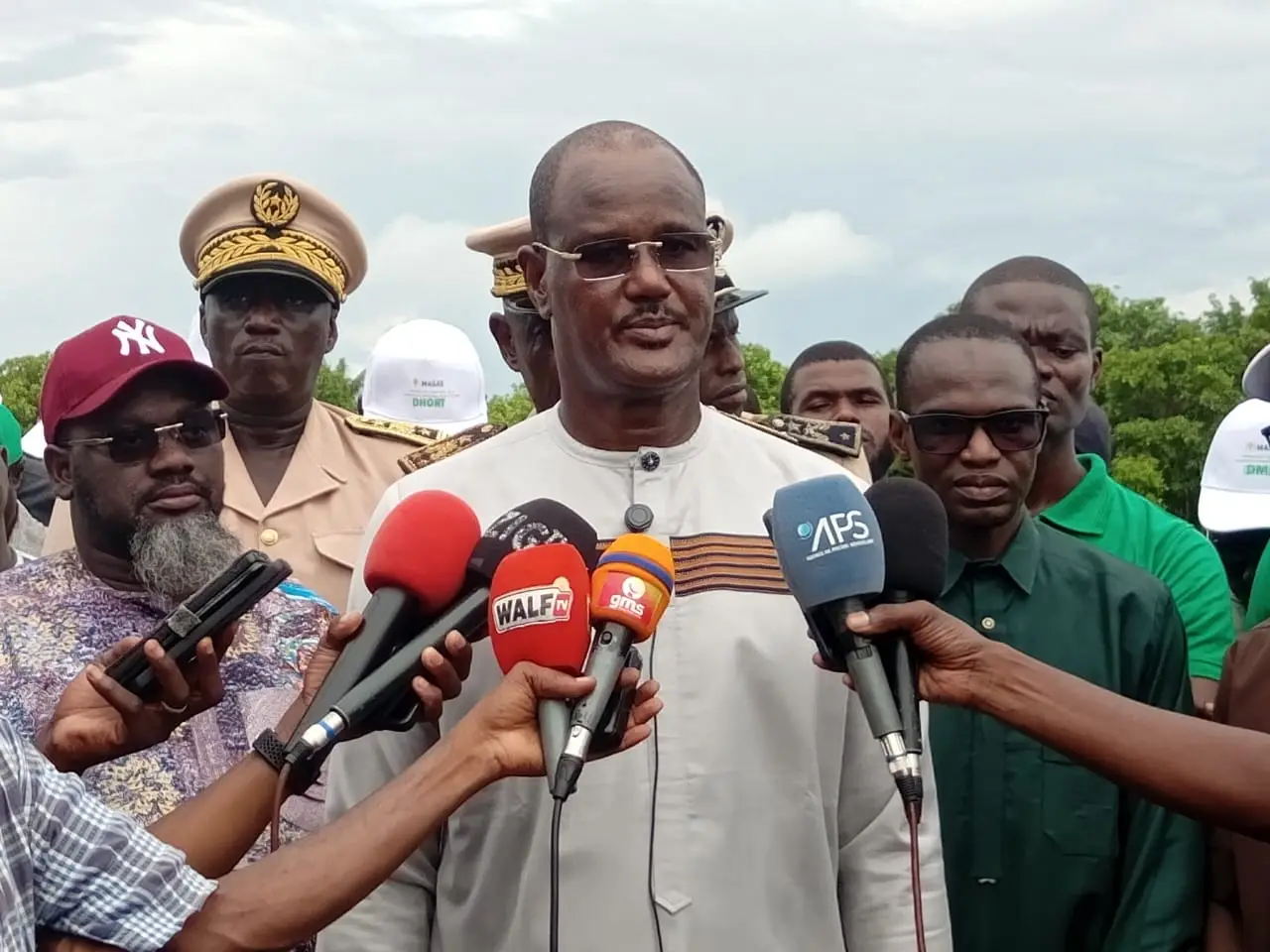
Agricultural campaign 2026: in Ziguinchor, Cheikhou Oumar Ba evaluates the crops and listens to the producers
The Minister of Agriculture, Food Sovereignty and Livestock, Dr Cheikhou Oumar Ba, is touring Ziguinchor on August 11 and 12 to follow the evolution of the 2026 agricultural campaign, indicates a press release. Peanut farms, ecological farm, rice growing and meeting with stakeholders are on the program.
ZIGUINCHOR – Take the pulse of the agricultural campaign as close as possible to the fields. This is the objective of the two-day visit by the Minister of Agriculture, Food Sovereignty and Livestock, Dr Cheikhou Oumar Ba, to the Ziguinchor region.
After several stops in other agricultural areas of the country, the minister continues his tour dedicated to monitoring the 2026 campaign. An approach which favors the field, direct contact with producers and the evaluation of local realities.
A 50 hectare farm in Diabir
The first stage takes the delegation to Diabir, in the commune of Oulampane. The minister is due to visit a 50-hectare peanut farm, developed by eight households.
The operation uses cattle traction and equipment subsidized by the State. It illustrates the efforts made to improve productivity and reduce the arduousness of agricultural work.
In Tobor, innovation in agriculture
In Tobor, in the commune of Niamone, the minister will discover another facet of Casamance agriculture. The ecological farm of young entrepreneur Papis Badiane covers two hectares.
Greenhouse production, fertigation, composting, dwarf coconut trees and fish farming are developed simultaneously. The farm has five 1,000 m² greenhouses and one 500 m² greenhouse intended for nurseries.
The farm also participates in the training and integration of young people. Eight jobs were created and 46 interns were welcomed and trained.
A campaign driven by favorable rainfall
According to data as of August 5, the rainfall situation is generally favorable in the region.
The accumulations vary from 320.5 to 515.6 mm in Bignona, from 394.1 to 762.2 mm in Ziguinchor and from 449.1 to 686.3 mm in Oussouye. With the highest totals, the Ziguinchor department currently appears to be the best watered.
This situation accompanies the development of the main crops. The rice is at the nursery and transplanting stage in the lowlands. Corn progresses from the seedling phase to the start of the crop. The peanut is between the 7 leaf stage and flowering, while the cowpea goes from the seedling stage to the beginning of branching.
The phytosanitary situation remains, for the moment, relatively calm.
Inputs available
The level of implementation of inputs is also considered satisfactory.
Peanut seeds have a planting rate of 97.91%, compared to 99.95% for corn and 96.51% for cowpea. For fertilizers, the rates reach 100% for 6-20-10 and Terracalcou.
The ministry continues to monitor the implementation and transfer of inputs in order to guarantee their effective availability to producers.
Producers facing the minister
The tour will also be an opportunity for direct exchange with agricultural stakeholders in the region. Producers, professional organizations, breeders and other value chain stakeholders are expected at the Kadiandoumagne Hotel in Ziguinchor.
They will be able to present their concerns and formulate their proposals. A report will be drawn up to ensure follow-up of the recommendations resulting from these discussions.
Rice, another priority
The second day will be devoted in particular to rice growing, with a visit to Katouré, in the commune of Nyassia.
This step will highlight the rice potential of Casamance, but also the efforts made to strengthen the capacities of producers.
With its arable land, water resources and agricultural diversity, the region has significant assets to contribute to Senegal’s food sovereignty.
The structuring of the sector is also progressing. The Regional Directorate of Rural Development has registered 315 cooperative societies, thus contributing to the formalization and better organization of producers.
Through this tour, the ministry wants to bring agricultural policy closer to realities on the ground: observe, listen and act, to better support producers and promote the agricultural potential of the territories.
O. FEDIOR
