
Adaptation at double speed October 20, 2026
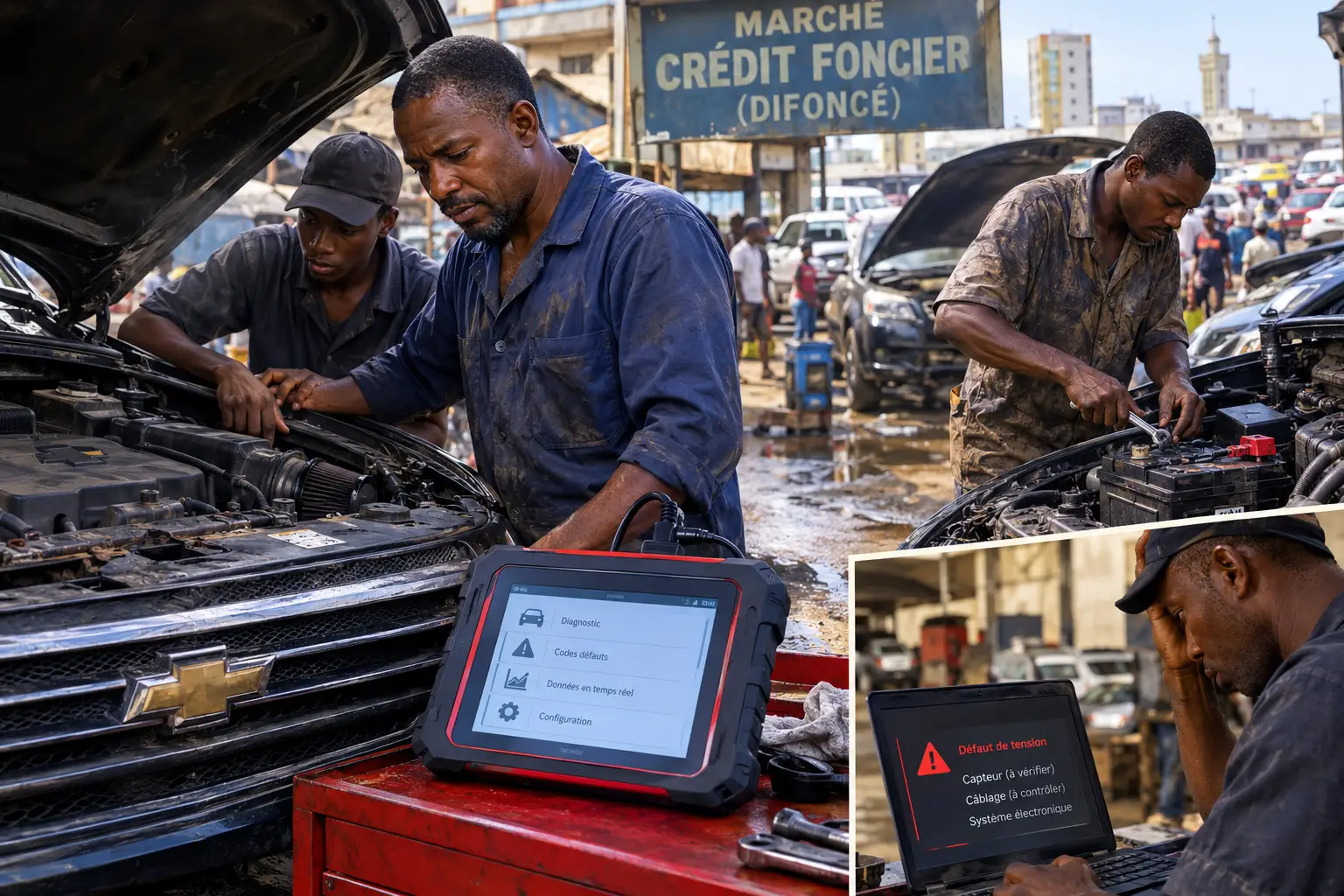
In the aisles of the Crédit Foncier market in Dakar Plateau, the mechanics are busy in the old-fashioned way. But, faced with electronic vehicles, they have to deal with the diagnostic case, an expensive and often essential tool.
In front of the grille of a black Chevrolet, Moustapha, in his forties, listens phlegmatically to the sluggish coughing of the engine that his apprentice is trying to start under his instructions, while a slight smell of gasoline emerges from the ground.
Wednesday October 14, 2026, the “Crédit régional” market, nestled in the heart of the Dakar Plateau district and commonly called “Difoncé”, is in full swing. The surrounding crowds, mixed with the honking of horns, hardly seem to distract this mechanic who is trying as best he can to find the origin of the car’s breakdown.
Notwithstanding the arrival on the market of diagnostic cases, today almost essential for promptly detecting breakdowns, Moustapha remains attached to traditional, “outdated” repair methods, he says with a bit of a smile.
For him, this casual attitude is justified in more than one way. “I have been in this profession for a long time. The experience and the unusual noises of the engine often allow me to trace the origin of the problem,” he explains, without even deigning to look up at the engine.
According to him, the mechanic’s ear, honed by years of practice, remains a precious instrument. It makes it possible to distinguish a suspicious clicking sound, an abnormal whistle or a vibration which indicates a tired part.
However, the mechanic does not reject this technology. He resorts to it when he finds himself faced with a difficulty that his knowledge and his usual checks are not enough to resolve. The diagnostic case then becomes a support, a means of pushing the research further and avoiding engaging in blind repairs.
Moustapha is well aware of this, the profession is evolving. “I think the future will be driven by new technologies. We will have to adapt,” he admits.
Barely a few meters away, after stepping over puddles of oil, we come across a second open-air construction site. With the wrench in his right hand, Abdoulaye Guèye tightens the battery screw. His outfit, well stained, bears the marks of long hours spent under the hoods.
Like Moustapha, he long thought he could do without a diagnostic case. “When you know the mechanics well, you can often tell where the problem is as soon as you look at the engine,” he says.
A technology that is essential
However, this belief was put to the test by a car that gave him a hard time. One day, he says, he found himself faced with a recent Range Rover whose problem he could not identify.
Hours passed, then days, without him being able to precisely determine the origin of the failure. Despite his numerous attempts, the vehicle resisted his usual methods.
He finally sought help from a mechanic friend equipped with a diagnostic case. The use of this device made it possible to resolve the situation, continue the research and definitively resolve the problem.
This experience marked a real turning point in his practice. Since then, Abdoulaye Guèye has regularly used the diagnostic case, particularly when working on recent vehicles whose electronic systems make troubleshooting much more complex.
“There are faults that can be easily found, but there are others that waste your time. With the suitcase, we can move forward more quickly,” he explains.
According to him, saving time is not the only argument. Customer trust is just as important. “There are customers who demand that we use the suitcase,” he adds.
Some motorists, accustomed to dealerships, even find going through the scanner more reassuring than a simple test drive.
Furthermore, believes the workshop boss, the tool is not that complicated to use. In fact, the diagnostic case has an automatic system and a manual mode.
“Simply select the vehicle make, enter the model, then start detection. In automatic mode, the case scans all the computers and directly displays the error codes. The mechanic only has to read the instructions to know exactly which part to install or repair,” he explains.
However, using this device requires understanding how the engine works. It guides the diagnosis, reduces trial and error and sometimes avoids needlessly dismantling parts that are still valid.
However, access to this equipment is not an easy task. Between the purchase price of the diagnostic case, the need to train in its use and any software updates, the investment can weigh heavily on a workshop’s finances.
Not all mechanics have the same resources, while needs vary depending on the makes and models of vehicles supported.
“You have to pay between 600,000 and 1,500,000 FCfa to have a good diagnostic case,” he says.
To this amount are sometimes added subscriptions, specific cables and software which must follow the evolution of manufacturers.
To get around this financial obstacle, a solidarity network has been set up in the aisles of “Crédit Landier”. Those who are not lucky enough to own the device call on equipped colleagues.
For a small contribution, they come and plug in their diagnostic case to go through the scanner. “Here, no one really works alone. Whoever has the suitcase lends it or comes to plug it in for others,” says Ibrahima, a mechanic based not far from Abdoulaye Guèye’s workshop.
The blind spots of a “mutation”
If the computer case stands out for some as the modern “panacea” for workshops, its use in the field quickly reveals cruel limitations. The tool does not work miracles and sometimes falls into the trap of digital illusion.
By scanning the vehicle, the device simply indicates an electronic symptom without ever explaining the physical cause of the breakdown. A simple sensor clogged with dust or a wire exposed by repeated friction can trigger a general alert on the screen, pushing the “too gullible” mechanic to unnecessarily replace expensive electronic parts.
“The suitcase doesn’t think for us, it just gives us clues,” warns Modou Ndiaye, an experienced automobile electrician in the sub-sector.
“If you just read the error code and change the designated part, you’re likely to see the customer the next day with the same light on. The machine reports a voltage fault, but it will never tell you that a rat has chewed the cable at the bottom of the chassis. This is where manual know-how comes into its own.”
The other major flaw lies in the very origin of the equipment and the training of the users. Indeed, many cases in circulation in informal workshops are entry-level copies or pirated versions whose software is never updated.
Faced with the surge of hybrid cars and the latest models stuffed with encrypted chips, these devices quickly become obsolete or provide erroneous diagnoses.
By Pathé NIANG
