
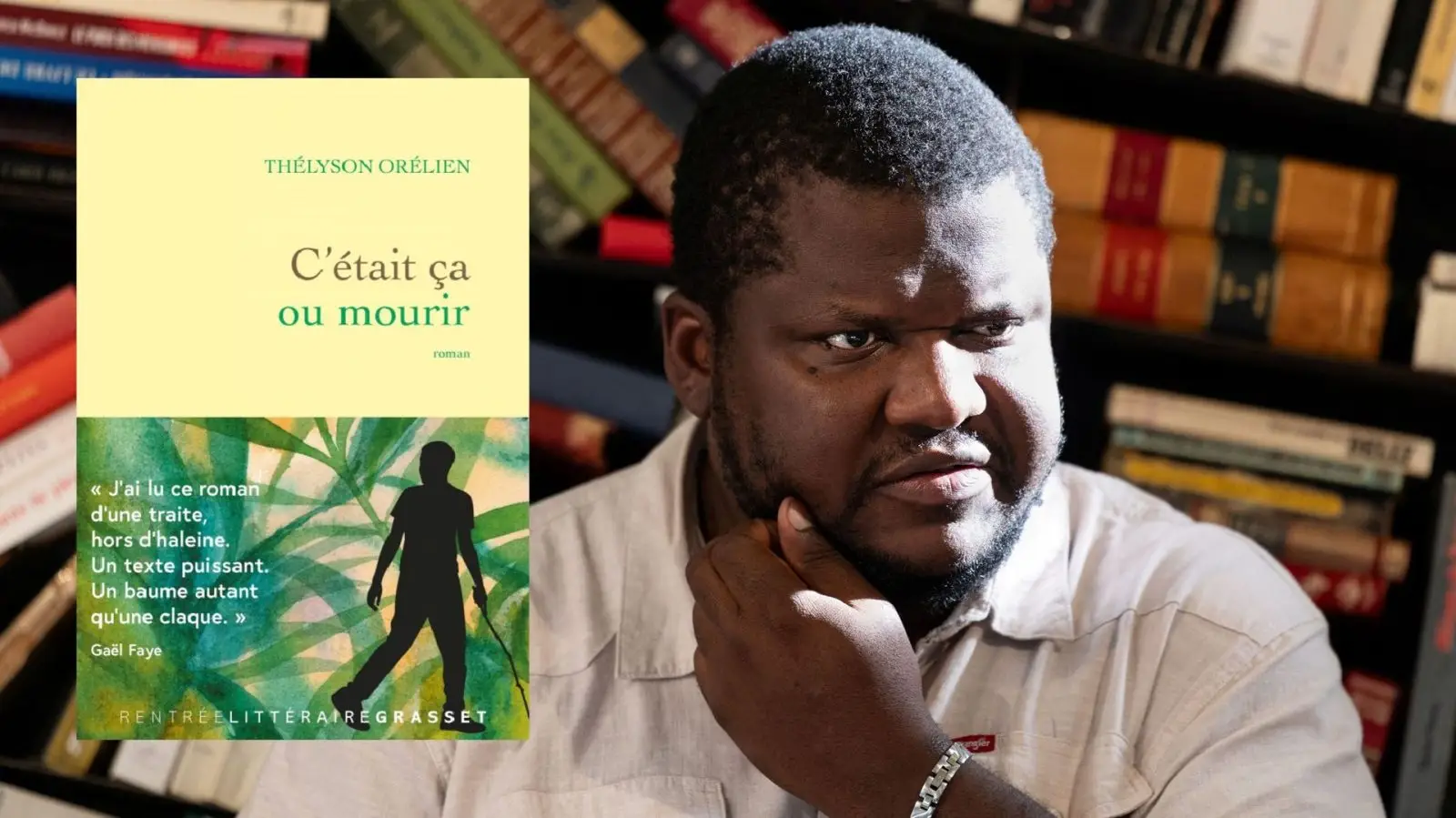
Accusations of use of AI: Thélyson Orélien defends his novel
Novelist Thélyson Orélien disputes accusations that his book It Was That or To Die was written by artificial intelligence.
In a statement entitled “This novel that I wrote”, the author returns to the genesis of the work, evokes his personal journey and recognizes youthful errors, while denouncing the harassment of which he claims to be a victim. His book, which has exceeded 75,000 copies sold since the end of August, remains in the running for the Renaudot prize.
Thélyson Orélien decided to speak. Accused of having massively used artificial intelligence (AI) to write It Was That or Die, the novelist defends the authenticity of his work and fully claims authorship of his book.
“It is a slander and a heresy,” he said in his press release sent to Agence France-Presse (AFP) by its French publisher, Grasset. Entitled “This novel that I wrote”, the text constitutes a response to criticism that has appeared since September 21, the date from which, according to the author, the accusations multiplied.
“A writer speaks through his writings and his writings speak for him. But silence has its price: by remaining silent, I let others tell my story for me,” he explains to justify his speaking out.
A novel born in 2017
To support his defense, Thélyson Orélien returns to the origins of It Was That or Die. He claims to have started writing the book in the fall of 2017, in Laval, Quebec, before completing a first version in 2019. This first manuscript had more than 300 pages.
The writing then continued through several phases of revision. The author says he deleted scenes, reworked passages, moved elements of the story and modified certain characters before the publication of the work in 2026.
He particularly emphasizes the seniority of his main character, Jonas Dorléon, as well as the place occupied by Haiti, Quebec, migration and exile in the story. Themes that he links to his own journey and to the stories collected over the years.
“Haiti, the biological mother, has inhabited this novel from day one, just like adopted Quebec, migration, exile: stories that I have experienced myself and others that I have heard over the years,” he writes.
The writer acknowledges having used certain tools to carry out research, particularly on foreign expressions. However, he refutes any intervention of artificial intelligence in the drafting of the text.
“No sentence in this book was created by a machine, any more than the meaning or order of a story that comes from my gut,” he assures.
A commercial success amid controversy
The controversy comes at a time when It Was That or To Die is enjoying significant commercial success. According to information provided, the novel has exceeded 75,000 copies sold since the end of August. The work is also still in the running for the Renaudot Prize, one of the most followed literary distinctions of the French school year.
This success helps to place the book at the center of attention, while questions about the conditions of its writing fuel the debate. Thélyson Orélien rejects accusations of massive use of AI and asks that his work be appreciated from the text itself.
“What I’m asking can now be summed up in one sentence: let us judge the novel It was that or die for what it is,” he declares.
The author does not, however, demand that questions about his past be dismissed. Rather, he believes that they should not be confused with the question of the origin of his novel, for which he places the beginning of writing in 2017.
Youthful mistakes recognized
In his press release, Thélyson Orélien also returns to previous writings and to errors that he admits to having made in his youth. He recalls leaving Haiti in 2010, after the devastating earthquake, passing through the Dominican Republic, a journey which has similarities with that of his character, Jonas Dorléon.
At the time, he explains, he read a lot and sought to discover the worlds of many writers. He cites in particular René Depestre, Édouard Glissant, Aimé Césaire, Patrick Chamoiseau, Jacques Stephen Alexis, René Char, Charles Péguy, Ernest Hemingway, Gabriel García Márquez and Fyodor Dostoyevsky.
He also evokes the influence that certain readings may have had on him, notably Le Matin des magiciens, by Louis Pauwels and Jacques Bergier. But he clearly distinguishes literary admiration from the appropriation of texts.
“I made unacceptable mistakes, despite my youth and inexperience. I deeply regret it and apologize unreservedly,” he admits.
This recognition constitutes an important part of his declaration. The author does not seek to deny his past, but disputes that it could be sufficient to establish that his novel was produced by artificial intelligence.
“A youthful error cannot serve as proof against a novel started in 2017 and which will finally be published in 2026,” he maintains.
Criticism, yes, harassment, no
Beyond the literary controversy, Thélyson Orélien denounces the personal consequences of the accusations made against him. He believes that the questioning of his work ended up affecting his identity and his humanity.
“By attributing to a machine a text which is mine, which is that of all mine, we have not only come to challenge my quality as a writer but my humanity,” he writes.
He also claims to have suffered threats, racist harassment and what he describes as a media lynching for several weeks.
The writer nevertheless recognizes the right of journalists to investigate and that of readers to examine his old publications. He also admits that his novel could be criticized or even rejected by certain readers.
“Criticism is always legitimate, but the threats, media lynching and racist harassment that I have suffered for weeks are unbearable,” he laments.
A call to read the novel for what it says
In conclusion, Thélyson Orélien returns to the essential: the story that he says he wanted to tell through Jonas Dorléon and the wounds linked to migration and exile.
He presents It Was That or Die as the fruit of personal work, nourished by his experience and that of other migrants. His ambition, he assures, was neither to win prizes nor to become famous, but to tell a story capable of touching readers beyond their origins.
“I didn’t write this book to win awards or become famous. I have nothing to prove to the people who accuse me,” he says.
While the novel continues its commercial journey and remains in the running for the Renaudot Prize, the author’s statement sets out his line of defense: recognize his past errors, refute accusations relating to artificial intelligence and ask that his work be judged on its content.
At this stage, the press release restores the position of Thélyson Orélien. Accusations relating to the use of AI, like the arguments put forward to contest them, must be distinguished from facts established by independent verification.
CG DIOP
