
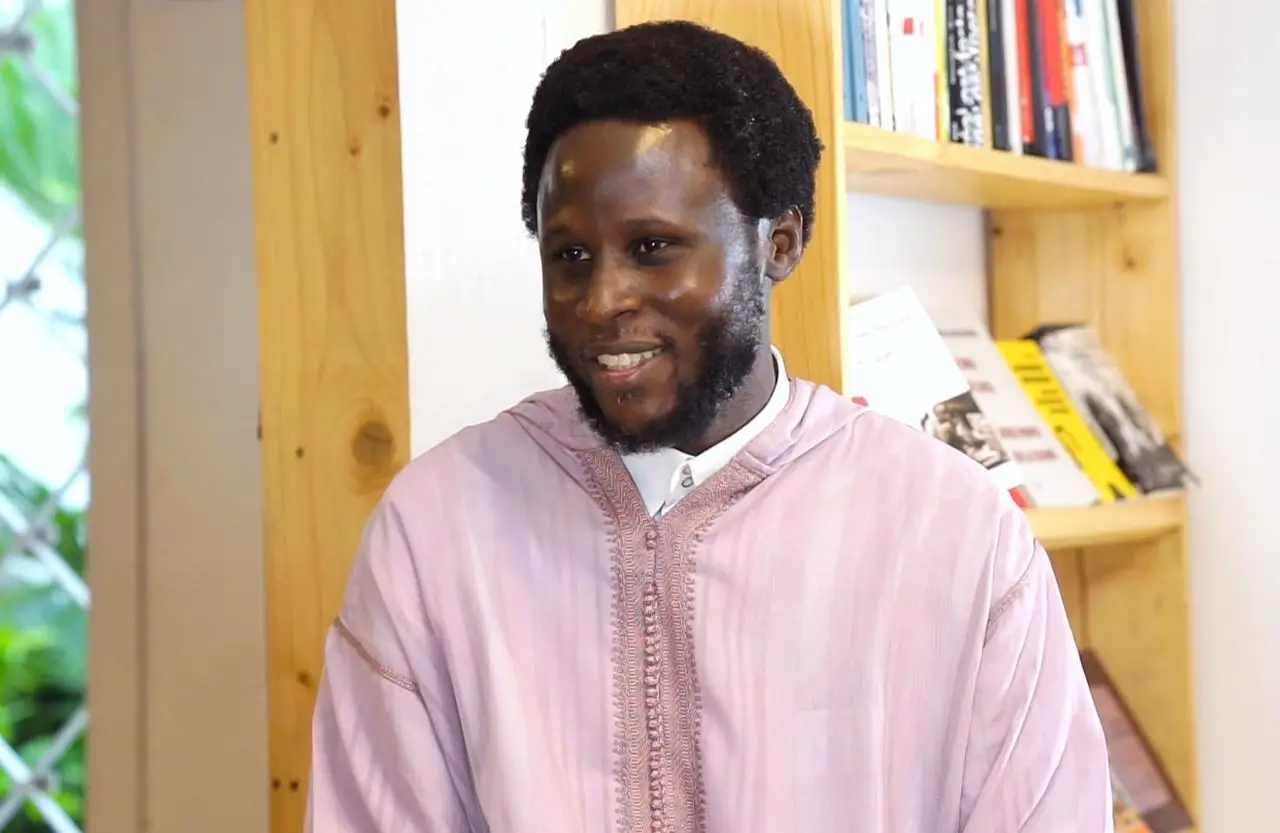
Abdoul Aziz Al Hussein Diop, journalist: “The railway allowed Mame Maodo to direct hearts and minds”
A trained journalist and passionate about cinema and audiovisual, Abdoul Aziz Al Hussein Diop traces, through his documentary 7e Gare, the spiritual and intellectual influence of Seydil Hadj Malick Sy, known as Mame Maodo, beyond Tivaouane. By bringing together railway memory, religious heritage and transmission to younger generations, it highlights the traces left by the religious guide in several towns in Senegal. The screening scheduled for October 17, 2026 will be followed by a panel devoted to the recovery and future of the railway.
Why did you choose the railway as a common thread to trace the spiritual and intellectual influence of Seydil Hadj Malick Sy, known as Mame Maodo, beyond Tivaouane?
The railway, in addition to the fact that it constitutes a major and material element in the history of colonization, brought territories closer together, participated in the opening up of certain areas, developed trade and made interaction between populations possible by facilitating travel.
This allowed personalities like Seydil Hadj Malick Sy and other scholars from our country to make contact with the populations, in order to counter Western influence and preserve our identity.
In an oral quote, Seydil Hadj Malick is reported to have said: “let them annex the territories and invade hearts and minds. » . And the railways were used by Mame Maodo to access the territories to guide hearts, in following the word of God (swt) and the love of the Prophet Mouhamed (pbuh).
What symbolic meaning does this “7th Station” have in your approach?
7th Station can have several meanings: spiritual, mystical and intellectual. You know better than me that in the Tijaaniyya and in the Koran, the number 7 is very symbolic. The Tidianes are even called “seven yi” to allude to this number.
But in this title, it is more assimilated to the 7th railway station, going from Dakar to Saint Louis. At the time there were: Dakar – Thiaroye – Rufisque – Sébikotane – Pout – Thiés – Tivaouane. By counting Tivaouane is the 7th station.
This is why in a famous song, Adjaratou Dial Mbaye (peace to his soul), described Mame Maodo as “Borom 7th Station”.
Your documentary explores several cities, including Saint-Louis, Louga, Thiès, Dakar and Rufisque. What concrete traces of Mame Maodo’s influence have you discovered in these territories, and how does his legacy differ from one city to another?
The choice of these cities for this season is not trivial. It comes from a popular discussion between Seydil Hadj Malick Sy and his heir Serigne Babacar Sy reported by our master and beloved Sheikh Abdoul Aziz Sy Al Amine.
In this discussion, it was, in other words, the distance between Serigne Babacar and her Father. Given the spiritual maturity of Mame Khalifa, they could no longer share the sphere of Tivaouane. Serigne Babacar made him several city proposals between Saint Louis, Louga, Thies, Dakar and Rufisque.
Thus, we looked at these cities in Senegal to establish the existing links between them and Seydil Hadj Malick Sy (rda). And in all these cities, several relationships are established, buildings both religious and cultural are erected there, families are conceived there and personalities formed.
Which makes his legacy both material and immaterial.
You use archives, testimonies, portraits and interviews to reconstruct this memory. What difficulties did you encounter in documenting Mame Maodo’s journey and distinguishing historical facts from stories transmitted by collective memory?
We had the chance to rely on elements already constituted by illustrious historians, researchers, traditionalists, etc. Among them we can cite Professor Rawane Mbaye (may Allah grant him lasting health) who devoted most of his life to retracing the life and work of Seydil Hadj Malick Sy.
An immense work that deserves to be magnified. His thesis on Mame Maodo gave us a lot of guidance on several sequences in the film. This allowed us to compare certain oral traditions transmitted for example by Seydou Welle, grandson of Mame Alphahim Yoro Wele, uncle of Mame Maodo, who was an outstanding specialist in the history of Mame Maodo.
“7th Station” brings together religious heritage, railway memory and national story. How have you worked to make this heritage accessible to younger generations, particularly those who know little about the history of the Senegalese railway or the journey of Mame Maodo?
Serigne Cheikh Tidiane Sy Al Maktoum feared a youth without creativity. In my opinion, this fear could imply that we must work to adapt our cultural and religious heritage to the aspirations of young people. And frequent their environments without prejudice and propose methods of transmission that suit their expectations.
Today, through audiovisual and cinema we can make this journey of Mame Maodo enriching and enjoyable. And allow young people to identify with this multi-sectoral heritage.
The screening on October 17, 2026 will be followed by a panel on the revival and future of the railway in Senegal. How can this documentary contribute to food for thought on the future of the Senegalese railway, and what change of perspective do you hope to generate among the public authorities and the general public?
In the different cities we passed through, nostalgia for the train was felt. But beyond the emotion that it symbolizes, people often repeat their wishes to see the train return to service for several reasons: economic, tourist and social.
Some elderly people we met still talk about the wagons loaded with fresh, dried or smoked fish, vegetables which left Saint Louis or Dakar to return from the jolof, the baol loaded with livestock, poultry or other dairy products.
And we said to ourselves that it would be interesting to raise the debate on the revival of the railways and to advocate. Moreover, this subject occupies a central place in the national transformation agenda Vision Senegal 2050, which is designed to make rail the backbone of the country’s opening up and economic integration.
This is why, in this documentary with a historical and spiritual vocation, we have associated stakeholders in the railway sector, namely the Chemins de fer du Senegal (CFS) and the Grands Trains du Senegal (GTS) to host, in the company of religious authorities, this panel.
And we wish to continue this subject through the traveling projection that we are planning in the cities where we have visited, for greater impact among the population.
Comments collected by Arame NDIAYE
