
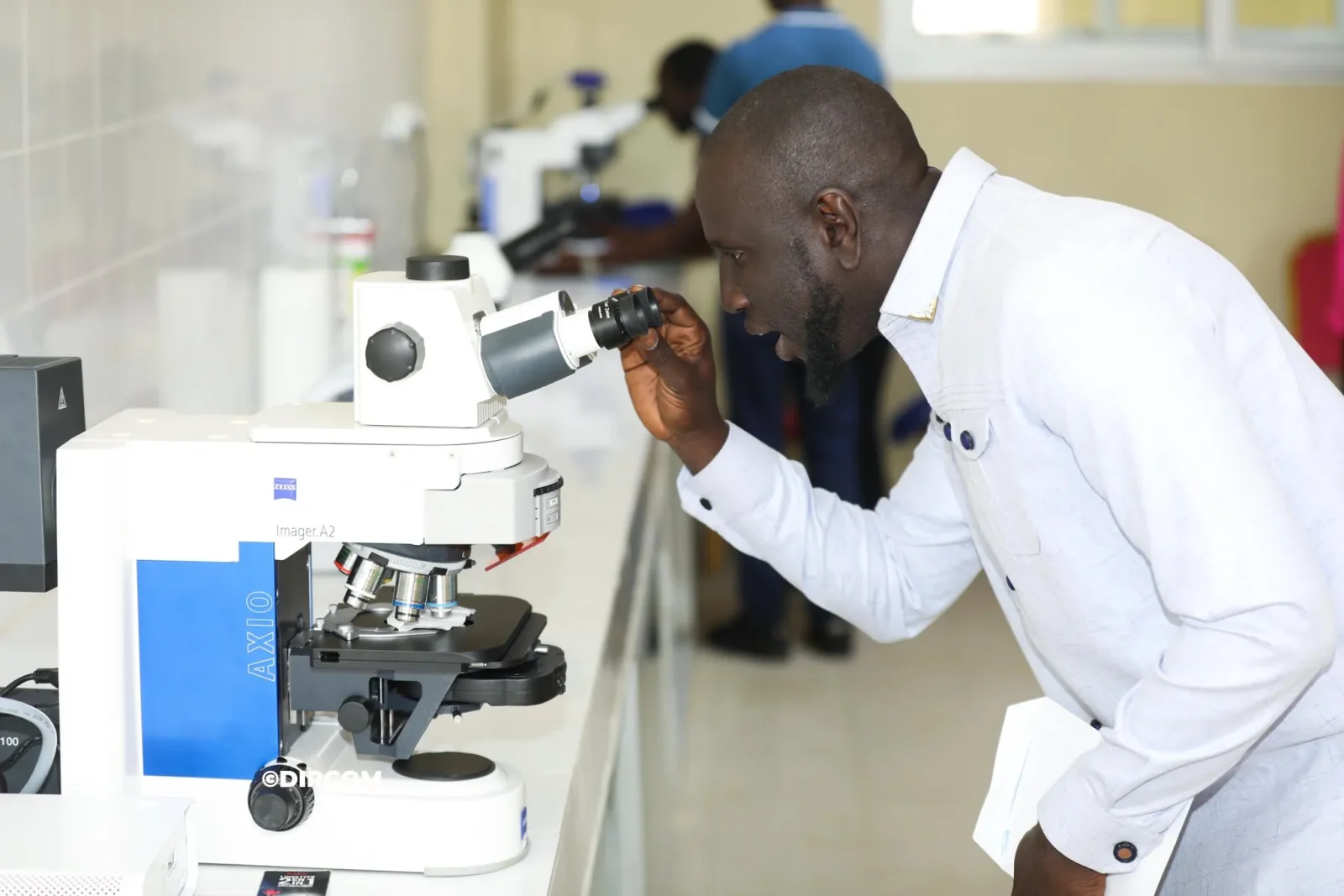
Ucad: focus on the Laboratory of Quantum Photonics, Energy and Nano Manufacturing
At the Faculty of Sciences and Technology of Ucad is the Laboratory of Quantum Photonics, Energy and Nanofabrication. It is directed by Professor Balla Diop Ngom with the aim of transforming agricultural residues into nanomaterials intended for energy storage.
Peanut shells, bissap flowers, jujube stones, banana residue or cashew nuts. We are at the Quantum Photonics, Energy and Nanofabrication Laboratory at Ucad. In the laboratory headed by Professor Balla Diop Ngom at the Faculty of Science and Technology of Ucad, these subjects are changing status.
From simple agricultural residues, they become the raw material for research which aims to contribute to the energy sovereignty of Senegal. A specialist in solid state physics and materials science, the teacher-researcher has just been appointed vice-president for West Africa of the African Academy of Sciences.
A continental recognition which comes as his team multiplies the work to move fundamental research towards concrete applications. The process developed in the laboratory is based on the transformation of biomass into nanomaterials. The residues are first reduced to powder then mixed with water according to parameters determined by the researchers.
After filtration, two materials are recovered. The extract makes it possible to manufacture nanocomposites of oxide and carbon intended for the cathode, while the solid residue is transformed by pyrolysis into activated carbon to constitute the anode.
“The innovation that we have brought is the ability to be able to use only water and biomass,” summarizes Professor Ngom. The experiments carried out with bissap have, according to the researcher, made it possible to reach 55 Wh/kg for a power of 1,000 W/kg.
Also read: Liberian Academy of Sciences: Professor Balla Diop Ngom of Ucad appointed Fellow
Above all, behind these figures there is an ambition: to have local storage technology capable of supporting the development of renewable energies. “Photovoltaics have this limit which is intermittency. During the night, there is no more sun. We must therefore develop local technology that allows the surplus to be stored,” he explains.
The imagined device thus seeks to combine the properties of the battery and those of the supercapacitor. Ultimately, this technology could notably meet the energy needs of areas with difficult access to the electricity grid. The challenge now lies beyond scientific proof.
“What remains is to develop a prototype and scale it up to move towards industrialization,” says the physicist. Part of the equipment was acquired thanks to international funding, notably from the Royal Society of London.
The laboratory has also developed scientific collaborations allowing researchers to access equipment unavailable on site. This dependence, however, constitutes a limit when it comes to protecting intellectual property. “There are innovative things that you cannot expose to your partners and that you want to keep for yourself,” explains Professor Ngom.
Added to this are the insufficiency of premises, logistical constraints and the need for additional financing to operate certain equipment. For the new vice-president of the African Academy of Sciences, the challenge is now to bring research, innovation and development closer together.
He believes that many results produced in Senegalese universities remain insufficiently valued. “There are quite a few scientific results lying dormant in the laboratories and which can solve Senegal’s problems,” he maintains.
By Daouda DIOUF
