
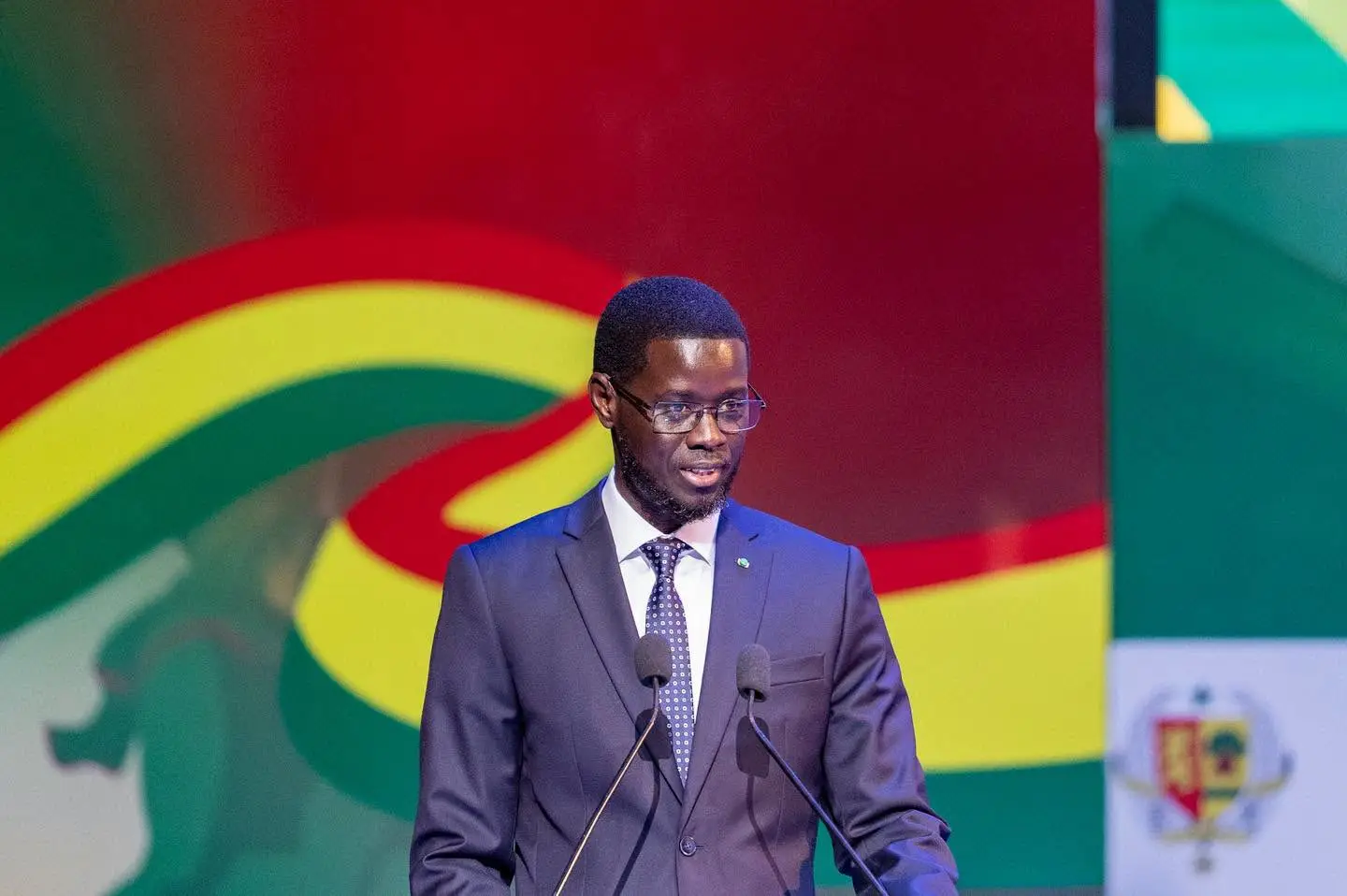
Dak’Art 2026: Bassirou Diomaye Faye makes culture a “superstructure of sovereignty”
At Cap Manuel, Thursday November 19, Bassirou Diomaye Faye opened the 16th edition of the Biennale of Contemporary African Art. In the old courthouse, the Head of State pleaded for a culture established as a pillar of sovereignty, a creator of jobs and wealth, and for a continent which regains control of its narrative.
A gesture of resistance
The President first justified the continuation of the event, despite “a demanding context”. His formula is clear: “We do not suspend the breathing of a people because times are hard. On the contrary, it is in these moments that a Nation needs its artists the most. » After the success of the Youth Olympic Games, whose architects he praised, he saw in this Biennial the continuation of the same story: “The world has seen what Africa can do when it tells its own story. »
(Anti)fragility, theme of the edition
The theme chosen by the Steering Committee, “(anti)fragility”, sounds according to him “like an act of philosophical resistance”. The Head of State described a parenthesis which “separates and connects in the same gesture”, revealing fragility while announcing its overcoming. He read there a response to what “the world system wanted to assign to us as our destiny”: economic, climatic, democratic fragility. Africa, he said, no longer wants to complain about its “delays” but instead wants to become aware of its strengths. Then this sentence, which sums up the philosophy of the Biennale: “Out of constraint, African Art creates a form. From lack, he creates a work. »
The President linked this message to world news, between museums questioned about the origin of their collections and artificial intelligence which questions “what, in creation, remains irreducibly human”.
The DRC in the spotlight
Guest country of honor, the Democratic Republic of Congo received a warm tribute, in the presence of its Minister of Culture, Yolande Elebe Ma Ndembo. For the Head of State, this choice is “artistic evidence, as much as fraternal evidence”. He praised creators who remind us “that we can take everything from a people, except its ability to create beauty and therefore to invent the world”.
Write your own art history
The heart of the speech is political. The President defends “a vision of full and complete cultural sovereignty”: “For too long, others have written this history in our place. Today, more than ever, we ourselves must write our own history of Art, with our words, our criteria and our institutions. »
In the Senegal 2050 National Transformation Agenda, culture changes status. It is no longer, he affirmed, “only a supplement of soul, but a superstructure of sovereignty, in the same way as the environment, our roads and our energy”. It forges identity and social cohesion, but it “creates value and income” and “offers jobs to our youth”.
A common market for African art
The President quantified the challenge: Africa captures less than 1% of the global art market. “This figure is not inevitable. It is the measure of the space that opens before us. » He announced his wish to support, with the African Union, a common market for African art, as an extension of the ZLECAF. The image stuck: “A work created in Kinshasa must be able to be exhibited in Dakar and acquired in Nairobi without encountering more obstacles than a bag of cocoa or a barrel of oil. »
The winners, “new faces of antifragility”
He finally thanked the Biennale teams, then congratulated the winners, from the Léopold Sédar Senghor Grand Prize to the Young Creator Revelation Prize. He sees “the new faces of antifragility”, responsible for carrying the colors of a generation which intends to “make the ordeal a material for creation”. Before declaring open Dak’Art 2026, which runs until December 19, he launched: “Long live African art! Long live Dakar, capital of creation! »
