
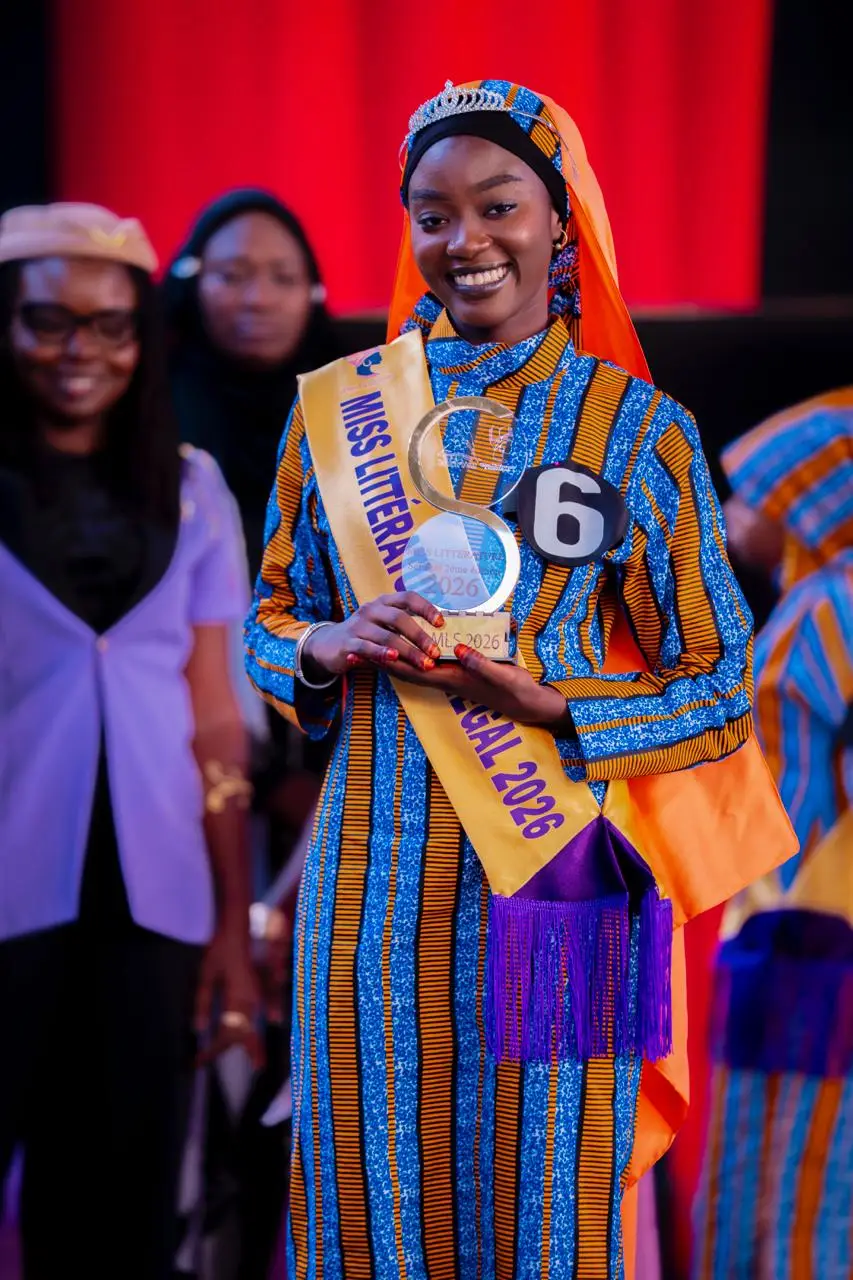
Miss Literature Senegal 2026: Fatou Bintou Sène crowned and awaited at the continental meeting
The second edition of the Miss Literature Senegal competition had its epilogue, Saturday November 14, 2026, at the French Institute in Dakar. At the end of a competition that mobilized 166 candidates from the 14 regions of the country, Fatou Bintou Sène, an engineering student at the École Polytechnique de Thiès, won the crown. She will defend the colors of Senegal at the African final scheduled for Benin in November 2027.
Letters were in the spotlight last Saturday at the French Institute in Dakar. There were ten candidates vying for the crown of Miss Literature Senegal 2026. At the end of a final marked by the quality of performances, eloquence and the enhancement of traditional outfits, Fatou Bintou Sène, representative of the Thiès region, was crowned. A second year engineering student at the École Polytechnique de Thiès, she succeeds Sokhna Aminata Fall from the Lycée d’Excellence Mariama Bâ de Gorée and becomes the ambassador of Senegalese literature on the continental scene.
Dieynaba Ba won first place as runner-up, while Sophie Charlène Nazala was named second runner-up. The ceremony took place in the presence of Mame Coumba Diop, Minister attached to the Minister of Culture, Crafts and Tourism, responsible for Culture, Creative Industries and Historical Heritage, as well as several authorities from the National Education sector.
Visibly moved by her coronation, Fatou Bintou Sène expressed her gratitude to those who accompanied her throughout this adventure. For her, this distinction rewards the efforts made, but also represents a responsibility. She now intends to fly the colors of Senegal during the African final in Benin.
“I am very proud and I feel very indebted to Senegal. Senegal has done a lot for my education and for the person I am today,” she confided, while inviting her compatriots to mobilize for this next deadline.
166 candidates for ten finalists
Behind this final, several months of selection and mobilization on a national scale. According to the promoter of the competition, Salamata Ousmane Diallo, cultural journalist at Radio Futurs Médias (Rfm), this second edition initially recorded 166 applications from the 14 regions of Senegal.
A pre-selection phase was organized simultaneously in eight regions, making it possible to select 30 semi-finalists. The latter met on October 10 at the Pikine Cultural Center for the semi-final, at the end of which the ten finalist candidates were selected.
The promoter noted the difficulties linked to the organization of a national-scale competition, while welcoming the support of academy inspections and French teachers mobilized in the different regions. She also highlighted the role of the Ministry of National Education, which sent a circular note to academic inspectorates in order to facilitate the participation of educational establishments.
For Salamata Ousmane Diallo, it is essential to give more visibility to young people who are involved in reading and writing, like those who excel in sport. “If sport strengthens the body, literature strengthens the mind and a country that wants to go far must work on both,” she declared.
The promoter also paid tribute to the women who contributed to the emergence of women’s literature by taking up the pen to tell their realities, their struggles and their aspirations. “Woman must not only be told, she must also be able to tell,” she asserted, thus pleading for more spaces for female expression in the literary world.
Sokhna Benga invites candidates to transform society through letters
Sponsor of this second edition, the Senegalese writer Sokhna Benga welcomed the initiative, which she considers to be a commitment to youth and culture. His novel Bayo, the melody of time was chosen as a reference work for this edition and served as support for reading and literary criticism exercises.
The novelist was delighted with this choice, presenting her work as a reflection on the dreams, questions and responsibilities of youth in the face of violence. In her speech, she insisted on the role of literature in the intellectual and civic training of young people.
Beyond diplomas and distinctions, she invited the candidates to put their knowledge at the service of society, to cultivate their passion for letters and to dare to publish their works. For her, reading and writing should also allow young people to better understand their environment and contribute to its transformation.
This edition was also placed under the sponsorship of Abdoulaye Fodé-Dôme, publisher, poet, novelist and president of the Association of Writers of Senegal.
Beyond the competition and the crown, Miss Literature Senegal intends to make reading and writing levers for promoting the potential of young girls. With the coronation of Fatou Bintou Sène, this ambition now takes on a continental dimension. The next meeting is set in Benin, where the winner will be responsible for representing Senegal.
Arame NDIAYE
