
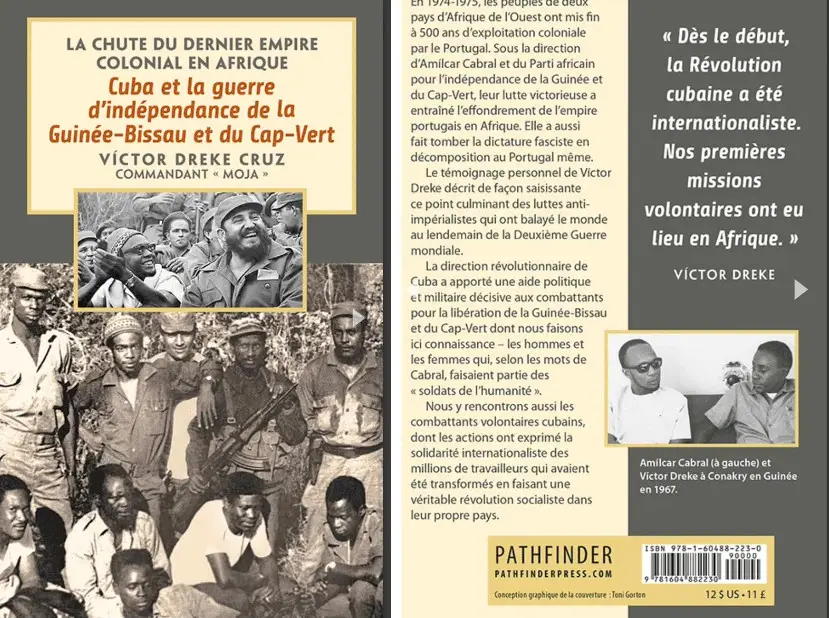
Decolonization: when Cuba supported African fighters
Through his work “Cuba and the war of independence of Guinea-Bissau and Cape Verde: the fall of the last colonial empire in Africa”, Cuban veteran Víctor Dreke looks back on his country’s commitment alongside African liberation movements. A historical contribution that historian Amadou Ba considers important to shed light on a still little-known episode of the decolonization of the continent.
The history of African independence was not written only on the continent. It was also nourished by international solidarity, military collaborations and political commitments from elsewhere. The Cuban intervention in the war for the liberation of Guinea-Bissau and Cape Verde is an illustration of this. It is this episode that Víctor Dreke highlights in his book entitled “Cuba and the war of independence of Guinea-Bissau and Cape Verde: the fall of the last colonial empire in Africa”.
In this work, the veteran of the Cuban revolution provides testimony on his country’s participation in the fight against Portuguese domination. Through his experience, he looks back on the living conditions of combatants, military strategies, relations with African executives as well as the difficulties encountered on the ground.
In his critical look at the book, Dr. Amadou Ba, historian, author and professor of history at Laurentian University, highlights the documentary and historical interest of this publication. He sees it as an important contribution to a history that is still insufficiently known: that of Cuban involvement in African liberation struggles.
More than 400 Cubans participated in this mission between 1966 and 1974. Their intervention, however, was not limited to military support. It also combined medical assistance, training and logistical support for fighters from the African Party for the Independence of Guinea and Cape Verde (PAIGC). Cuban doctors notably took part in the care of combatants and populations living in liberated areas.
Solidarity without substitution
One of the major lessons of this work lies in the place given to African leadership. Historian Amadou Ba insists that the story does not present the Cubans as the liberators of Guinea-Bissau. Rather, it restores to Amílcar Cabral and the PAIGC their central role in leading the struggle.
Cuban aid was, in fact, part of a broader international dynamic. The Soviet Union, China, Czechoslovakia, Guinea-Conakry, Algeria, Egypt, Yugoslavia and Sweden had also provided different types of support to the liberation movement. The Cuban volunteers nevertheless distinguished themselves by their direct participation in the fighting alongside the Guinean forces.
Beyond the military dimension, the book highlights the political thought of Amílcar Cabral. For the leader of the PAIGC, armed victory was not an end in itself. It was to open the way to a profound transformation of the living conditions of populations. The organization of the liberated areas, with the creation of schools, clinics, health structures and village administrations, reflected this ambition.
A victory with international repercussions
The work also places the Guinea-Bissau War in the context of the collapse of the Portuguese colonial empire. The bogging down of Portuguese forces in the African wars contributed to the crisis of the Lisbon regime, until the military coup of April 25, 1974, which opened the way to the Carnation Revolution.
After the unilateral proclamation of the independence of Guinea-Bissau in September 1973, Portugal finally recognized it in September 1974. Cape Verde in turn gained sovereignty in July 1975.
For Amadou Ba, this transnational dimension constitutes one of the major contributions of the book. African struggles have thus participated in political upheavals well beyond the continent.
The historian, however, notes certain limits to Víctor Dreke’s testimony. Written several decades after the events by an actor deeply attached to the Cuban revolution, the story naturally promotes internationalism and solidarity between peoples. Certain questions, notably internal tensions within the PAIGC, local perceptions of the Cuban presence or even debates within the Cuban government, would have merited more in-depth examination.
These reservations do not, however, diminish the historical interest of the work. For Amadou Ba, it constitutes both a first-hand testimony, a document of revolutionary memory and a resource for better understanding the dynamics of African decolonization.
By showing the links forged between Bissau, Conakry, Havana and Lisbon, Víctor Dreke ultimately reminds us that African independence was also the product of solidarity that crossed borders and oceans.
YEAR
