
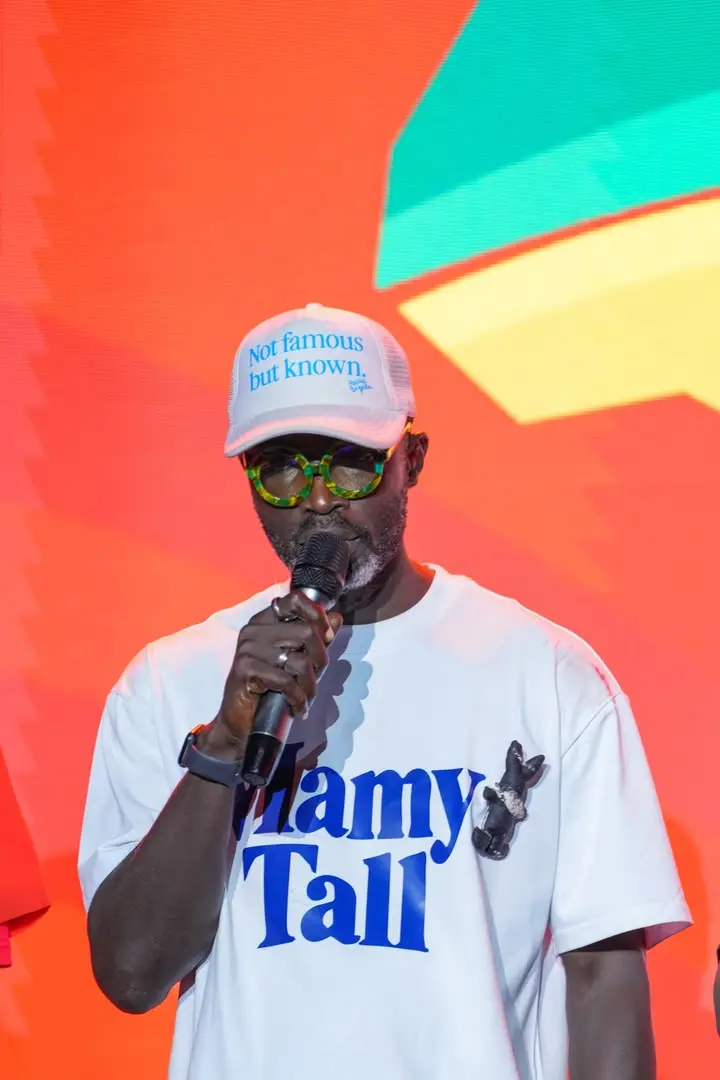
The “Nandité” at the helm of an academy (1/2) November 8, 2026
He was first a well-known face in the ecosystem of cultural and creative industries, to be one of its greatest ambassadors, before revealing the great artist that he is to the world, during the opening ceremony of the “Dakar 2026” Youth Olympic Games. Artistic director of the ceremonies for this world Olympic event, Ibrahima Cissé known as Xalil, with his team, dazzled the world with a performance that is already in the annals. With arts eloquently mixed with the authenticities of our heritage.
At Ibrahima Cissé known as “Xalil”, creation starts from fragments of our imaginations. Its practice then meets their senses. He replaces these debris, carrying unsuspected colors of our heritage and identities, to construct a fresco where each of us inevitably finds his part. It is the same recipe, “which is in no way miraculous”, that Xalil Cissé used on an African scale, as artistic director for the opening ceremony of the “Dakar 2026” Youth Olympic Games. Yes, “Africa welcomes, Dakar celebrates”. For Xalil, “Boy Dakar” the culmination of his state, it was necessary to give substance to this slogan, based on his own artistic considerations. He said it himself, at the end of the show, in a reaction that has become cult, “It’s Africa that is so rich, we don’t need alchemy.” So, for Xalil Cissé, the whole performance was nothing but evidence and articulations (controlled, of course). The evidence of a common memory of Africa which remained to be sublimated, by the collective genius of an exceptional Senegalese team which had authenticity as its guiding principle.
Read also: The arts nectar machine (2/2)
We found Ibrahima Cissé known as Xalil, artistic director of the Joj “Dakar 2026” ceremonies, Thursday evening at Kër Ayo (Cojoj headquarters) in Ouakam. Relaxed in his black capri pants of the same color as his t-shirt decorated with a L’Artisane brooch, mismatched red and purple socks, Xalil is already focused on organizing the closing ceremony. When we ask him the spirit that presided over the design of the framework of the opening ceremony of the YOG “Dakar 2026”, on Saturday October 31, the answer sounds simple. “The project started, basically, with the idea of family. The plot is articulated around that. “Maam, Doom, Sët” (grandmother, child, grandson), it all started from there,” Xalil tells us, who explains that the next challenge was to put this family into a more global plan that has “Africa at the heart and the universal as a goal.”
This is how he began to question how to address the world with our heritage, and go against the dictates of digital and Western logic. “This is where we delved into tradition, to talk about transmission and find this accepted African proposition. From the start, I had ruled out a fixation on technology, because I must not lose sight of the centrality of the human element,” confesses the artistic director of the “Dakar 2026” YOG ceremonies (opening and closing ceremonies, the 153 medal ceremony). His first task was to identify all the arts he would need (performing arts, cinema, design, music, etc.).
Addressing the world through our heritage
How to integrate cinema, for example, wondered Xalil. By bringing back these usurped symbols, Xalil replied, such as the horned motorcycle in “Touki Bouki” by Mambety, which Beyonce and Jay Z had subtly taken over. Yes, the performance on Saturday October 31 also meant resistance, at a time when Africa is demanding its stories! Still on the symbols, AlKebulan wore the same gold shoes as Linguère Ramatu in “Hyenas”. It is the return of Woman to regain her rights and her pre-eminence in the scale of humanity through the seal of motherhood. “Now, we had to put all of this into an idea not of opulence but of simply wealth, in the compositional elements that define us,” underlines Xalil, for whom it was just necessary not to build on a History other than that of Africa.
We saw the figure of Cheikh Anta Diop, summoned with his Carbone 14 laboratory, according to Xalil, to show that Africa does not only have rhythm and enthusiasm to offer. “We have scientists, intellectuals who have reached the highest heights of research. We don’t have to shy away from any name…” insists Xalil. Moreover, the mention of AlKebulan comes from there. It was, beyond a tribute, a popular rehabilitation of “Professor” Cheikh Anta Diop, in view of his contribution to the recognition of the continent as the cradle of humanity and of the black man in all his human dignity. Even this bias cannot offend Senghor from beyond the grave, as the cultural manifestation of Negro creativity showed its strength in this performance.
AlKebulan, Keb, Sitoé. Science, culture and us.
For the reference to AlKebulan, Xalil again started from the writings of the ideas of Cheikh Anta Diop, although dissonant voices refute the thesis. According to the Senegalese historian, Alkebuland (performed by Nicole Marignale) is the ancient name of Africa, meaning “Mother of Humanity”. This metaphorical figure of the mother, strong, beautiful and resilient, launched this ceremony under the seal of transmission. Sitoé (Sitoé as a child with Sally Diène, and Sitoé as an adult with Oumy Ndong) is a local first name and a tribute to the Senegalese woman, to her resistance in reference to the Casamance heroine Aline Sitoé Diatta.
It represents the Africa of the future, rooted in its traditions and turned towards the future. “This is why she received the transmissions, through the symbol of the kola and the torch, to perpetuate the legacy,” deciphers Xalil. Keb (Keb adult with Malang Sonko and Keb child with Elijah Fall), name of Egyptian origin, is historically associated with the connection between humanity and the earth. It is the representation of Africa today, with a vibrant, inventive and visionary youth.
By Mamadou Oumar KAMARA
