
The arts nectar machine (2/2)
“I’m the least creative on this team, the least interesting. I was working with people I’m a fan of. This is not the work of Xalil, but of a team. I was right behind to referee. In the end, we ended up with this collective work that resembles us and brings us together,” introduces Xalil when asked to present his team, no one of whom had until now ever organized or attended Olympic Games ceremonies.
Read also: The “Nandité” at the helm of an academy (1/2)
First the director, Adama Diop. “He is a machine in his own right, this guy,” exclaims Xalil, who did not know this theater actor before contacting him. “I did my research and came across him. I wasn’t necessarily looking for someone crazy, but a genius who wanted it and was ready to commit. And when I saw that he had established a school and heard his launch speech, I realized that he was the one I needed. He doesn’t live in Dakar all year round, but he was super excited when I called him to represent Africa,” confides Xalil Cissé, to whom Adama Diop offered to work on the symbolism of the circle.
The circle which refers to the bowl in Africa, to the king’s court, to the assemblies…, but also joins the five Olympic rings.
Then there is Marième Ngom, HMC general coordinator (dressing, makeup, hairstyling), who has solid experience in the cinema and fashion ecosystem. According to Xalil, it was a real relief to have someone who quickly understood and knew where she was going before she even took the path.
Moreover, Xalil specifies that, apart from Adama Diop whom he did not know, he knew all the rest of the team who were names that stood out to him during the writing of the project.
Certainty was even better affirmed with the designers who managed the three stages of the ceremony. Maguette Gueye from La Penderie de Maam, Khadija Bâ from L’Artisane and Selly Raby Kane. “For these three women, I did not even try to negotiate. I absolutely needed them in the team,” smiles Xalil Cissé.
Maguette Gueye dressed Time 1 of the ceremony with La Penderie de Maam, concerning everything related to heritage, the meaning of growing up in Africa. She made all the costumes for this act, whether it be the wrestlers, the drum major, the dancers, AlKebulan, etc.
For Le Temps 2, which is reporting today, Khadija Bâ L’Artisane took care of it. It carries a particular, very thoughtful style, which waltzes between modernity and heritage. She is above all an ace of handmade work, and her work resolutely visualizes the urban image in its spatio-temporal evolution.
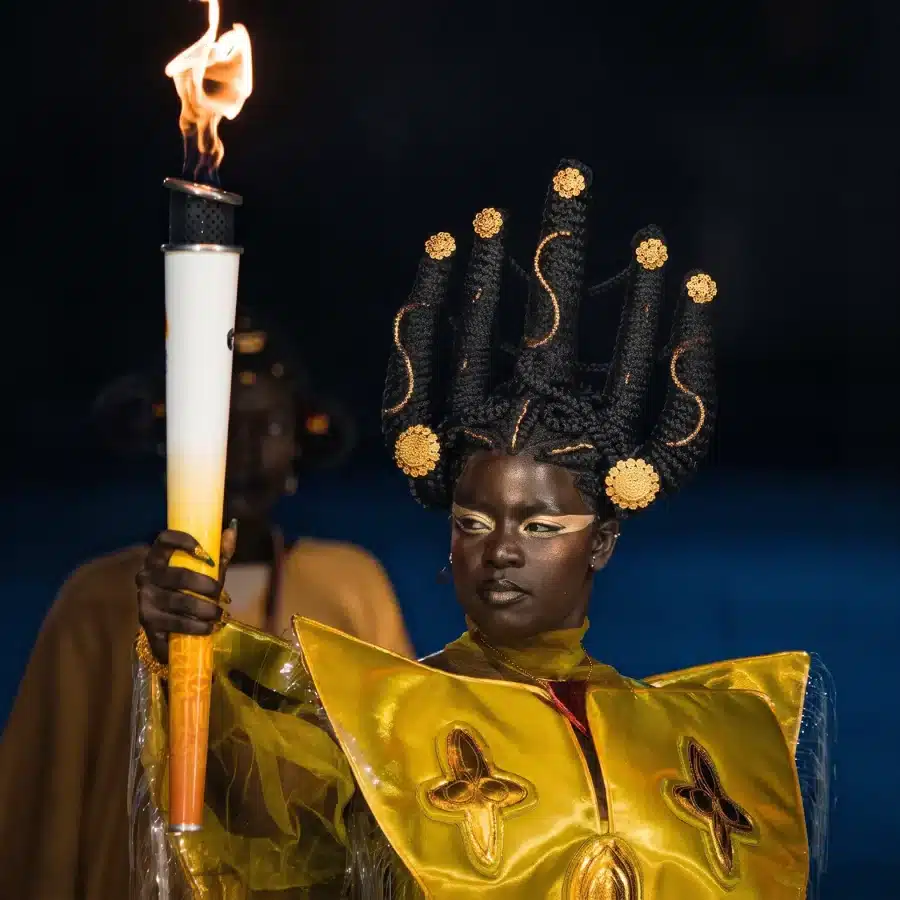
Selly Raby Kane, who dressed Time 3, is already famous around the world. For his creative madness, his futuristic approach, his genius in laying out decor elements that don’t yet exist.
A constellation of lights
When Xalil Cissé talks about Ismaïla Talla alias Iss 814, the musical director, we still feel the stars in our eyes. He is clearly fascinated.
“This guy, I’m just calling him to tell him I need a musical director on the artistic project. I immediately finish my speech, like a true genius, Iss 814 makes me countless suggestions, tells me how the sound should be worked on, how the rhythm should be sustained, etc. He even went, in this same telephone interview, to draw an outline of the ceremony. I told myself that I have my guy,” says Xalil in a burst of laughter which means amusement and admiration.
Iss 814, according to him, felt that he was only missing this rope to accomplish and paid more attention to this moment than the gold records he has already won.
This mutual esteem did not, however, prevent them from bickering throughout the project, because “Iss 814 is so talented and crazy that he runs more than the required speed”.
The two of them gave free rein to their madness in the studio. “We were having a little fun. We said to ourselves, for example, let’s try Saalimtoo, and bam! he rewrites the theme and composes something crazy,” remembers Xalil.
So they had their music from the whole first part. Then, since it was necessary to assume the music under the rule of African heritage, they went to look for artists and took real instruments to replay all the music composed by Iss 814.
Yeah, the sabar, the tama, and tutti quanti had to say their rights.
Then there is Khady Kassé, the scenographer. She was the one who created all the physical scenography elements for this performance. She arrived a little late in the project, but was able to stick to it perfectly according to the artistic director.
Khady Kassé was the scenographer for the 15th edition of the Biennale of Contemporary African Art in Dakar, which begins its 16th edition in less than two weeks (November 19 – December 19).
Xalil Cissé had the advantage of having worked on the opening of the Stade Abdoulaye Wade. So he knew the place and had identified his space.
The technical teams, who capitalized on many events in this stadium, also had perfect control of its infrastructures, “which allowed a considerable advance despite the relatively short deadlines given to us”.
There was also a stroll at the end, which was like a fashion show. That was somewhat the idea, an idea carried out by nine stylists.
Their names are Rashid, Donatela Crea, Niuku, Stef de Karda, Weuz Owens, Gelisa Georges, Radji Radji, Jeyna A and Carmena A. “These are young designers who came to lend a hand with 50 outfits, for the very impactful end of this time, following the artistic direction,” explains Xalil Cissé.
Dakar in “Dakar 2026”
The idea of Dakar, in its authentic urban reality, is reflected in the performance. First, the figure of Issa Ramangellisa Samb Joe Ouakam, played by the artist Obree Daman (real name Omar Samb, also a relative of Joe Ouakam). “He was very happy to have this role, because he is also from Joe Ouakam’s family. Then he carried it very well. Did you see the pipe, the outfit? “, exclaims Xalil, who says that Obree Daman immediately got into the designer’s idea.
And what about the scenes of life in Dakar? Beyond the nod to “Madame Brouette” by Moussa Sène Absa, it is all these “rickshaws” (coffee carts) which make up the decor of the capital, the “forox caaya”, the urban hustle and bustle, the pedestrian congestion, the illegal businesses, the petty thefts and the “tek xel”, etc. “All this is the city, it’s Dakar,” says Xalil Cissé.
After the ceremony, amidst the satisfaction, many spectators noted the “cacophony at the end”, considering that the artistic team relaxed at the end of the show. In truth, this scene is a real false shambles, according to the artistic director.
“You see, everything was ordered, controlled and regulated like music paper. We wanted to show that we can do very well, that all Africans can do very well. But we often sin in finishing. We have a problem finishing well. This is the image we wanted to pose. Tell people, we’ve spoken to the world, now let’s talk frankly with each other. This is our own turpitude. Isn’t that our feeling when we drive around Dakar? », questions Xalil Cissé.
The art of disorder in order. The slap on the Senegalese. To tell them that “Here you are”! “Art is also about painting a society. Point out things that are not good,” repeats Xalil.
Isn’t this also where the entry of the young VJ artist reveals all its relevance? He who, between the media and political disorder, opened a path where an entire young generation found him without warning. There you have it, the image of a youth that emerges, even in uncertainty and chaos.
A cosmogram that makes sense and pleasure
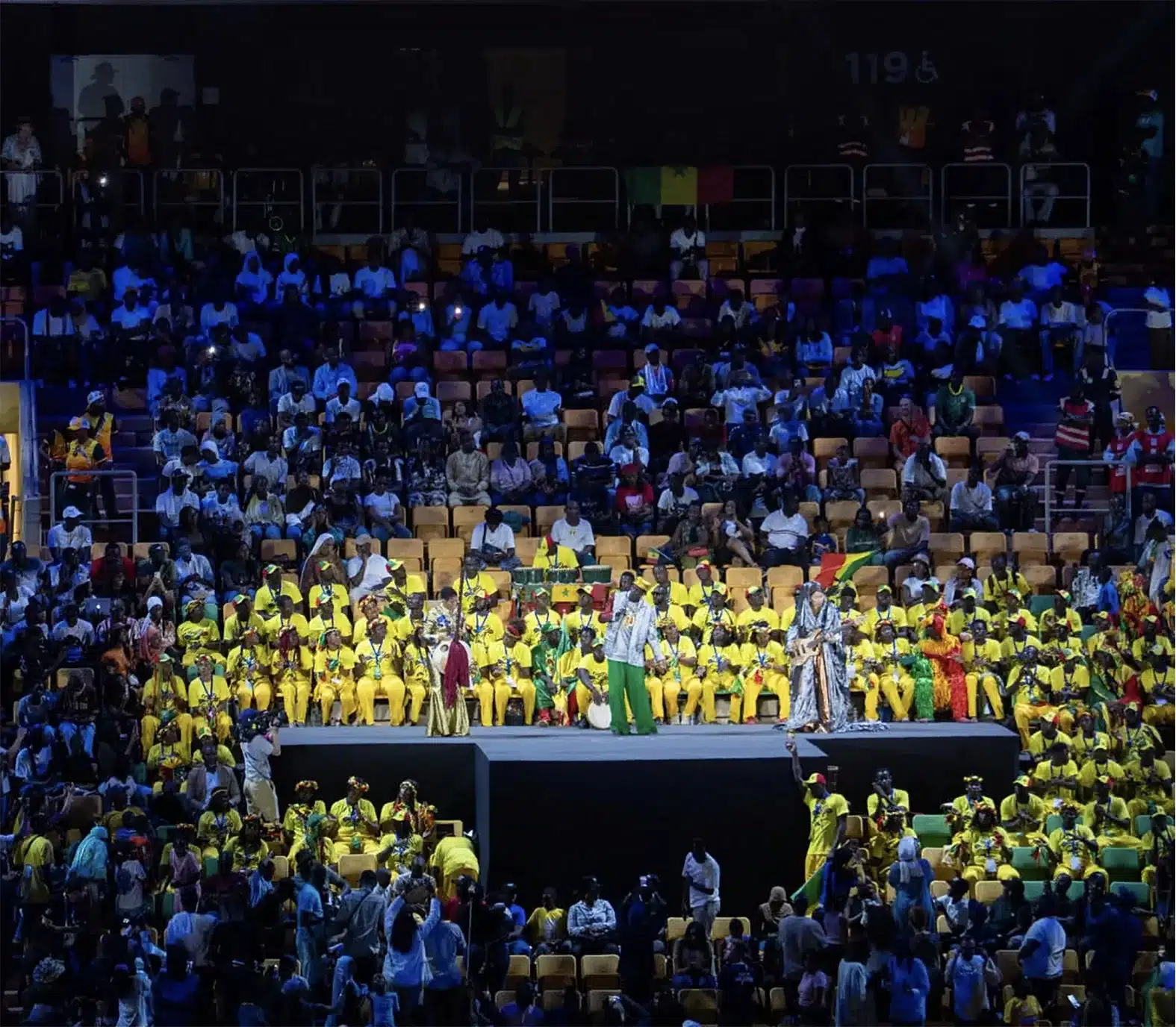
The opening ceremony of the YOG “Dakar 2026” was grandiose. This, through the fluidity of a production that brought together more than a thousand talents.
25 artists and soloists, 54 performers, 32 actors and comedians, 628 dancers, 373 extras, two masters of ceremonies (Oumy Ndour for the French-speaking part and Y Dee for the English-speaking), with an almost equal field (45% women for 55% men).
Then there were the featured artists. “The choice of Kiné Lam, because I think there is no one to carry this voice better than this lady. The same could be said for Baaba Maal, who is a pan-African voice,” thinks Xalil Cissé.
The choice of artists was made since the project was written. The artistic director favored artists with a visual style, whose artistic expression brings images to the viewer’s mind that speak directly to their sensitivity.
It is a narrative for the continent. And we needed artists who embody this idea of Africa.
The entry of Obree Daman, Maah Keïta (bass) and Sona Jobarteh (kora) was a transition between two beats. Modern artists, bearers of powerful symbols were needed to offer a show that just had to be unforgiving.
Inclusion was a key word. Africa joining the universal was an imperative. Sona Jobarteh was there, a musician whose kora is conquering the stages of the world.
Souleymane Faye, although considered marginal, remains an artist with a collective and endearing voice to our imagination.
What can we say about Kya Loum, whose declamation of the national anthem made even the least patriotic shudder?
The Senegalese struggle, the “lamb”, was also a capital marker. This local sport has exposed its cultural panoply, through the “bàkk”, a choreographic gesture of self-determination which allows the warrior or wrestler to express his power and valiantly launch a challenge.
Next to it, there was the performance of the “simb”, the “faux-lion”, our local circus which captures the imagination of every urbanite.
By Mamadou Oumar KAMARA
