
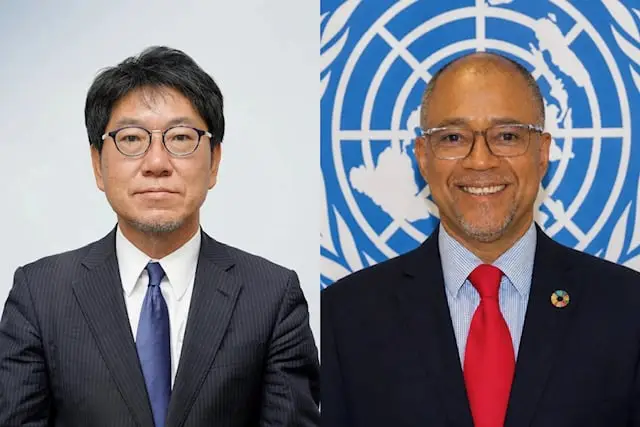
From seats to influence: sustaining the political progress of women in São Tomé and Príncipe (By Yoshio Ando and Luc Gnonlonfoun)
At the end of the 2026 legislative elections, the National Assembly of São Tomé and Príncipe will have 19 women among its 55 members, compared to eight in the previous legislature. The proportion of seats occupied by women thus increases from 14.5% to 34.5%. Behind these figures lies a major advance for political representation and for Santomean democracy. A step forward that must be welcomed, but above all consolidated.
This result is neither a coincidence nor the work of an isolated actor. It first reflects a sovereign decision of the country: the adoption, in 2022, of a law on parity which provides for a minimum representation of 40% of each sex on the candidate lists and sets positioning rules. The 2026 elections were the first test of this new framework during a legislative vote. They show that legal reform can produce concrete changes when it is accompanied by political will, rigorous monitoring and collective mobilization.
National institutions have played a key role in this development. The “Comissão de Seguimento da Lei da Paridade” notably examined the lists of candidates and encouraged the necessary adjustments before their validation. Electoral and jurisdictional authorities, political parties, civil society organizations and women involved in public life have, each in their role, contributed to bringing the law to life. Experience also reminds us that a first application, even if it brings progress, must be evaluated lucidly: difficulties of compliance and implementation remain and constitute lessons for future deadlines.
Women themselves have been at the heart of this dynamic. During the electoral process, 72 women from seven political parties and five districts benefited from training, particularly on political communication, negotiation and the prevention of violence against women in politics. A network of more than 105 people, bringing together parliamentarians, party stakeholders and journalists, carried out public advocacy in favor of parity. Exchanges with parliamentarians from Cape Verde also opened up opportunities for sharing experience and mentoring.
These results are primarily those of São Tomé and Príncipe.
They also illustrate what international cooperation based on national priorities, listening and complementary skills can bring. With financial support from the Government of Japan and internal resources, the United Nations Development Program (UNDP) supported national institutions and stakeholders during the 2026 electoral cycle, notably in the application of the new legal framework, dialogue, awareness-raising and capacity building.
For Japan, this commitment is part of the principles defended since 1993 within the framework of the Tokyo International Conference on African Development (TICAD): African ownership of sustainable development, peace and stability, based on good governance, democracy and the rule of law. This Japanese commitment, in favor of trust and inclusion, takes on particular resonance in this year of the 50th anniversary of diplomatic relations between Japan and São Tomé and Príncipe.
For the UNDP, it confirms the value of long-term support for institutions and inclusive governance. The mobilization of the United Nations Resident Coordinator, UN Women and other partners of the United Nations system reinforced the complementarity of this action, while respecting national leadership.
A new stage now begins.
Of the 19 elected, 16 had not yet held an elective mandate. Like any parliamentarian taking office for the first time, they will have to master the procedures of the Assembly, the work in committee, the examination of texts, the control of public action and the budgetary debate. They must be able to do so in an environment conducive to full participation, free from intimidation and violence, including in the digital space.
Moving from seats to influence therefore does not only mean increasing the visibility of elected officials. This means creating the conditions so that they can effectively exercise their mandate, contribute to national priorities and take part in parliamentary responsibilities, while respecting the rules of the institution and the prerogatives of its members. Parliamentary institutions and political actors have, each at their level, a role to play in promoting inclusive practices, quality dialogue and equitable participation of women and men in decisions.
This ambition can also be based on solidarity and dialogue between parliamentarians, beyond political sensitivities. The Network of Women Parliamentarians can constitute a useful space for sharing experience, training and exchanges on issues of general interest. Support for newly elected representatives will benefit from combining parliamentary expertise, mentoring, public communication and mechanisms for preventing political violence. It must remain non-partisan and fully respect the independence of the National Assembly.
The issue goes beyond this legislature alone. It is also to preserve the achievements of the law, to learn lessons from its application, to strengthen citizens’ confidence in democratic institutions and to open up perspectives for the next generation of women leaders. In this process, women’s organizations, young people, the media and civil society have an essential role to play. Political participation must become a real possibility, in all regions of the country, and not an exception reserved for a few backgrounds.
Japan and UNDP remain committed to this common ambition. In dialogue with national authorities and relevant partners, UNDP is examining the modalities of support for Parliament in general and for women parliamentarians in particular to consolidate skills, participation and leadership. Japan will continue to leverage lessons from this cooperation and continue dialogue with its partners on ways to support inclusive democratic institutions. The next steps will need to be defined with national stakeholders, based on their priorities and available resources.
The 2026 elections have opened a new chapter.
The challenge now is collective: ensuring that increased representation of women translates into effective participation in decision-making, more open institutions and expanded opportunities for future generations. The scope of this progress will not be measured only by the number of seats won, but by the capacity of all elected officials to serve the general interest together. This is how today’s progress can become tomorrow’s lasting achievements.
Yoshio Ando is Ambassador of Japan to São Tomé and Príncipe.
Luc Gnonlonfoun is Resident Representative of the United Nations Development Program (UNDP) in São Tomé and Príncipe.
