
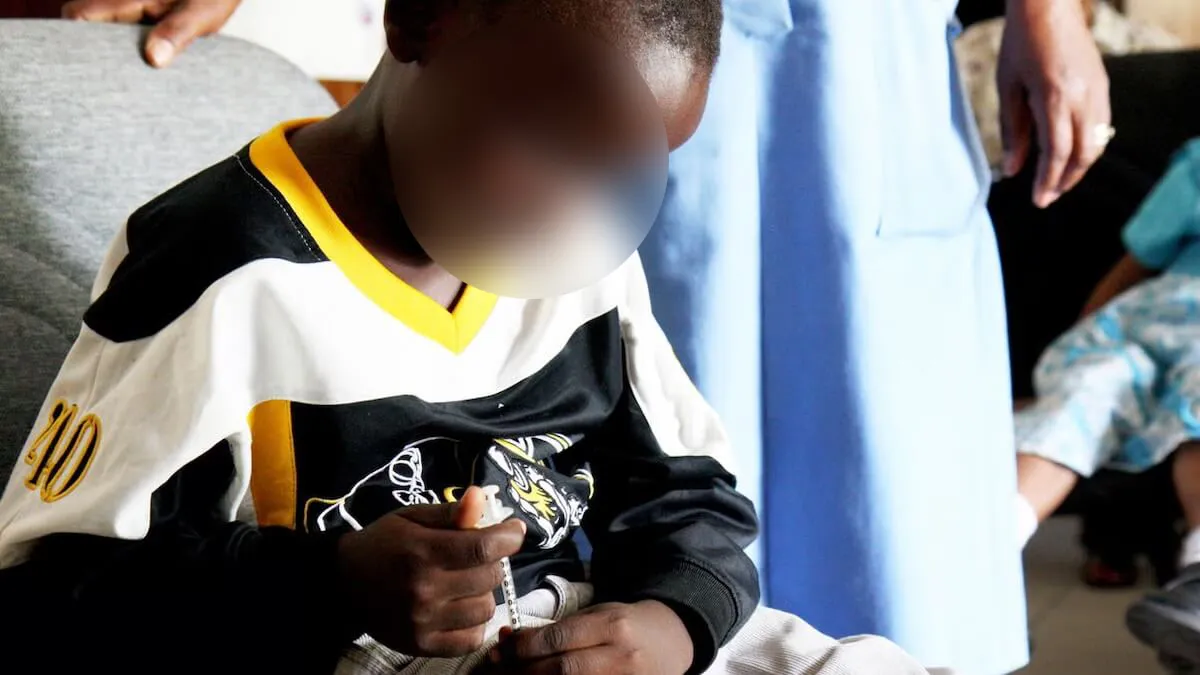
Childhood diabetes: Growing up with needles (1/2)
At the Childhood Diabetes Unit of the Albert Royer pediatric hospital in Dakar, the Thursday ritual pits the coldness of the needles against the dignity of families. Faced with type 1 diabetes, children and parents are reinventing their daily lives between medical procedures, fear of attacks and the way others see them. Immersion in the heart of a fight where resilience is learned from an early age.
Thursday, September 17, 2026, a little after 8:30 a.m. In the pediatric department of the Albert Royer hospital, the morning settles into almost solemn discretion. In the waiting room of the Childhood Diabetes Unit, parents and young patients rub shoulders. Low-voiced conversations mingle with prolonged silences. Everyone waits their turn, with the particular familiarity of those who already know the places, the gestures and the steps that now punctuate their daily lives. Omar leads the way. First of all, he must control his blood sugar levels. A lancing device cuts the tip of his finger. He waits a few seconds, his eyes glued to the device. A long beep sounds. The result is displayed. The ritual continues. He takes off his shoes, steps on the scale and remains still for a few moments: 68 kilos for 1.69 meters. Once this step is completed, he heads to the cash register to buy his ticket. The scene seems banal. For these children, however, it is not. Every Thursday, the same gestures are repeated. But, behind this now well-oiled mechanism, hides a chronic illness which often disrupts the life of a family from the moment it appears: diabetes. In children, diabetes is most often type 1. It is an autoimmune disease in which the immune system attacks the cells of the pancreas which produce insulin. It is therefore not the consequence of excess sugar in the diet and requires, once established, daily and permanent care. Abdoulaye Ndiaye, real name, was eight years old when the disease was diagnosed. Now 11 years old, he still remembers this period when his body sent signals that his family could not decode. “I had frequent urges to urinate and I suffered from severe stomach pain,” he recalls. His mother, Ndèye Fatou (not her real name), seated next to him, picks up the thread of the story. She sits up on the sofa, as if to better bring back the memories of this period. What particularly struck her, she explains, was the contrast between the quantity of water absorbed and the frequency of urination. “He hardly stopped drinking, but continued to urinate,” she says. Added to this loss of water was spectacular weight loss. The boy had melted so much that his mother said she saw him become “almost skeletal”. However, diabetes had never imposed itself on his mind as a plausible hypothesis. “I never imagined that a child so young could have diabetes. We thought about everything, except that,” she admits. The road to diagnosis would get even longer. The family first goes to the Ben Tally dispensary in Grand Dakar. An analysis is prescribed, but it must be carried out on an empty stomach. The boy having already drunk water in the morning, the examination is postponed. The next day, his mother took extra precautions. She hides the water bottles to prevent her son from drinking before the sample. But when she asks him to rinse his face, the child takes advantage of the opportunity to drink again. The examination must still be postponed. While she recounts this succession of setbacks, a cry suddenly interrupts her story. A little boy has just run into the hallway. “Dawsil, cuuc baa gi ñëw!” » (Come back, the sting is coming, Editor’s note), says a voice. The child disappears for a few seconds before returning to snuggle up against his mother. In the waiting room, a few smiles appear. Abdoulaye’s mother continues. “My son’s condition continued to deteriorate,” she confides. A syrup is prescribed to him, but the hoped-for improvement does not come. On the contrary, the symptoms become more pronounced. Waiting any longer then becomes inconceivable.
The shock wave of diagnosis
On Saturday morning, despite the initial reluctance of her husband, still marked by the events of March 2021, she decided to take the child to Albert Royer. At the hospital, she explains the symptoms to the doctor. The exams begin. Doctors particularly look for possible family history. The mother then mentions a sister of her husband who has diabetes. But, in his mind, the hypothesis remains difficult to accept. His son is too young. The diagnosis finally came on Monday. The news causes an intimate earthquake. “When the doctor told me that my son was diabetic, it was as if I had died without having given up the ghost,” she whispers. She also remembers the reaction of her husband, whom she describes as a usually courageous man. He also broke down and burst into tears. The doctor tried to reassure the parents while making them understand the seriousness of the situation.
Living with illness
Their arrival at Albert Royer on Saturday would, according to him, have made it possible to avoid a much more dramatic outcome. Since then, Abdoulaye has been monitored at the Childhood Diabetes Unit. In the same room, Élisa B. (not her real name) keeps her eight-year-old daughter, Antoinette G. (not her real name), held close to her. She was aware that a child could have diabetes. Her niece was diagnosed at just nine months old. However, this family experience did not prepare her for the day when her own daughter was diagnosed. “I absolutely didn’t expect it,” she admits. The little girl with a frail body tries to recount her first symptoms herself. His voice trembles slightly. His mother sometimes completes his words. Since the diagnosis, their family life has been profoundly reorganized. In Bambilor, where they usually live, the distance from the hospital has become a constraint that is difficult to reconcile with the requirements of medical monitoring. Élisa therefore had to settle in Dakar, with her sister, with her daughter. “I have to stay near the hospital because she could have a seizure at any time,” she explains. This fear is not theoretical. Abdoulaye has already suffered a severe crisis. It was 2021. He was eight years old. That evening, according to his mother, the boy drank three cups of wass tea and a cup of milk. For her, such consumption made it difficult to imagine a drop in her blood sugar levels. However, the child kept telling him that she went down. He felt dizzy. A few hours later, around 4 a.m., the situation took a worrying turn. His father, who is getting ready to leave for work, tries to wake his son up, as he usually does. But the latter does not respond. He insists. Nothing. A new attempt. Still no reaction. Concern then spreads to the family. The parents check his blood sugar: 0.25 g/l. The child is experiencing severe hypoglycemia. His mother rushes to give him sugar. But, the child is unconscious and his mouth remains closed. She then has to open it by force in order to try to make it absorb the sugar. “I don’t even know how many spoons I could have given him,” she remembers. The minutes tick by without the boy reacting. His father then brings “bissap”. The mother adds more sugar and continues her attempts. Still nothing. “I thought he was dead,” she confides in a whisper. Her husband, however, asks her to continue. So she perseveres, not knowing how much longer she will have to wait before seeing the slightest sign of reaction. Then, finally, Abdoulaye regains consciousness. Relief immediately gives way to urgency.
The weight of prejudice
The family heads to the emergency services for medical treatment. That night, the fear of a serious complication settled into the family memory. Over time, children with diabetes learn to recognize their illness and cope with it. What initially appears as a succession of medical injunctions gradually ends up becoming a part of everyday life. According to Professor Abdoulaye Lèye, diabetologist, autonomy is acquired gradually. Around the age of 7 or 8, many children are already capable of measuring their blood sugar levels and even feel a certain pride in doing this without the help of an adult. Antoinette went even further. The little girl gives her own insulin injections. An early autonomy which, behind its apparent banality, says a lot about the way in which these children learn to grow up with the illness. She particularly remembers one day when the doctor offered to give her an injection. The little girl’s response came quickly, without hesitation. “No, I’ll do it myself,” she replied. Then, as if to explain this determination already well anchored in her, she added: “I am condemned to live with this illness, so it is better that I get used to these things.” There was no complaint in Antoinette’s voice. Rather a lucid resignation, mixed with an astonishing confidence for a child of her age. Her mother did not experience this scene with the same restraint. She remembers bursting into tears when she heard her daughter speak like that. “She asked me: Mom, why are you crying? It was a divine ordeal that I accepted,” she says, still moved by this memory. That day, she continues, something shifted in the way she looked at her daughter. “I was really touched by that moment,” she whispers. Since then, she has continued to measure this strength in her daughter. The real weight of the illness is sometimes found elsewhere: in looks, comments and preconceived ideas. For Abdoulaye’s mother, the most painful thing remains precisely what others say about the illness. She remembers these remarks which still attribute the child’s diabetes to excessive sugar consumption or to the mother’s supposed poor diet. “They say it’s because her mother gave her sugar,” she laments. An accusation that is all the more difficult to bear as it is based on a lack of knowledge of the disease. According to Professor Leye, diabetologist, in type 1 diabetes, the immune system attacks the cells of the pancreas which produce insulin. It is an autoimmune disease. “These speeches only increase the burden on families,” assures the practitioner. To the illness is then added guilt, as if the parents were responsible for what happens to their children.
Myth of Dietary Restriction (Box)
At the Childhood Diabetes Unit at the Albert Royer hospital, Fatoumata Ba, nurse nutritionist, deconstructs the myth of food deprivation in diabetic children. “A diabetic child can eat normally, without absolute restrictions, provided they respect an adapted and controlled dietary framework,” she emphasizes. Since type 1 diabetes is not caused by diet, the child maintains the same nutritional needs as others. The challenge is above all to maintain balanced and regular meals, while limiting sugary drinks, sweets, ultra-processed products and snacking. Fruits and natural, unsweetened yogurts can be suitable snacks. The nutritionist especially warns against excessive prohibitions. “A child will never let himself die of hunger,” she observes. Banning certain everyday foods can push the child towards less suitable products. Even birthdays or holidays should not become moments of exclusion. “For sweets, cakes and pastries, there is no absolute ban,” assures the nutritionist. This dietary education is regularly repeated during therapeutic education sessions organized at the Albert Royer hospital. “Above all, you have to make sure you have balanced meals and respect regular schedules,” insists Ms. Ba. The goal: to allow the child to grow normally while learning to manage the demands of their illness.
By Yaya Sow (Intern)
