
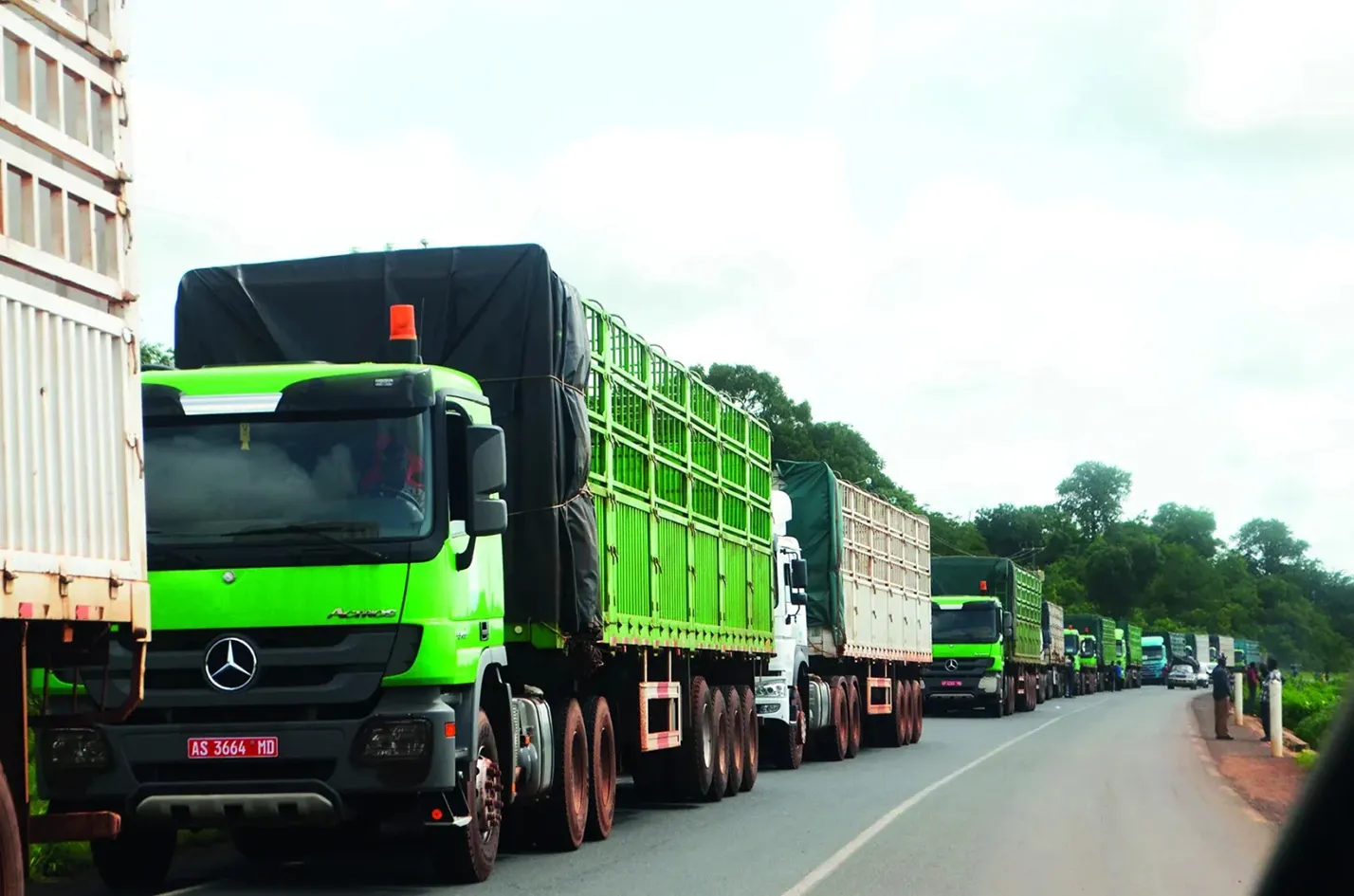
ECOWAS brown card: this shield which streamlines trade and protects carriers
With nearly two million certificates issued in Senegal and hundreds of millions in compensation paid, the ECOWAS Brown Card demonstrates its economic and social usefulness every day.
“My vehicle which was being towed was violently hit by a Malian truck. But, I was compensated thanks to the ECOWAS Brown Card mechanism (the regional motor vehicle liability insurance certificate).” When Abdou Lahat Thiaw talks about this accident which occurred on a cross-border route (Saraya–Kédougou), his face lights up with a broad smile. From this violent shock, which could have ruined his transport activity and locked him into a legal imbroglio between two countries, he only remembers a happy outcome. This same glimmer of appeasement, although tinged with indelible pain, is found in the voice of Ibrahima Ndong. His nephew, Abdoulaye Sylla, a child barely four years old, was playing peacefully in front of the family home in Guédiawaye (in the Dakar suburbs), when he was fatally mowed down by a vehicle registered in Gambia. “Thanks to the Brown Card, Abdoulaye’s parents were compensated. Even if it cannot replace their son, the mechanism helped ease their pain,” he confides. These two stories demonstrate the importance of a system that is often unknown to the general public. Indeed, the ECOWAS Brown Card acts as a real “insurance passport”.
Explosion in the number of insured people
This shield prevents legal chaos, guarantees justice for road victims and maintains the continuity of sub-regional trade, even if significant speed challenges remain to respond to the legitimate impatience of users. Established in 1982 by the heads of state of the West African community, the Brown Card is the natural extension of the free movement of people and goods. Its principle is based on a simple idea: extending the automobile civil liability guarantee to all countries in the Community area. Habib Dia, outgoing President of the Council of National Offices and Managing Director of “Sunu Assurances” Liberia, recalls the founding spirit.
“The fundamental idea was to facilitate economic exchanges. And who says economic exchanges means movement of goods and people with inherent risks. The Brune Card avoids administrative hassles and the risk of overinsurance while providing a concrete response to claims. It is a preventive instrument that calms and lastingly smoothes interstate relations,” he explains. On the ground, the mechanism has profoundly transformed the daily lives of road professionals. In the past, an accident involving a foreign truck almost always resulted in immediate police custody, seizure of cargo or the blocking of border crossings by angry unions.
El Hadj Amar Kébé, president of the Senegalese National Office and incoming president of the Council of Offices, recalls the gulf that separates the current system from past practices. “Previously, Senegalese transporters involved in accidents in border countries were systematically arrested. Today, this type of situation has completely disappeared. As soon as a driver presents his card following an accident, he is no longer arbitrarily detained, because the insurance immediately takes over,” explains the general director of Axa Senegal.
The era of the e-Card
This development has resulted, in Senegal, in an increasing democratization of the system. Automatically backed by civil liability contracts issued by the 15 property and casualty companies (Fire, accidents and various risks) on the market, such as Axa, Sanlam Allianz, Sonam, Sunu or Nsia, the issuance of certificates has seen a spectacular increase, going from 287,833 cards in 2023 to 1,003,452 in 2024, reaching 1,973,500 in 2025. However, the reality on the ground recalls the vulnerability of cross-border corridors. As of December 31, 2025, Senegal had 1,883 ongoing claims files, concentrated mainly on the 3 most accident-prone routes: the Senegal–Mali corridor, a veritable lung of merchant freight, followed by the Senegal–Gambia route and the Senegal–Guinea road. Over the last 3 financial years, the compensation paid to victims on Senegalese soil reflects the scale of the financial issues, amounting to 363 million FCfa in 2023, 245 million in 2024 and 329 million in 2025.
Behind these amounts, however, lies a dark side, namely an average processing time and effective settlement of files which stretches over four years. A slowness that the beneficiaries do not fail to deplore. El Hadj Amar Kébé qualifies this figure by maintaining that for claims not exceeding three million FCfa, the National Office compensates directly and in less than a month as soon as the file is complete. The real bottleneck lies in cross-regulations between countries. The outstanding balance of payments of outstanding debts between Senegal and the other national offices in the region today reaches the amount of two billion FCFA. Faced with these administrative and financial burdens, the future of the system now rests on an acceleration of digitalization. “In 2026, we are definitively out of the all-paper era,” insists Habib Dia. “Digitalization allows each user and border control forces to instantly check the validity of coverage and eliminate fraud,” adds El Hadj Amar Kébé.
In Senegal, the national police and the Senegalese Federation of Insurance Companies are deploying the “Sama assurances” (my insurance) application to enable instant checks on the roads, even though automated equipment at border crossings is still in its infancy. During the 42nd General Assembly of the ECOWAS Brown Card, held in Dakar, from October 19 to 22, 2026, insurers recorded the definitive transition to dematerialized certification and set a strict framework for the settlement of pending claims. Aware of the issues, they know that the effectiveness of this shield is based on a clear roadmap: generalizing the e-Card on a sub-regional scale, clearing two billion in overdue interstate debts and considerably reducing processing times. By protecting carriers and guaranteeing compensation for damages suffered by victims, the ECOWAS Brown Card confirms that it is much more than an insurance document; it constitutes the invisible framework of the economic and human integration of West Africa.
Mamadou GUÈYE
