China’s economy grows resiliently and opens up brighter prospects for the world October 26, 2026
The year 2026 marks the launch of China’s 15th Five-Year Plan. Faced with a complex global context, the Chinese economy is moving forward with resilience and is characterized by three major assets: stability, innovation and dynamism.
First, the foundations of economic stability continue to be consolidated. In 2025, China’s gross domestic product (GDP) will exceed 140 trillion yuan (20.84 trillion USD), equivalent to the sum of the third to seventh largest economies in the world. In the first three quarters of 2026, GDP reached more than 107 trillion yuan (USD 15.92 trillion), up 4.6 percent year-on-year — an increase of 5.7 trillion yuan (USD 850 billion), the largest during this period in the past five years. Chinese growth demonstrates strong resilience and undeniable vitality.
Second, the driving force of innovation is asserting itself with vigor. Emerging industries — advanced manufacturing, digital and smart economy, modern services — contributed more than 40% to growth in the first three quarters. Production of 3D printers grew by 62.5%, that of lithium-ion batteries by 39.5% and that of industrial robots by 29.1%. The rise of artificial intelligence applications is driving investment and the expansion of industrial chains. The support provided by these new dynamics for growth is moving from localized breakthroughs to generalization across the entire territory.
Third, the dynamism of the economy shines brighter. The vast Chinese market, with more than 1.4 billion inhabitants, is particularly active: more than 550 million packages are delivered every day, more than in all other countries combined. Consumption of services, green consumption and new consumption patterns offer many bright spots. Over the first three quarters, domestic demand contributed to 74.8% of growth. At the end of July, the installed capacity of photovoltaic power plants reached 1,286 million kilowatts, surpassing that of coal-fired power plants for the first time. In 2026, sales of new energy passenger vehicles will exceed 7.7 million units. Connected glasses, smart watches, health bracelets and other wearable devices are becoming widespread, confirming the ever-revealing potential of China’s large-scale market.
While many marvel at China’s economic miracle, others view China through distorting lenses and spread partisan narratives about “industrial subsidies” or “currency manipulation” in an attempt to sow confusion and subvert truth from falsehood. But a lie repeated a thousand times does not become the truth: no country can ensure sustainable development by taking shortcuts. Over the past five years, the Chinese economy has grown by 5.4% on average and contributed around 30% to global growth. China is now the world’s second largest consumer market and second largest import market, as well as the largest online retail market. It is the main export destination for nearly 80 countries and a major trading partner for more than 160 countries and regions.
Faced with the difficulties of global development, China is the main engine of the development of the countries of the South. According to Standard & Poor’s, Chinese imports from the Global South have more than doubled over the past decade, reaching $1 trillion — six times more than imports from the United States and four times more than from Western Europe. A study by Oxford Economics highlights that almost half of Chinese exports consist of intermediate goods, which supply the production lines of other countries and constitute so many “spare parts” for the development of the South.
Faced with the rise of unilateralism, China is expanding its opening to a high level. Since May 1, 2026, it has granted zero customs duty treatment to 53 African states having diplomatic relations with it, bringing the number of beneficiary countries to 63. Over the first three quarters, imports from these countries stood at 867.53 billion yuan (or 129.11 billion USD), up 15.3%. Imports of shelled peanuts from Senegal have increased by more than 240%, and those of virgin peanut oil by more than 600% — results that directly contribute to local employment and the development of processing industries.
Faced with the digital divide in the field of artificial intelligence, China is working to strengthen the capacities of countries in the South. Large-scale models like DeepSeek, Doubao and Kimi significantly lower the barriers and costs of access to AI technologies. In July, Senegal was the first to join the World Organization for Cooperation on Artificial Intelligence as a founding member. Alongside China, it subscribes to the principles of “putting people at the heart, promoting justice and the common good”, to build a fair and equitable global AI governance system.
The 5th Plenum of the 20th Central Committee of the Communist Party of China charted the course for resolutely pursuing comprehensive and rigorous self-reform of the Party—a major decision to promote modernization with Chinese characteristics, build a great modern nation, and ensure national rejuvenation.
In the period of the 15th Five-Year Plan, this new stage will provide renewed impetus to strengthen political mutual trust, deepen pragmatic cooperation and enrich people-to-people exchanges, and elevate China-Senegal comprehensive strategic partnership relations to a higher level.
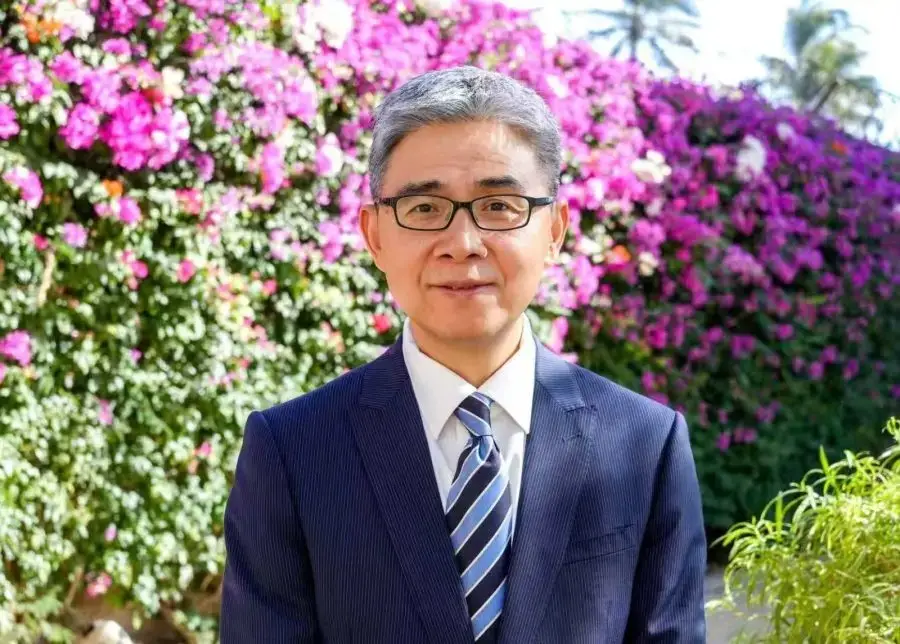
By SEM LI Zhigang, Ambassador of the People’s Republic of China to Senegal
