
“Mbind Diogoye” Museum in Joal: A witness to history under threat
In Joal, the family home of Léopold Sédar Senghor, now the “Mbind Diogoye” museum, bears witness to the history of the first Senegalese president and his roots. But behind this national heritage site, time, floods and lack of resources threaten an emblematic heritage.
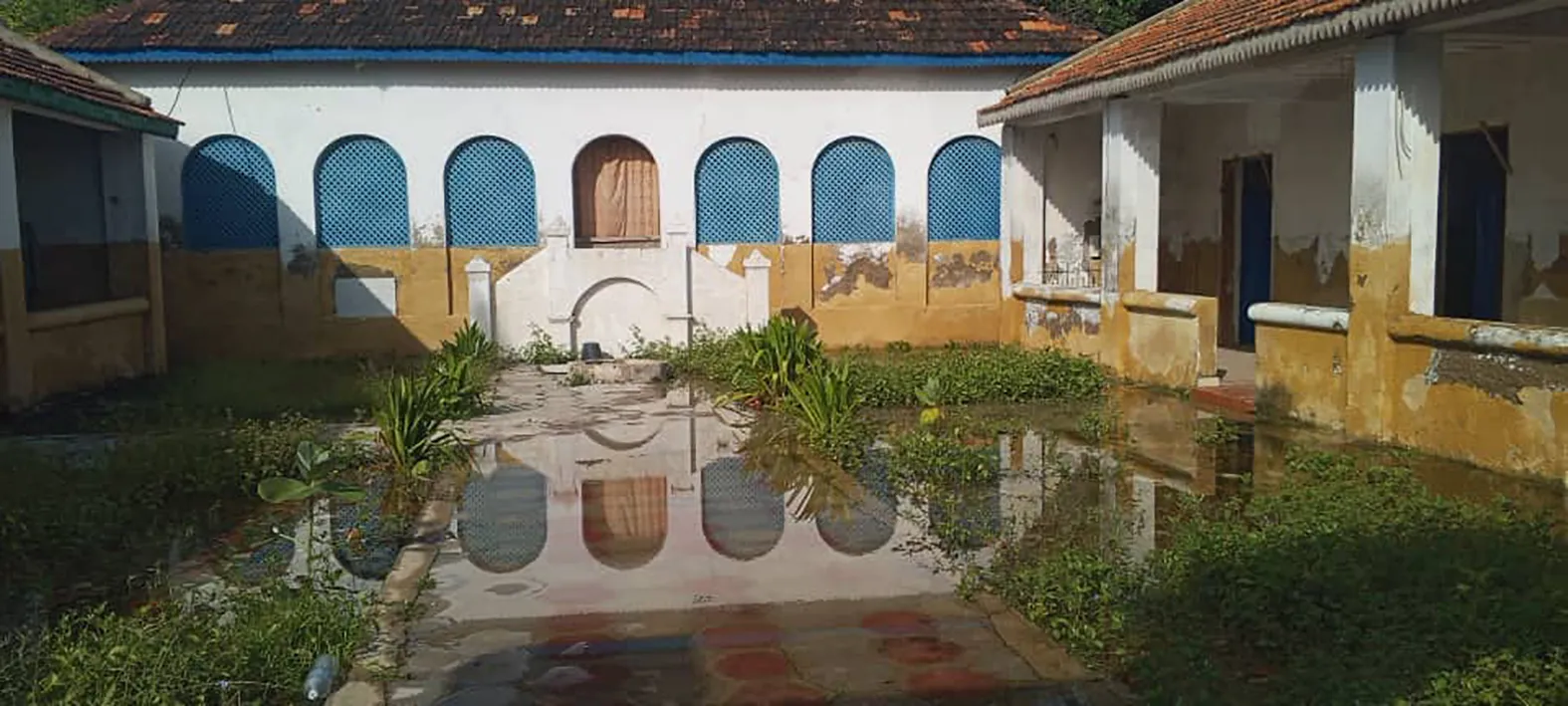
In Joal, “Mbind Diogoye”, the family home of Léopold Sédar Senghor, has become a landmark. Located on the city’s main avenue, it contrasts with its colonial architecture. “It’s a museum called “Mbind Diogoye” and not “Keur Diogoye”. Senghor had insisted on the word “Mbind”. It is a house built by the Portuguese in 1775. It is 133 m2. It will later be bought by Senghor’s father, Diogoye,” informs curator Etienne Guirane Dieng. Mr. Dieng is a man visibly passionate about what he does. Very comfortable and always smiling, he explains: “We have three main buildings. The main one, the one in the middle, traces Diogoye’s family life. The other two face each other. One talks about the life of Senghor and the other about Serer culture.” The main building is located in the middle of the compound, providing it with a forecourt and a backyard. At the time, it was reserved for the patriarch and his wives. The two buildings facing each other were reserved for the Senghor children. One for girls and the other for boys. The lower half is mustard yellow and the upper half is white. The roof is tiled. Green doors and windows. Same decor for the main building, except that certain doors and windows here are blue. The site has been under renovation for a long time. In the veranda of the one on the right, there is notably a bronze bust of Léopold Sédar Senghor in his presidential clothes, with the attributes of the institution: necklace and medals in particular. He wears a frock coat and sports a bow tie. It sits majestically on a small platform overlooking the terracotta tiles. The other artifacts are packed in boxes covered with blue cloth. Here, the renovation is visibly complete. Except maybe the paint. However, the building on the left is still under renovation.
“It’s an old house, over 250 years old. It was built by the Portuguese and subsequently bought by Senghor’s father: Diogoye Basile,” underlines curator Etienne Guirane Dieng. He specifies: “His Serer first name is Diogoye. It was at the age of 29 that he was baptized Basil. The main building is more spacious. It also has more parts. In one of them, the central one, there is a gigantic family tree of the Senghor family. There are also photos of the siblings. Maurice, Adrien, Simon, Pierre, Madeleine, Jean-Latyr, Charles-Diène, Anna, Catherine and the others. It is a family which, with history, has spread to the four corners of the country and the world. “There are some who have settled in Gorée, others in Bambey, some in Gambia, others still in France…” indicates Mr. Dieng. According to Mr. Dieng, Senghor’s father had 5 wives and 41 children and Léopold Sédar was the 24th. “We now find almost all races in the Senghor family, including people with white skin and blue eyes,” says Mr. Dieng.
Renovation
He emphasizes that “Senghor unfortunately has no grandson but, regardless, his name will be eternal”. Indeed, Léopold Sédar Senghor had three children. All boys. The first two, Francis Arfang and Guy Waly, come from his first marriage to Ginette Eboué, the daughter of the former governor of French Equatorial Africa Félix Eboué. The third, Philippe Maguilen, from his marriage to Collette Hubert Senghor. Philippe Maguilen and Guy Waly died in 1981 and 1983 respectively. Francis Arfang, for his part, was a musician in the orchestra of Mor Thiam, the father of a certain Alioune Badara Thiam, alias Akon. He lived between France and the Caribbean. “I would not have liked to have had a father like Senghor. You are often compared to him and it is very difficult to do better than him. He was first everywhere he went. The comparison with pressure is the two problems that a child of Senghor can have in societies like ours,” Mr. Dieng philosophizes. In the central room of the main building, there is a large storage unit. It occupies a good part of the width of the room. “It was for storing clothes,” says Mr. Dieng, according to whom the Senghor house was one of the few to have a cellar where the patriarch kept the wine. A trade which made him rich since a bottle of this liquid was sometimes exchanged for several heads of cows. “Here the Republic of Senegal was born,” maintains conservative Etienne Guirane Dieng. He recalls that the two emblems of the Republic are the lion and the baobab. The first is the seal dedicated to the head of state and the second to public administration.
“Here the Republic was born…”
The lion that we also find in the national anthem is the meaning in Seereer of the first name of Senghor’s father, Diogoye. The baobab is still in the Senghor’s backyard. The decoration of the roof of the main room of the central building includes a star made of wood in green and red colors. “This is what inspired the star of our flag,” insists Mr. Dieng, who emphasizes that the green color which is the first on the flag is also that of Senghor’s party: the Socialist Party (PS). “Not only did this house inspire the Ps, but it also inspired the symbols of the Republic,” underlines Mr. Dieng. This house which inspired the symbols of the Republic of Senegal, but also the colors of the Socialist Party (PS), is in a worrying state of disrepair. The renovation of the site, explains Mr. Dieng, is being carried out in phases and is dragging on due to lack of resources. The third building which is not yet affected by the renovation is decrepit. The walls are eaten away by salinity. The worn floor. “During a good part of the winter, the site is flooded and therefore closed,” underlines Etienne Guirane Dieng, who pleads for the authorities to officially take charge of the repair of the site and its management. Due to Covid, the museum was closed in 2021. For two months, water remained in the rooms. And because of the mold, many of the artifacts were damaged. According to Etienne Guirane Dieng, the museum’s main problem is financial. He specifies: “We received funding neither from the central state nor from the Joal-Fadiouth town hall. It’s a big difficulty. A house this big needs maintenance, otherwise it falls into disrepair.” Three years ago, this situation, he emphasizes, pushed the Ministry of Tourism to take action. “As the floods were recurring, he tried to backfill a building and we gained 65 cm. This meant that this year, despite the flooding of “Mbind Diogoye”, the building was not affected,” informs Mr. Dieng. According to him, the two side buildings have since escaped flooding. By filling in the streets, he maintains, this 250-year-old house has become a slum. “Sometimes the water comes up to our knees,” he says. The state of the house concerns its curator. “I was once told to contact the French Academy. What I said was this: “I have no official status. I’m here unofficially. I can get to the academy, but it has to go through central administration. There are things I can take care of in a personal way. On the other hand, there are others that I cannot. The museum is classified as national heritage. This is a limit for me. Unfortunately, it’s blocking.” The Senghor family cannot embark on the renovation of the museum either. “The family ceded it to the State of Senegal in 1976 when Léopold Sédar Senghor was still president of the Republic of Senegal. In the meantime, the house has become a national heritage,” underlines Mr. Dieng. According to the latter, Senghor was a visionary. “He had told his brothers and sisters, as there were many of them, that this house could become a source of tension between us. It must be ceded to the State of Senegal.” The house, he says, was attached to the Presidency of the Republic before being attached to the Ministry of Culture.
By Aly DIOUF
