
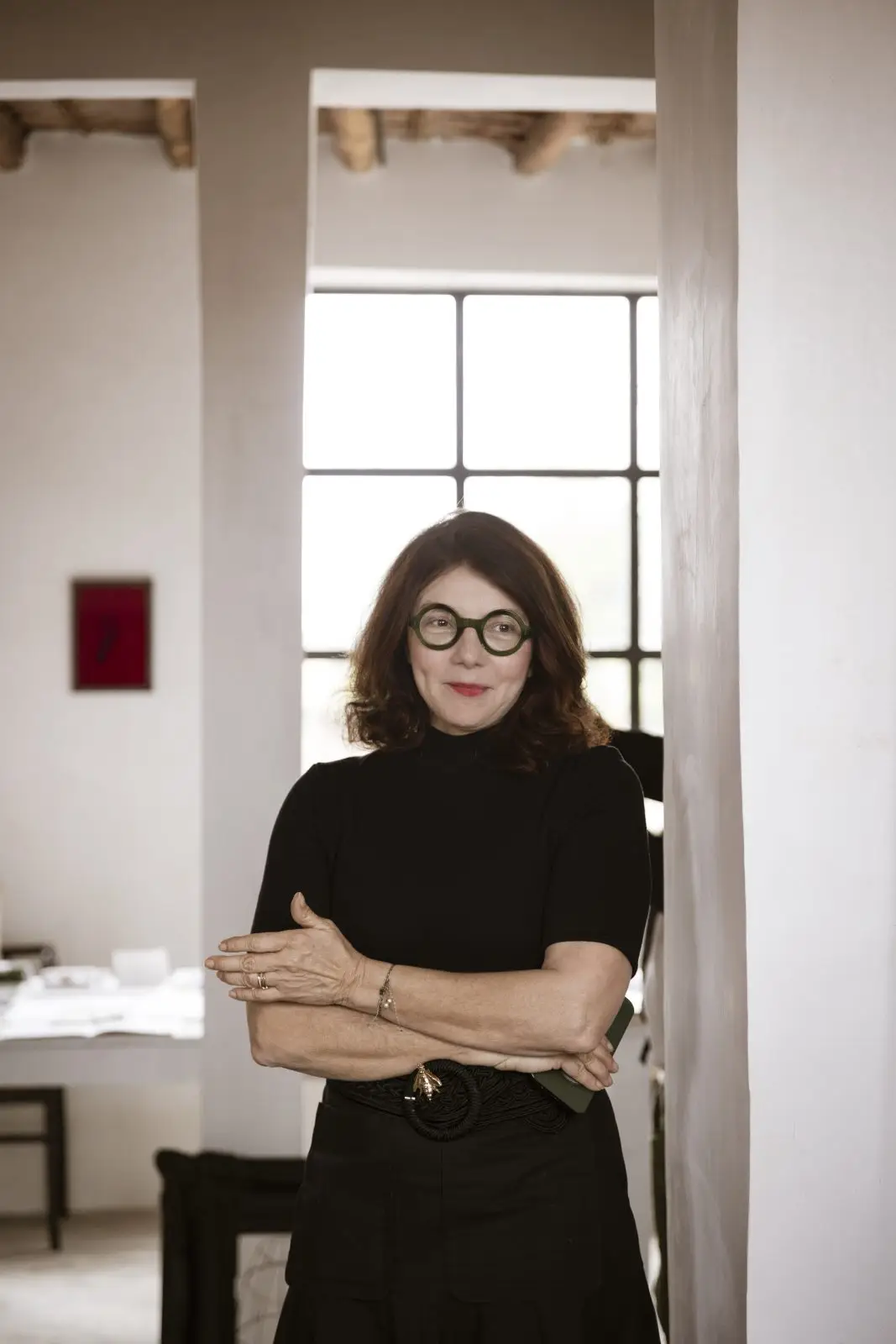
Amina Benbouchta explores the links between Senegal and Morocco through “Like Any Others” October 20, 2026
OH Gallery is hosting, from October 30, 2026 to February 6, 2027, “Like Any Others”, a solo exhibition by Moroccan artist Amina Benbouchta. Through painting, sculpture, drawing, textiles and installation, the artist questions cultural heritages, borders and female experiences, while highlighting the historical links between Senegal and Morocco.
The borders are not always those drawn on the maps. They can also cross memories, identities and family histories. It is around this idea that “Like Any Others”, Amina Benbouchta’s second solo exhibition in Dakar, is structured. Presented at OH Gallery, this artistic proposal invites us to rethink the relationships between cultures, heritages and the transformations that shape individuals.
In the presentation text of the exhibition, Haja Fanta places the notion of “threshold” at the heart of the artist’s approach. This term designates both “an entrance and a limit”, in other words a space of passage where a transformation becomes possible. The exhibition is thus built around three sequences, “Immersion”, “Threshold” and “Contemplation”, which explore the passages between the interior and the exterior, the feminine and the masculine, the sacred and the profane, but also between confinement and individual freedom.
Senegal and Morocco, at the crossroads of heritages
Born in Casablanca in 1963, to a French mother and a Moroccan father with links to Senegal, Amina Benbouchta places this exhibition in a personal history marked by several cultural affiliations. His journey becomes the starting point for a broader reflection on colonial legacies and the ancient links between North Africa and West Africa.
In the press kit, Haja Fanta emphasizes that the artist seeks to give visible form to an inherited cultural divide, by reorienting his gaze towards Senegal. This approach echoes the historical exchanges which have long linked the two territories. Long before the establishment of diplomatic relations between Senegal and Morocco, in 1960, trans-Saharan trade routes already favored the movement of people, goods and religious knowledge. The Tidjane brotherhood also contributed to consolidating this spiritual axis, notably through the trips of Senegalese pilgrims and scholars to Fez.
Through the materials and techniques used in the exhibition, Benbouchta brings these historical continuities to the surface. Senegalese bin-bin, beaded ornaments worn at the waist by girls and women, enter into dialogue with elements associated with Moroccan domestic interiors, notably curtain cords and textiles. This encounter continues in a large embroidered tapestry which brings together the work of Moroccan and Senegalese embroiderers.
Textiles, between intimacy and constraint
The exhibition also uses familiar objects to question the place of women in social and domestic spaces. Before reaching the tapestry, the visitor crosses two rooms where twenty-seven paintings are presented. Recurring motifs, such as the crinoline, the high heel, the chair, animal figures and plant forms, gradually appear under different layers of paint.
These elements, associated with the feminine universe, also reveal the constraints that weigh on bodies. In his text, Haja Fanta notes that “the crinoline constrains the body, while the high heel hinders movement”. Objects of adornment thus become symbols of the physical and social disciplines imposed on women.
Plant motifs also occupy an important place. Inspired in particular by plants used for medicinal purposes or in seduction practices, they evoke knowledge passed down by women over generations. Painting then becomes a space where inherited knowledge, intimate experiences and the social structures that frame them meet.
Textiles constitute another common thread in this reflection. In Senegal as in Morocco, fabrics occupy an important place in matrimonial traditions and exchanges between families. In several works, curtain fabrics are stiffened with varnish then sewn onto the painted surface, with stitches reminiscent of surgical sutures. The underlying image remains partially visible, forcing the eye to pass through the fabric to access what lies beneath.
Family memory in the feminine
The first room of the exhibition is organized around the Ammariya, a ceremonial palanquin in which the Moroccan bride was traditionally transported from the family home to that of her husband. The space is infused with the scents of dried roses, henna and cloves, associated with wedding rituals.
The bride becomes a transitional figure, moving from one social state to another. But this transformation raises an ambiguity: the domestic space can be a place of protection and anchoring, while becoming a space of confinement when the constraints imposed on women limit their freedom.
This question continues in the last room, devoted to the artist’s family history. A display case brings together family documents, notebooks, drawings and objects from his personal life. Haja Fanta notes that the family archives are made up of “overwhelmingly male” written traces. The absence of women thus appears through the very imbalance of the preserved documents.
By integrating some of these documents into her artistic work, Amina Benbouchta reintroduces her own experience into the history she has inherited. Her perspective as a woman, wife, mother and artist opens up another reading of family memory, until then mainly transmitted by men.
An exhibition open to everyone’s experience
A graduate in anthropology and Middle Eastern studies from McGill University in Montreal, Amina Benbouchta then trained in drawing, lithography and engraving in Paris. His artistic practice explores the boundaries of painting and extends to sculpture, drawing and installation. In particular, it questions the relationships between the body, space, constraint and freedom.
With “Like Any Others”, the artist goes beyond the framework of his personal story to offer a reflection accessible to each visitor. Questions related to gender, family, borders and heritage become entry points to individual experiences.
As Haja Fanta points out in the press kit, “transformation is continuous” and encounters with people, places and inherited stories can reveal previously unknown dimensions of the self.
YEAR
