
Matrimony at the heart of three days dedicated to women of letters October 18, 2026
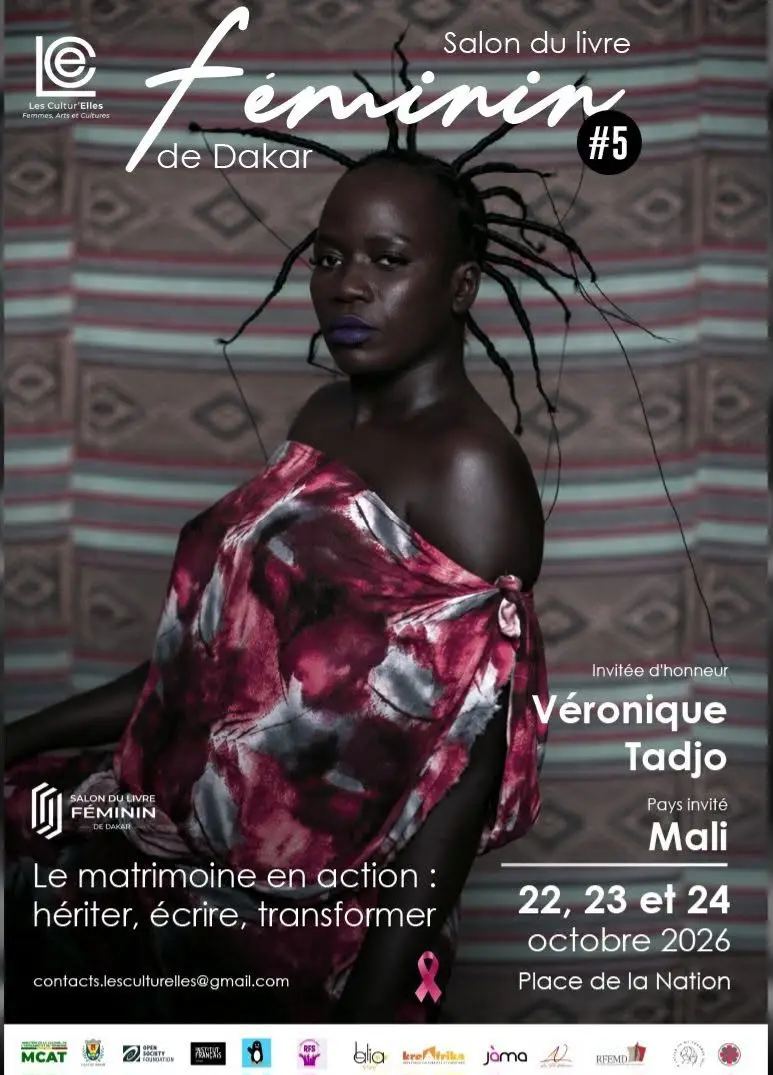
From October 22 to 24, 2026, Place de la Nation will host the fifth edition of the Dakar Women’s Book Fair. Organized by Les Cultur’Elles, this literary event will highlight the cultural heritage transmitted by women, with the writer Véronique Tadjo as guest of honor and Mali as guest country.
Women’s literature is returning to Dakar. After several editions dedicated to the promotion of women’s works, the Women’s Book Fair returns from October 22 to 24, 2026 at Place de la Nation, formerly Place de l’Obélisque. For this fifth edition, the organizers place memory and transmission at the center of discussions, around the theme: “Matrimony in action: inherit, write, transform”.
In the press kit, Les Cultur’Elles explain that this theme invites us to “rediscover the legacies transmitted by women, to question their place in collective memory and to recognize their role in the creation and transformation of societies”. The challenge is to make visible knowledge, practices, stories and works that have long been underestimated in dominant representations of heritage.
For three days, authors, editors, researchers, artists and cultural professionals from Senegal and elsewhere will take part in conferences, literary and professional meetings, co-creation workshops, exhibitions, book presentations and signing sessions. So many activities designed to encourage reading, support female literary creation and promote the circulation of knowledge.
Véronique Tadjo at the heart of the discussions
The writer Véronique Tadjo will be the guest of honor of this edition, while Mali will be the invited country. Its program includes a school meeting at the Mariama Bâ high school in Gorée on October 21, then a public meeting on Friday October 23 at 5 p.m. Alongside Fatimata Diallo Ba, she will discuss with the public her journey, her work and her reflections on literature, memory and contemporary societies.
On Thursday, October 22, the opening ceremony will be marked by an inaugural conference by Mariama Ndoye, specialist in Lebou oral literature and director-curator of the Léopold Sédar Senghor museum. At 3:30 p.m., a panel will bring together Véronique Tadjo, Professor Fatou Sow, Awa Sene Srr and Sokhna Benga to explore the links between orality, memory, writing and transmission.
Two prizes to dedicate female feathers
The recognition of authors is also among the priorities of the Salon. Two distinctions will be presented during the opening ceremony on Thursday October 22. The Ken Bugul Book Prize rewards literary works written by women. For this edition, fourteen works were examined and seven finalists selected.
The High School Girls Prize for the 1st Women’s Book recognizes a first work written by a Senegalese woman and published by a Senegalese publishing house. By involving high school girls in the discovery and evaluation of works, this initiative aims to stimulate critical reading and encourage meetings between young readers and authors.
The program also includes the presentation of the collection of short stories À Contre-Plumes, resulting from a creation and writing residency organized in April 2026. This approach is part of the desire to support women in their literary journey and to offer them spaces for creation and sharing of experiences.
A space for transmission and visibility
Over the course of its editions, the Dakar Women’s Book Fair has welcomed more than 300 speakers, supported 56 women through creative residencies and enabled the publication of five collective works. The 2025 edition brought together more than 1,000 visitors and participants.
Founded in 2021 by Amina Seck, the Les Cultur’Elles structure works to promote cultural and creative industries for the benefit of women. Through the Show, it aims to strengthen their visibility in spaces for the creation and dissemination of knowledge.
As the press kit recalls, the ambition is to “make Dakar the capital of women’s literature”. An objective which this year takes the path of heritage: recognizing the legacies bequeathed by women, making their stories heard and inscribing their contribution in the collective memory.
Arame NDIAYE
