
German investment creates jobs and boosts the local economy October 18, 2026
Like GAUFF ENGINEERING and Klingele Paper & Packaging, German companies present in Senegal train skills and create the conditions for sustainable employment.
The economic partnership between Germany and Senegal is not only reflected in the amounts invested. It is also measured in the infrastructures that bring territories together, the factories that locally transform products, the skills that are passed on and the jobs that are created. On the ground, several German companies have chosen to be part of this dynamic, by adapting their know-how to the needs of the Senegalese market. Klingele Paper & Packaging and GAUFF ENGINEERING provide a concrete illustration of this. The first is located in the heart of the new industrial geography of Diamniadio. The second involves rural electrification, with a new phase which should extend its action to hundreds of villages. “We considered that Senegal was the gateway to ECOWAS,” explains Guillermo Rodríguez, West Africa regional director of the company.
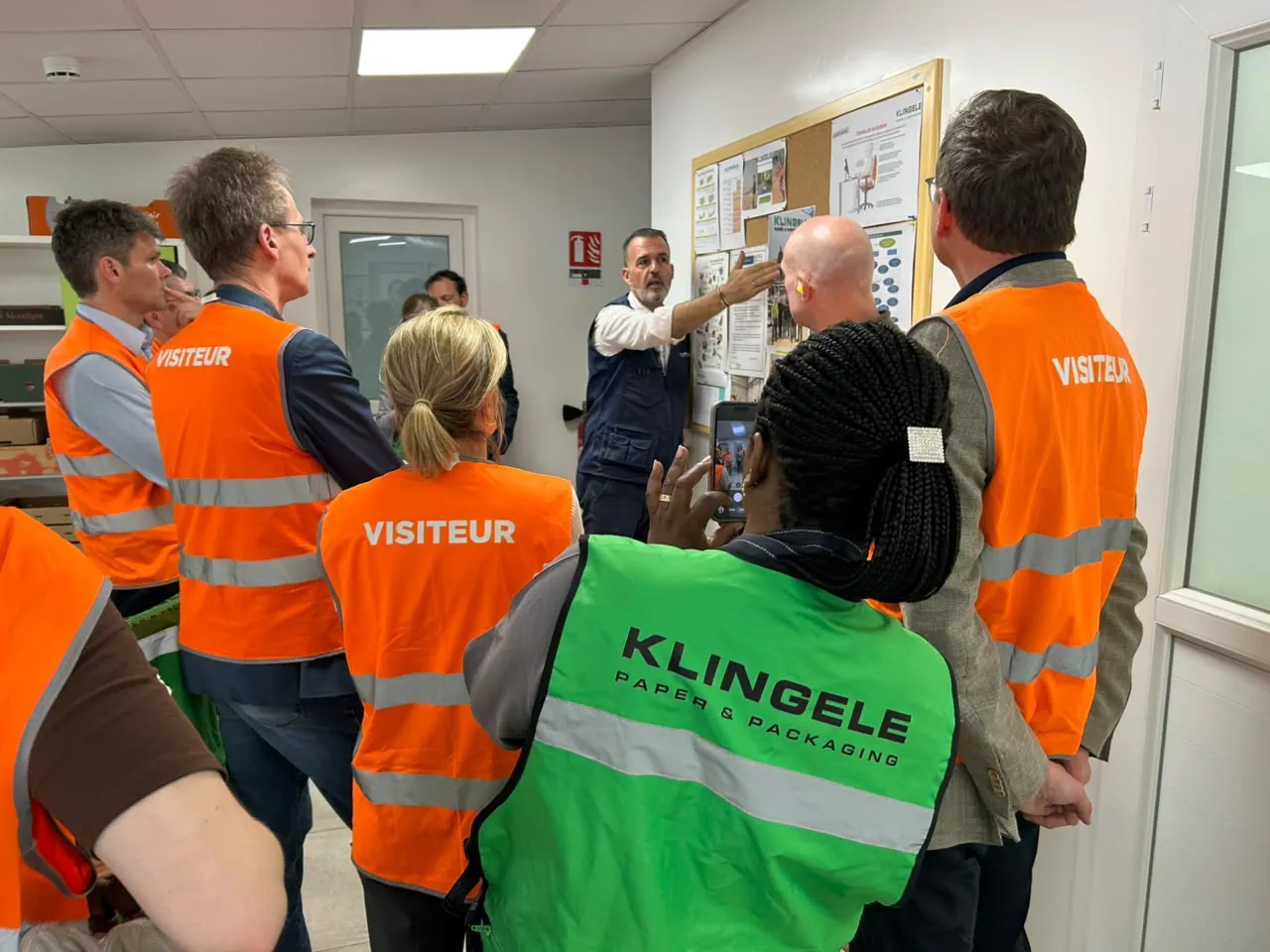
This establishment also revealed to Klingele another asset of Senegal: its human resources. The Mauritanian experience had imposed a significant internal training effort on the group. “The difference between the two countries is not due to people, it is due to the training ecosystem. In Mauritania, we had to build our skills internally, and the teams in Nouadhibou and Nouakchott are the best proof of this today. In Senegal, we found an already very dense network of professional training schools, which considerably reduced our investment in initial training and allowed us to scale up more quickly. “. The company recruits locally, sends certain employees to train in its factories in Germany and employs technicians on site. “100% of our staff, from the three factories we have on the African continent, are local,” rejoices the regional director.
The German family group, founded in 1920, today has 21 corrugated cardboard factories in twelve countries. In Senegal, Klingele acquired, in 2023, 24,000 m² in the Diamniadio industrial center. The project benefited from funding of 5 million euros with the support of KfW-DEG, while GIZ supported the company with the training aspect. The objective, according to the regional director, is to gradually reach 100 to 120 jobs, compared to 26 currently. This development directly supports the needs of the agricultural sectors. The packaging here is not a simple finished product. It constitutes a link in the chain which makes it possible to protect, transport and promote Senegalese production intended for international markets.
GAUFF ENGINEERING, electrify to free economic activity
After Diamniadio, German investment took another form. With GAUFF ENGINEERING, it involves electricity networks, photovoltaic plants and infrastructures which must bring energy closer to rural populations. GAUFF, as Project Manager, carried out the studies, the preparation of calls for tenders, the supervision of executions and the management of the project. The first phase of the project called “ASER-300-villages” carried out with the Project Manager the Senegalese Rural Electrification Agency (ASER), from 2019 to 2025, made it possible to contribute to the electrification of 372 villages, according to Lutz Ekhoff, the project director of GAUFF ENGINEERING in Dakar, in an interview with the newspaper Le Soleil. The program also included 90 sites intended for income-generating activities (IGA): market gardening areas, cold rooms, ice machines and post-harvest platforms. Around 860 young Senegalese and operators/dealers were also trained in the field of electrification and its management. Financing for this first phase was provided by KfW IPEX-Bank to the tune of 120 million euros.
These figures, which affected around 200,000 people in rural areas, speak of a transformation that goes beyond the simple connection of private homes. Please note that in electrified sites, energy can be used to pump water, maintain production or operate a machine. “Having electricity can sometimes even make it possible to power pumps in wells or machines on post-agricultural platforms,” explains Mr. Ekhoff. Furthermore, for agricultural and fisheries production, the issue is also that of conservation. “It is now possible to have fridges and cold rooms, which we have developed in particular to store agricultural and livestock production, as well as to create a certain number of ice machines for fishermen’s preservation,” he continues.
A second phase of rural electrification – focused on the south and south-east of Senegal
GAUFF ENGINEERING is now preparing a new stage of its intervention with ASER. According to the director, the new second phase of the program should concern 750 villages, with a significant concentration in the south and south-east of Senegal. The majority of the localities concerned should be connected to the existing medium voltage network and other 180 villages should be equipped with photovoltaic plants and mini-networks. Start-up is hoped for in 2027. The envisaged financial volume is again around 120 million euros, a level comparable to that of the first phase.
This new stage therefore extends an approach in which infrastructure is considered with its effect on the local economy. Training young people, powering hydraulic equipment, enabling the conservation of products or supporting income-generating activities: electricity is becoming a lever for development.
Klingele and GAUFF are banking on Senegal as a production space. They create or prepare jobs. They pass on skills. They rely on Senegalese partners. And they benefit, each in their own field, from the German cooperation ecosystem, notably through KfW/DEG and GIZ.
By Adama NDIAYE and Babacar Guèye DIOP
