
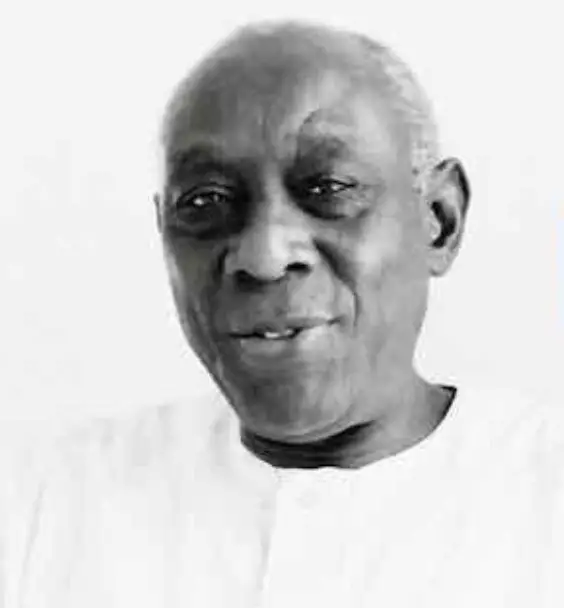
Cheikh Hamidou Kane has left, demonstrating once again the ambiguity of our adventure
With the disappearance of Cheikh Hamidou Kane, Senegal loses one of its great intellectual figures. Writer, philosopher and senior civil servant, his work has perpetually fueled the nagging question between the influence of African tradition on the one hand and Western modernity on the other.
Cheikh Hamidou Kane had a non-prolific but fabulous literary trajectory, of which The Ambiguous Adventure, published in 1961, will remain the most dazzling literary expression. Cheikh Hamidou Kane was born on April 2, 1928 in Matam. He was first supervised in Koranic education before joining the French school.
After obtaining his baccalaureate at the Van Vollenhoven high school in Dakar, he continued his studies at the Institut des Hautes Études in Dakar, before moving to Paris. At the Lycée Louis-le-Grand then at the Sorbonne, he studied law and philosophy and obtained two licenses. He completed this training with the National School of Overseas France, from which he graduated in 1959.
Back in Senegal, he will occupy several administrative functions. Governor of the Thiès region, High Commissioner General for Planning, he then pursued an important international career, notably at UNICEF, where he became regional director for sub-Saharan Africa. He will also hold responsibilities at the Research Center for International Development, before becoming Minister of Industrial Development and Crafts, then Minister of Planning and Cooperation.
“The Ambiguous Adventure” was published in 1961. Cheikh Hamidou Kane himself recognized that the journey of Samba Diallo, the main character of the novel, is closely linked to his own experience.
Through this work, Cheikh Hamidou Kane asks a question which still remains one of the great intellectual questions of Africa. How to access knowledge and modernity without losing your identity? The novel thus depicts the confrontation between tradition and modernity, but also that between two educational systems. Thierno’s Koranic teaching aims at the spiritual formation of man. The Western school brings the sciences and the instruments for understanding the modern world.
A single book for more than thirty years
The particularity of Cheikh Hamidou Kane also lies in his relationship to writing. He was never a fruitful author. For more than three decades, “The Ambiguous Adventure” remained practically his only novel. Published in 1961, it quickly brought him international fame and received the Grand Literary Prize for Black Africa in 1962. This rarity is perhaps justified. Sheikh Hamidou Kane also chose to devote a large part of his life to public action, development and international responsibilities.
His literary silence was therefore not necessarily an escape. It could also be a form of choice and fidelity to solidly established questioning. It was not until 1995, thirty-four years after “The Ambiguous Adventure”, that “The Guardians of the Temple”, his second and last novel, was published. Two novels in more than three decades, a short bibliography, but a considerable footprint. “The Ambiguous Adventure” appears to be much more than a novel. It is the work of eternity, entering history forever, its author with it.
O.BA
