
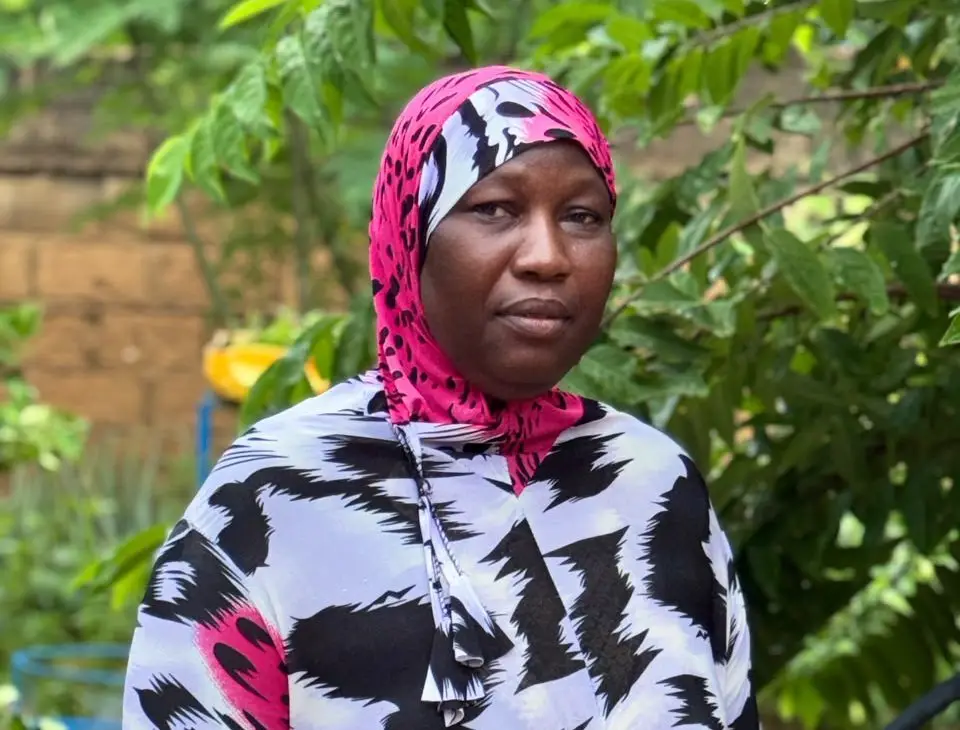
(PROFILE) Aminata Faye, a life between chalk, earth and henhouse
At the age of fifty, Aminata Faye did not choose between teaching, serving her community and cultivating the land. She decided to fit all these lives into one. In her native village of Ndorong Lôg, in the commune of Mbam, this teacher carries out several activities at the same time. First deputy mayor of the commune of Mbam, entrepreneur in livestock and agriculture, she is also involved in the development of women.
A few drops of rain fall on Aminata Faye’s vast home. But they don’t seem to have any influence over the fifty-year-old. Barely welcomed, we already see her at work, going from one enclosure to another, bustling around her animals with disconcerting simplicity. Here, no desk, no stacked files or first deputy mayor’s chair. The chosen one gives way to the breeder.
At the start of Thursday afternoon, Aminata Faye is in her element. Roosters, pigeons, goats, quails, sheep… his home houses a real little farmyard, where each animal seems to have its place. She doesn’t hesitate to get her hands dirty to feed and take care of them. Simple gestures, carefully repeated, for these animals that she considers full members of her family.
Beside him, the few drops of rain become almost a detail. The fifty-year-old moves forward, feeds, checks, gets active. A scene which contrasts with her chosen costume.
But as soon as this task is finished, there is no question of taking a breath. Head to the vegetable garden, located right next door. After the animals, the earth. Another part of her daily life, just as familiar, where the entrepreneur continues her coming and going between breeding, agriculture and responsibilities.
Family legacy
Its relationship with agriculture is not new. It dates back to childhood, a time when his father, although a policeman, had already passed on to his children a taste for the land. “I had a love of the land, animals and everything very early on,” she says. A passion which has taken root over the years and which, still today, guides his choices.
His father notably left them more than 30 hectares. For Aminata Faye, this land is not only a family heritage. It is a promise of continuity. She sees it as a space capable of feeding the family, the animals and, when production allows, generating income.
She also defends organic farming, convinced that excessive use of fertilizers ends up affecting the land, animals and consumers. For her, producing is therefore not only about harvesting, but also about preserving what will allow us to produce tomorrow.
In her journey as an entrepreneur, breeding occupies an important place. It started modestly, with a few animals intended mainly for family consumption. Then, in 2020, it took a step forward by building premises that could accommodate 600 broiler hens. Since then, she has changed her model and turned to local chickens, which she considers more interesting in the long term since they allow several livestock products to be produced: meat, eggs and chicks.
Added to this are sheep and goats. Here again, his primary motivation remains family self-sufficiency. Having animals at home, she explains, allows you to have meat for the family, but also to sell if necessary.
Square organization
At Aminata Faye, entrepreneurship is therefore not only a matter of profits. It is also a question of security, foresight and family solidarity. For this fifty-year-old, the key to her entrepreneurial success lies in the pleasure she gets from doing what she does. “When you love an activity, the time you devote to it ends up being forgotten,” she says, with a smile on her lips.
Its professional organization also contributes to this. “At school, I benefit from a class whose schedule allows me to be more available in the afternoon. At the town hall, my status as first assistant also allows me to manage certain meetings and certain files,” she confides, looking back on her daily organization.
A certain vision of entrepreneurship
Aminata Faye does not romanticize entrepreneurship. She knows the risks, particularly when it comes to organic production. Losses are part of the journey, she believes. “The entrepreneur must know how to take risks, learn from her failures and readjust,” she believes.
His conception of business is very similar to that of teaching. Faced with a difficulty in a class, the teacher looks for a solution. For her, it’s the same in entrepreneurship: understand what went wrong, correct it and start again.
Patience is thus one of the qualities that she places at the heart of the entrepreneurial adventure. In his eyes, there is no question of wanting to become rich overnight. “I like to take my time,” she says.
The woman at the heart of her fight
But behind the chickens, the fields and the municipal responsibilities lies a fight that is particularly close to his heart: the empowerment of women. Aminata Faye, however, refuses to reduce this notion to money, material goods or social appearance. For her, an autonomous woman is not necessarily one who owns an expensive car or multiplies the external signs of wealth. Autonomy is also found in the ability to maintain one’s family, take care of one’s loved ones and remain faithful to one’s principles.
His ambition now goes beyond his personal exploitation. She wants to contribute more to the empowerment of women and remind them of their value in society. “My fight is for women to know that they are not small things. It cannot be manipulated,” she says.
Arame NDIAYE (text) – Mamoune DIOP (image and video)
