
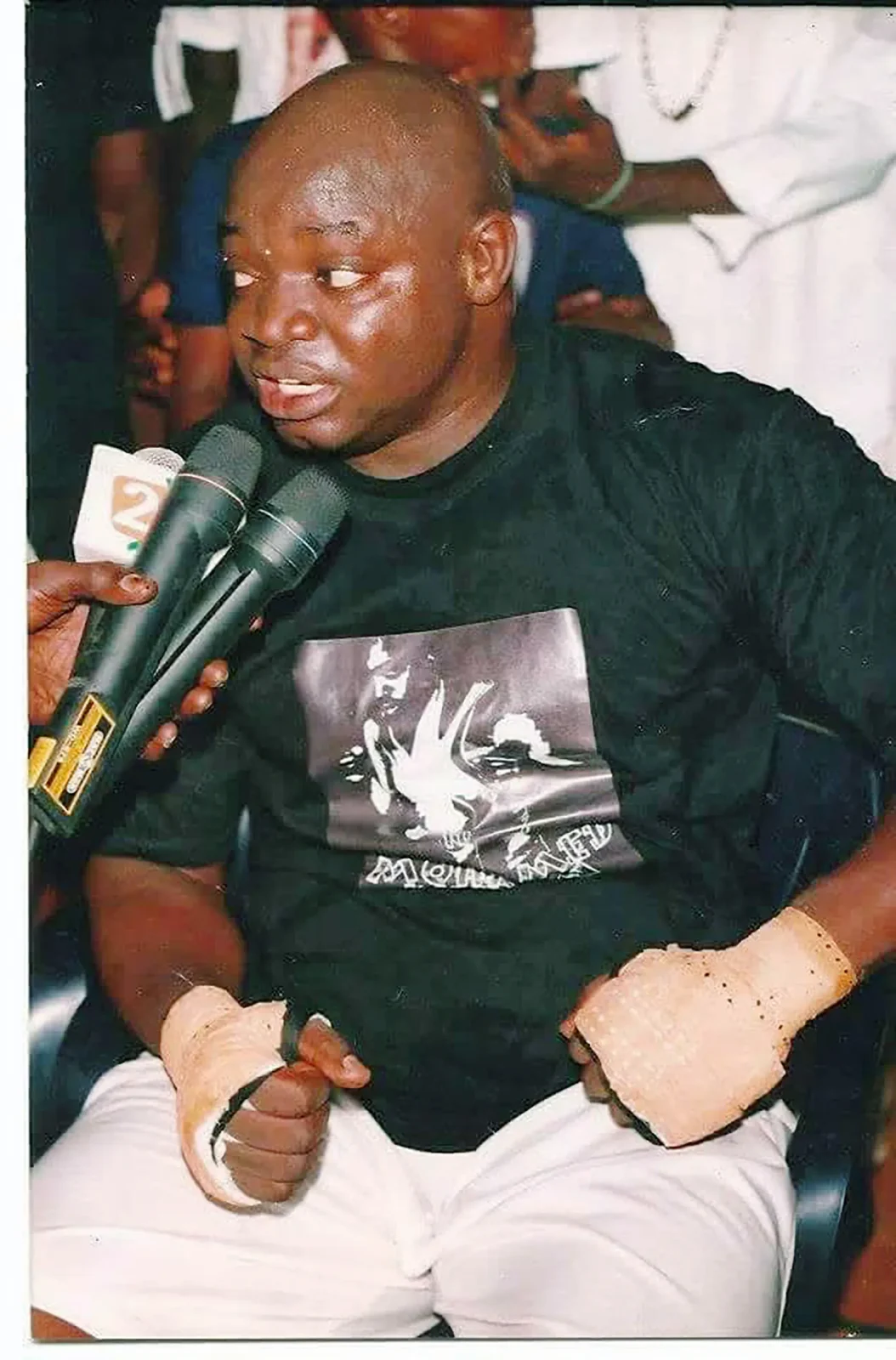
Khadim Ndiaye, former Senegalese boxing international: from the ring to maker of “King of the arenas”
Some fighters have left their mark on the sport through their exploits before reinventing themselves or retraining after their sporting career. The section “What happened to them?” » tells of their post-career life. Today, spotlight on Khadim Ndiaye, former Senegalese boxing international, still “ranked 4th in the world” in 2007, who became kingmaker of the arenas with his foals Balla Gaye 2 and Sa Thiès.
Khadim Ndiaye is a born champion. He proved it throughout his career as a professional boxer, marked by travel, medals and great fights. Born in Colobane Angle Mousse, in Dakar, he grew up in Guédiawaye after a fire which destroyed his family’s homes. “There was a fire that destroyed our homes. This is how the State evicted us to relocate us to Guédiawaye,” he says.
Young Khadim attended French school for some time before dropping out. “I stopped, as they mockingly say, in “Nandité” class: CM2. It was sport that ruined my studies. First of all, I was a good footballer. I had proven myself with the interclasses. They nicknamed me Maradona,” he remembers.
But ultimately it was boxing that changed the course of his life. The young man is sent to a metal carpentry workshop in “Difoncé”, in the city. There he meets a young man from the Mendy family, who has come to spend vacations and learn the trade. One Friday, he did not show up at the workshop. The next day, Khadim questions him about his absence. His friend explains to him that he had gone to watch a boxing fight by his paternal uncle, Emmanuel Mendy.
Intrigued, Khadim wants to know more. He asks to discover this discipline which also fascinates him. International ascent The appointment is made for the following Monday. “That’s how I found one of the trainers in the room, named Mamadou Kane,” says Pa Kane. I signed up straight away and started training. It was in 1991,” he says. From the outset, however, attempts were made to discourage him.
He learns, progresses and gains power quickly. His first participation in the Senegal championship is a real eye-opener. At the time, the competition included two categories: hopefuls and elites. A convincing performance among the hopefuls allows access to the elite. “I participated in the Senegalese championship as a beginner and I flew through it with style in the 71 kg category,” he recalls. His performances quickly attracted the attention of technicians, notably national coach Alexis Tavares and national technical director Joseph Diouf. “They saw very early in me the qualities of a future great. They selected me for the national boxing team,” he says.
Khadim Ndiaye’s talent then took on an international dimension. In 1993, just two years after his debut, he was selected for an African selection organized in Abidjan. The competition is high. Among the Senegalese are Djibril Kandji of Asfa and Pape Sow. Khadim Ndiaye impresses the technicians present and becomes the only Senegalese selected.
In a selection bringing together the best boxers from several African countries, he won the gold medal and was one of four African fighters selected. “It was afterward that we got a grant to go and hone our skills at Insep in Paris, as standard bearers for all of Africa,” he reveals. At Insep, he confirmed his potential and is among the two best young African boxers of the moment.
His journey then took him to Indonesia for a world ranking competition. In 2007, he reached 4th place in the world. “My record hasn’t been broken yet. It was Pape Sow, who was very gifted and very strong, who approached me a little later, as a Senegalese, in the world rankings, since he is 6th in the world,” he explains.
His performances also attracted attention in France. French officials would have liked to see him take French nationality. He refuses. “The director of Insep in Paris and the Minister in charge of Sports made me the offer to take French nationality, but I did not accept this offer. I have always been proud to be a worthy representative of Senegal,” he says.
And added: “I never wanted to betray my national flag. I love my country. And I struggled a lot in my career.” Khadim Ndiaye claims to have fought 384 fights and used up several passports by accumulating visas. From the ring to the arena African Games, Francophonie Games, African Championships: his journey is punctuated by international competitions and medals.
He claims to have been twice African champion. He had also qualified for the Athens Olympics. But an illness ultimately prevented him from participating. He is replaced by the soldier Djibril Fall of Asfa. In 2009, after traveling the world and defending the colors of Senegal, Khadim Ndiaye decided to hang up his gloves. “I had defended the colors of Senegal everywhere in the world. I struggled a lot to honor the national flag, but I did not receive recognition from the authorities and I stopped,” he says, his voice heavy with emotion.
But retirement from sport does not mean the end of the adventure. Even before ending his career, Khadim Ndiaye had started coaching. He gradually became a coach and put his experience as a boxer at the service of wrestlers. Towards the end of his career, he joined Kamal Salamé’s Mermoz stable. He rubbed shoulders with several big names in wrestling: Khadim Ndiaye, Mor Fadam… The task was not without risk. But it is with Balla Gaye 2 that his adventure in wrestling will take on a new dimension.
Their meeting took place in 2011, at the initiative of Aziz Ndiaye, when the son of Double Less was to face Tyson. Guy, physical trainer from the Olympic Club, puts the two men in touch. “I was already a gym trainer at the Olympic Club. During our interview, Aziz Ndiaye told me that what he wanted was to be able to prepare his wrestler Balla Gaye 2 so that he would not take Tyson’s blows,” he explains. The challenge interests him. He proposes a work program that Balla Gaye 2 follows to the letter.
The sessions are going well. Khadim emphasizes movement, avoidance and protection against Tyson’s right hand, while working on his foal’s natural qualities. On the day of the fight, July 31, 2011, he especially asked him to attack Tyson in order to disrupt him. Balla Gaye 2 applies the instructions and wins spectacularly. The experience will be renewed for the fight against Yékini, on April 22, 2012. Balla Gaye 2’s victory over Yékini confirms him as King of the arenas. “It was I who made him King of the arenas, since it was I who had prepared him in boxing,” he confides.
After accompanying Balla Gaye 2 to the summit, the former boxing international will continue his work with the Double Less family. This time, it is Sa Thiès who is entrusted to him. After the defeat of the cadet of Balla Gaye 2 against Malick Niang on May 1, 2013, his brother asked Khadim to help him bounce back. Coach Khadim accepts the challenge. He works on Sa Thiès’ shortcomings in the fight and also works to restore his confidence. The result does not take long.
On April 27, 2014, Sa Thiès faced Jordan, member of the Tay Shinger de Pikine stable and foal of Eumeu Sène. The son of Double Less wins in an expeditious manner. After his victory over Zarco, on June 22, 2025, Sa Thiès moved closer to the summit and opened the doors to the royal fight against Modou Lô. Albourakh Events formalizes the poster, scheduled for April 5, 2026. For Khadim Ndiaye, this fight required special preparation. “When this shock was over, I gave valuable advice to Sa Thiès. I told him that he had to get used to the idea that, to beat Modou Lô, you have to be physically stronger than him, more explosive, even more lively, very ready on the technical-tactical level and be ready to give up your life,” explains the technician.
The message is heard. Sa Thiès is working accordingly, with all of its technical support, in order to approach this meeting with the best possible weapons against the champion. Result: he dethrones Modou Lô and becomes, in turn, King of the arenas. From Senegalese international boxing, ranked 4th in the world in 2007, to king of the arenas, Khadim Ndiaye left his mark on his era.
Abdoulaye DEMBELÉ
