
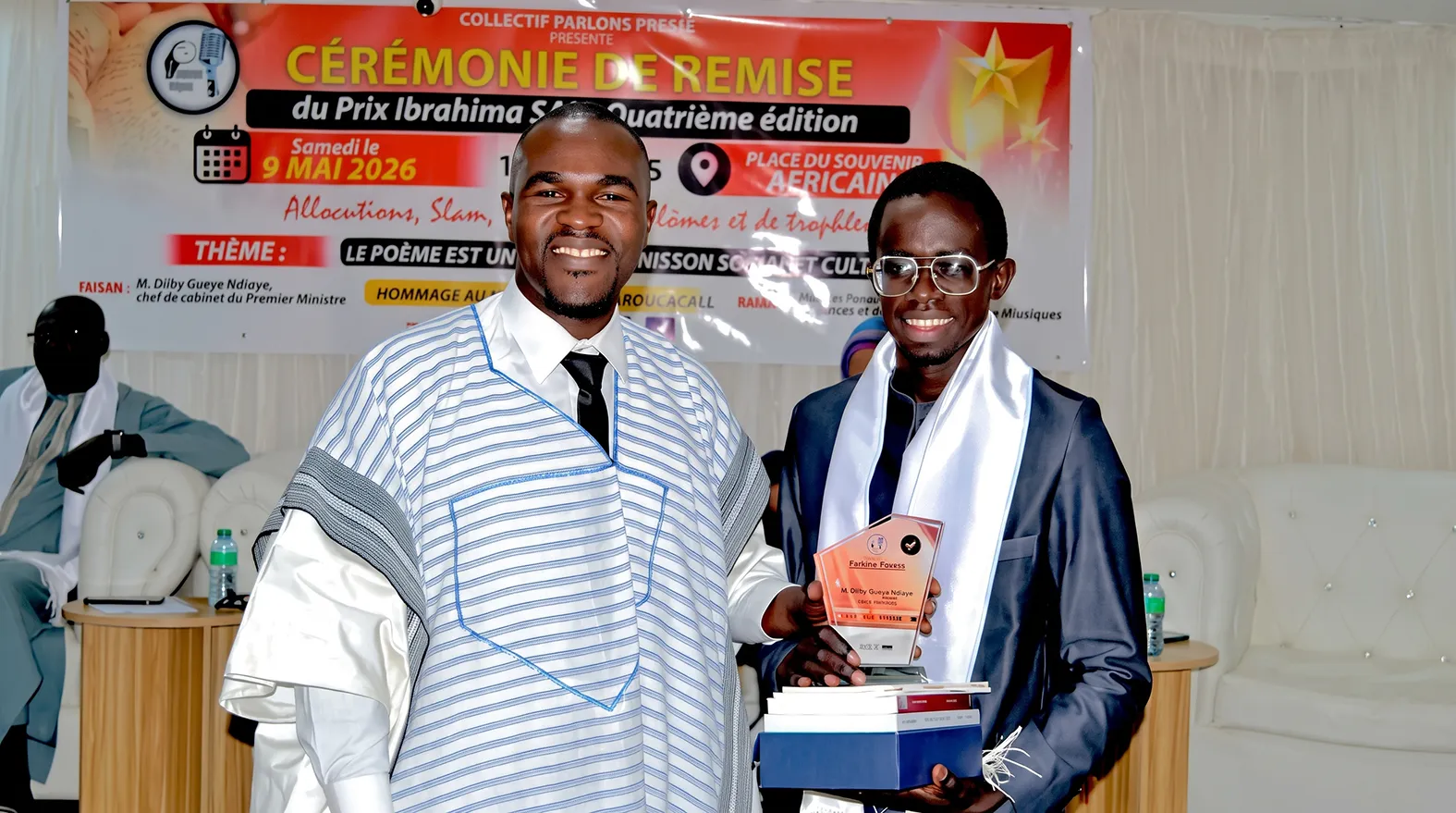
“Tomba d’Ivoire”, collection by Jules Marie Ndane Diouf: the return to the sources of a young poet
Winner of the second Ibrahima Sall Prize, the collection “Tombe d’Ivoire” by Jules Marie Ndane Diouf delves into the lands of childhood, myths, love, death and those forgotten by society. Under the tutelary shadow of Senghor, the young poet seeks to pick up a broken thread. A poetry of memory, of roots and concern, shot through by the desire to make verse something other than an ornament.
“Tombe d’Ivoire” resembles a lighted lamp in an abandoned house. We don’t know exactly who left it there. The light trembles, illuminates poorly, cuts silhouettes, brings out faces that time had erased. And suddenly the house starts to breathe again. This is how to understand Jules Marie Ndane Diouf.
His collection, composed of around thirty poems, earned him the second Ibrahima Sall Prize during the fourth edition of the competition. A distinction obtained at the end of a selection bringing together more than 40 candidates and 10 finalists. Fatimata Diallo Bâ, professor of classics and writer, as well as Djiby Guèye Ndiaye, accompanied this fourth edition of the Spring of Poets organized by the collective “Parlons Poetry”, in collaboration with the magazine “Sénégal Njaay”.
But, a price is never enough to say a book. It designates, at most, a place where poetry has encountered a gaze. To understand “Tombe d’Ivoire”, we must therefore return to its title. We have to push this door open. “Tombe d’Ivoire”, the expression could first make one think of death. Either way, it’s everywhere in the collection.
The coffins, the tombs, the ancestors, the ghosts, the vigils, the cemeteries and the departures compose a kind of funereal geography. “It is, in a way, the buried past, the amnesiac memory of contemporaries with regard to Senegalese literature,” explains the poet. The book was born from an oversight. Or rather anger against forgetting. Senghor is the central figure, the tutelary shadow that runs through the collection.
The kingdom returned from childhood
The poet wants to return to the work of the first president of the Republic of Senegal, but also to what it carries with it of memory, language, land, myths and values: “We all failed by forgetting Senghor or by denigrating him because he was a bad president.”
For him, the politician belongs to political history. The poet, for his part, remains in the library, in the classrooms, in the memories, in the voices which take up his images. Jules does not ask that Senghor be sanctified. He simply wants his work to be reread. The first movement of the collection immediately establishes this tension between disappearance and resurrection.
In “Les nuits de Palmade”, the poet returns to ancient nights. Fire, hills, savannahs, stars, jackals, drums, warriors and ghosts populate a childhood. The poem moves forward like someone walking through the night with a dim lamp, groping for the objects of their former home.
The poet says it himself: “This poem is a coherent set of memories of a sacred place, but also of a forgotten divinity”. Senghor goes through the book like a dead man who has refused to remain silent. In “Tombe d’Ivoire”, which gives its name to the collection, the poet addresses him directly. The grave is soiled by the rains, but the dead man is not erased. “The spring torrents have soiled your old grave,” writes Ndane.
The poet looks at the descendants of the deceased, those he calls “the courtiers with black eyes and white dreams”, and worries about their relationship to the inheritance. In the eyes of Jules Marie Ndane Diouf, nature is not a setting. She has skin, breath, a memory. Caïlcédrats, cheesemakers, palm trees, baobabs, palm trees, fig trees, prosopis, lianas, herbs, savannahs, bolongs and hills form a true cosmogony.
In “Les Fastes du Levant”, a simple blow of a pestle is enough to awaken an entire childhood. In “Mother Nature”, the plains, roses, frost, butterflies, dragonflies, antelopes and felines compose an almost animistic scene. The living world is everywhere too. Even when he speaks of death, Ndane returns to the earth. In “Whispers from a Coffin”, the buried man finds mother earth.
In “Funeral”, the departure towards the tomb is accompanied by songs and dances. In “Ton pas mon pas”, mourning becomes the desire to rejoin the one who has left. However, it would be simplistic to make “Tombe d’Ivoire” a collection focused solely on the past and the ancestors. Love occupies a real place there, sometimes sweet, sometimes carnal, often restless.
“The heart represents this tomb where the joys, sorrows, sorrows and anxieties of eternal love come to die,” confides the poet. In the collection, there is a sensuality which does not necessarily seek the spectacular. It belongs to the language of the poet, to his images, to this way of bringing desire into a personal liturgy.
“Érotis” continues this vein with more tactile writing. Saliva, mouth, roots, fingers, breath. The journey continues. “Beyond the good” brings love back to the maternal figure. The son refuses to be “the burden of your sorrows”. He would like to be “the sun of your dark days”.
The cry of children left behind
The collection changes temperature when it arrives at “Complaint of a street child”. The voice is no longer just that of the adult poet looking back at his past. “Today my pot is empty/I’m sick, I’m afraid; my master will be furious.” It’s the turn of the absent parents, hunger, the few coins, the teacher, begging, school memories. The child has almost nothing. However, he keeps a few words: “Hello, good evening, goodbye…”
The author himself explains that he devoted this part to the talibés: “These little children who are sent to beg in the streets without any valid reason”. This is one of the ambitions he claims after his prize: “The renewal of my apprehension of poetry: to put it at the service of society”. The poet claims art for progress.
He wants to look at what hurts. There is also, in almost every page, an adversary that no one can defeat: time. “What does time want from me! » asks the poem “Fugacity”. The question comes up in different forms. In lost childhood. In mourning. In love. In the departures. In the returns. In aging bodies. In the graves. In the memories. Time for the poet never moves quietly.
He “gallops”, he devours, he buries, he brings back, he misguides. In “Les Nuits de Palmade”, Jules returns to the child he once was. In “Childhood, the Golden Age”, the past appears as a definitively inaccessible territory. In “The Return of the Warrior”, absence, a sound material. And in “Complaint of a Street Child”, time ends up accomplishing its most terrible work: the child grows up. “At the corner of life/The ages cling to the minutes”.
The street is still there. But, the child now has white hair. Poverty, too, ages with him. You should undoubtedly read “Tombe d’Ivoire” with its rough edges, its excesses, its sometimes dizzying images, its unexpected associations, its words which seem to seek their own path.
The poetry of Jules Marie Ndane Diouf is not a perfectly oiled mechanism. It advances by shocks, by visions, by repetitions, by accumulations. Between the village and the world. Between childhood and adulthood. Between life and death. Between love and oblivion. Between Senghor and the young poet’s own voice. Jules Marie Ndane Diouf does not claim to have found Senghor. He seeks to find what, in Senghor, could still speak to his generation.
By Adama NDIAYE
