
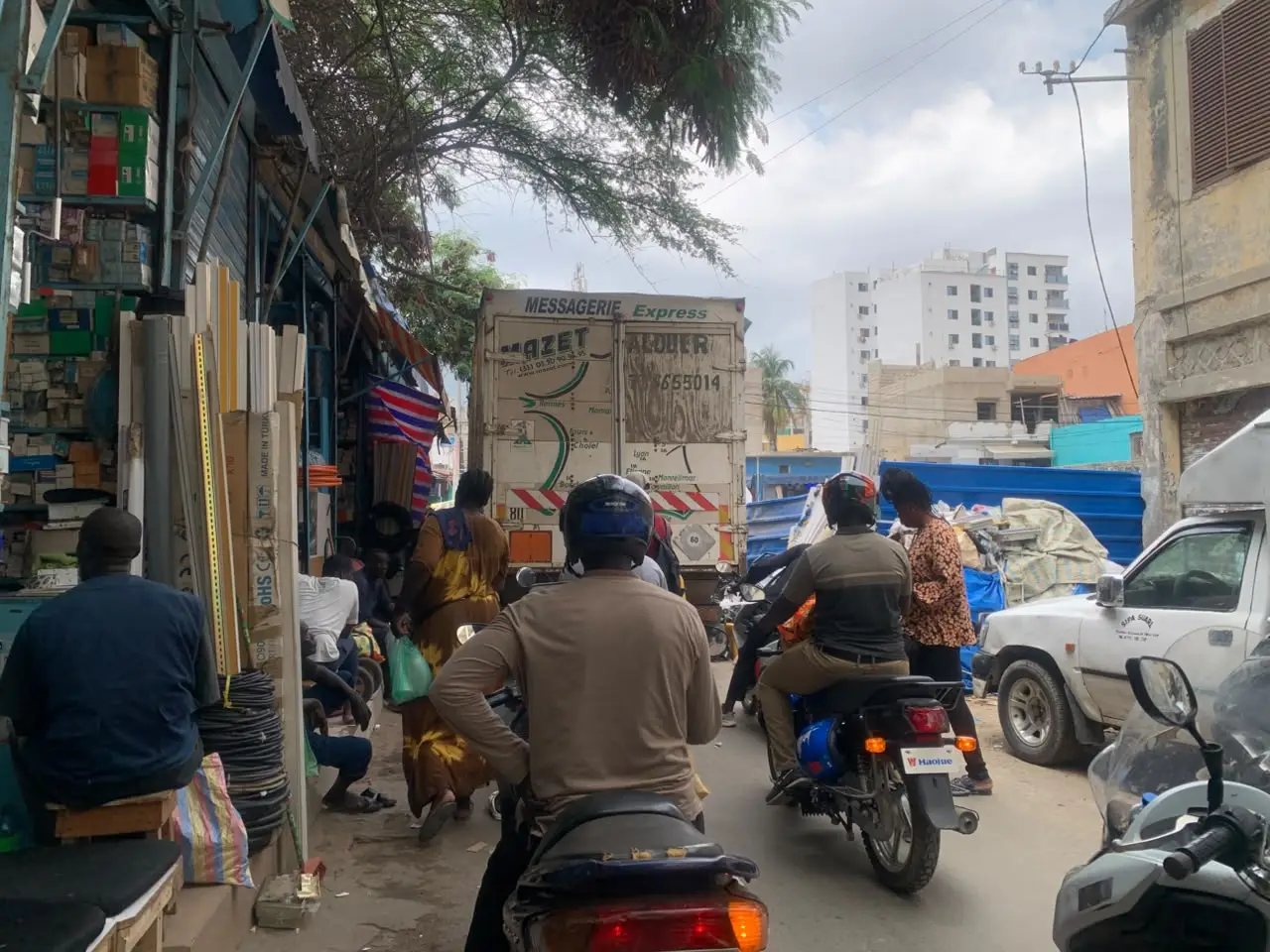
Sandaga: A market on the sidewalks of Dakar
In the heart of Dakar is the Sandaga market. This market, like many others in the capital, is characterized by a large number of street vendors and also vehicles that find parking on the sidewalks. Pedestrians, for their part, find themselves on the asphalt road, sometimes a few centimeters from traffic.
On Avenue Blaise Diagne, near the temporary premises of Plateau town hall, Sandaga’s tentacles are gradually joining those of Petersen, a few hundred meters away on said avenue. On what must have been the sidewalks, cars, “thiak thiak” motorcycle garages, but also stalls. On these stalls, various goods are exposed to the sun, to the curiosity and needs of passers-by. Notebooks, books, pens and backpacks give way to shoes as traffic moves towards Avenue Jean Jaurès. On this road that motorists share with pedestrians, the horns sound like a poorly organized concert, without a score.
It’s 12:26 p.m., the temperature is flirting with 37 degrees. As he entered Jean Jaurès, a shoe merchant named Mor, Ude (Editor’s note, shoemaker) he added, sat on the side of the road between two parked cars. He faces the passers-by who walk sideways on the road and stick lovingly to the parked cars when those in circulation honk their horns close to their ears. Mor says he has to occupy the sidewalks. “Itinerant merchants cannot not exercise. Many start there. It is an important part of the country’s economy. For me, if I find premises, others will still come and occupy these sidewalks,” thinks Mor. For him still, “the best would be to find a solution which will allow pedestrians and cars to pass without a hitch, but also for us to sell without fearing that our goods will be confiscated”. Mor is there, according to him, to work, he only asks to get a few tickets. Like this phone accessories seller who is positioned a little behind, he also makes a similar request. “We have no request for the authorities, except the possibility of working in these difficult times,” he asks in a low voice.
“People here eat in the street, they sleep in the street, they sell in the street”
About three hundred meters away, Gassama, a clothing seller, perhaps between 45 and 50 years old, is one of the street vendors. It is, this Monday, on Avenue Lamine Gueye, opposite the original market under reconstruction. “We have to understand each other, it’s not easy for anyone. It’s true that we obstruct the passage and that we are in front of stores, but that is not what we want. The sun’s rays are already weakening our goods,” he pleads. “We must cultivate tolerance,” for Gassama.
Tolerance that this lady, manager of a fabric store, intends to highlight. His business is located on the same avenue as Gassama’s stall, about ten meters down towards the Saprolait building. “Although it is not easy to live with streetwalkers in this situation, we have to deal with it. One day they will be better and will leave,” she thinks, surrounded by fabrics of all kinds and colors. This gentleman, visibly elderly, does not seem to agree with tolerance. He runs a large Persian fabric store on the corner where Avenue Peytavin and Avenue Émile Badiane intersect. The presence of street people in front of his premises pisses him off. “I don’t even want to talk about it, otherwise I’ll get upset.” I could talk about this situation for years,” exclaims the old man. Which shows even more clearly the wrinkles on this face that the heat does not spare. “I’ve been here for fifty years, nothing has been done. People here eat on the street, they sleep on the street, they sell on the street. They do everything there! “. He continues without blushing, but well on sight. “And it’s a capital!” So much anarchy in a capital. This is absurd! I don’t even have the words.” He only views negatively the “anarchy” which has found refuge at the doors of his shop. He is not the only one. This lady doesn’t understand it either. “They hang their merchandise on the doors of our stores. When customers try to come in, they hold them at the door offering them their items.” A moment of silence, both hands outstretched towards the door and in suspension, she seems to ask: “look for yourselves”.
And the pedestrians in history?
She continues without giving the impression of having tired. “We pay taxes, electricity and rent, despite all this, we cannot run our business. Because it must be said, this is not normal. The authorities come by once every three months, seize their goods, but it never lasts. The same day, some return. With this, where will we go? “.
From time to time, human traffic jams form on what remains of the sidewalks. Some passers-by stop to bargain for a few items, which forces others to move aside on the road. They continue their way on the asphalt. Between the cars parked on the sidewalks, those waiting on the roadway for customers, merchants and traffic, pedestrians are forced to make winding paths. “In particular, it is up to the pedestrian to be careful here,” said a young man who narrowly avoided a motorcycle while he was walking on the road. “Where am I going to walk?” On the stalls, on the cars, or I can do like in “Subway Surfers” too. I’m very good at surfing in this open-air mess,” the young man quips. Samba is his name. “It’s never going to change,” he says before blending into the massive crowd. For Martin, a foreign tourist, this is part of the charm of Dakar. “You still have to be patient and careful, especially since it’s very hot,” says the tourist.
On El Hadj Abdou Karim Bourgi Avenue, the “rickshaws” add to a setting similar to that of Lamine Gueye, although less crowded with people. Beggars too. A lady is sitting against a post, looking tired. The sun’s rays reveal the fluorescent threads coming from the abdomen of a spider. She had woven some which went from the lady’s head to one of her arms which she had placed on this paved ground. It’s five minutes to 1 p.m., 40 degrees have been reached. This young lady in red heels and brown skirt, Nafi, expands the responsibilities in such a situation. “Those responsible for this mess wouldn’t fit in a spoonful of Gargantua. Even the shopkeepers, at least some of them, put their goods on the walkway. I don’t talk about merchants and motorists. There are some who park to pick up customers, others actually park on the road,” complains the young lady of around 30 years old. “All this in a capital which will host the Youth Olympic Games in a little over thirty days. When measures are taken, they only last for a few days,” according to Nafi. It still provides a clarification. “The informal sector, despite this disorder, keeps the country alive. This is the sector that keeps our economy on life support. This is surely what makes the task a little more difficult for politicians.”
Boubacar DIOP
