
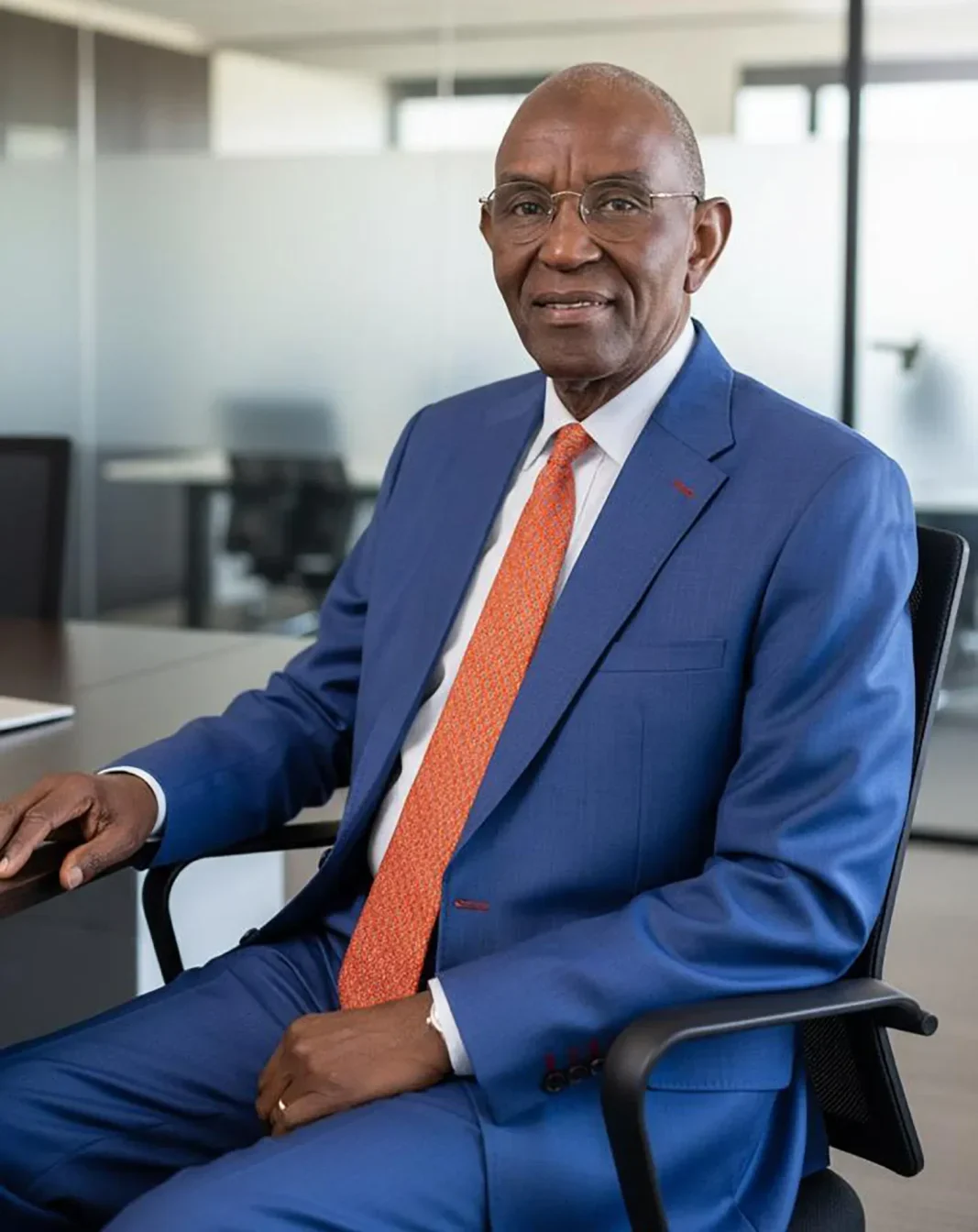
President of CORED: Ibrahima Souleymane Ndiaye, a pioneer of national television September 22, 2026
Ibrahima Souleymane Ndiaye, former director of national television and current president of the Cored Peers Tribunal, embodies half a century of journalistic memory. A graduate of the 7th class of Cesti, he belongs to a generation which wrote the first great pages of Senegalese television. From Guinguinéo to the Rts studios, from the roads of Senegal to media self-regulation, a look back at the journey of a pioneer driven by “a conviction deep in the soul”: that of professional and responsible journalism.
More than 15 years after retiring, Ibrahima Souleymane Ndiaye no longer necessarily expects to be recognized in the street. However, every evening, he invited himself into all Senegalese homes as a star presenter, reporter, or director of notable documentaries on national television. In the 1980s when the small window was rare and precious, it did not go unnoticed: the agents of the National Radio and Television (Rts) becoming major public figures, “stars” respected and recognized in the street, carrying on their shoulders a heavy responsibility, that of informants of the people, guarantors of national cohesion and privileged witnesses of the first transformations of post-colonial Senegal. Today, the septuagenarian remembers it with his distinctive voice, marked by decades of practice at the microphone. “Times have changed a lot. We lived through the good times, eh! », he smiles.
A time when “there was only one television channel”, with only twelve reporters to cover the country and seven or eight presenters to cover the newspapers. From Guinguinéo to the benches of Cesti But sometimes all it takes is a single look for the phrase to come that brings the former director of national television from 2007 to 2009, back to his years of glory on the small screen: “I know you. I watched you a lot on television and it is partly thanks to you that I became what I am, you participated in my training,” an international civil servant said to him one day, on board a plane. The fact is anecdotal, but behind this scene of recognition, there is above all a long history with Senegalese journalism. Indeed, Ibrahima Souleymane Ndiaye, whose real name is Ibrahima Ndiaye, carries this story like a living memory. For more than three decades, from the end of the 1970s to the beginning of the 2010s, the man we nicknamed Ndiaye 2 to distinguish him from another Ibrahima Ndiaye at Rts went through the great socio-political changes in Senegal with professional ethics firmly anchored in his body. Born in 1954 in Guinguinéo in the Kaolack region, this son of a railway worker grew up among the rails, in a Senegal in full transition. At a time when Guinguinéo was a real railway junction, he did all his primary schooling there, briefly at the Guinguinéo 1 school, then at the Guinguinéo 2 school located in the Campement district, built to prevent children from crossing the railway tracks. “My mom held my arm.
She would take me through the station, and when she finished, she would let go of my hand and I could go to school,” he remembers. At the time, the days were sometimes extended by hunting trips with friends. Rabbits, hares and monitor lizards are brought back to the village, then come tea, hot bread fresh from the bakery and long vigils. Childhood memories that he revisits today with a touch of nostalgia. So like a good railway worker’s son, after his CM2, his mother wanted to see him join the Thiès railway school to take over from his father, but his teacher was firmly opposed to this. In the process, he and six other students in his class will be directly sent to the Charles de Gaulle high school in Saint-Louis, reserved at the time for the best students. He stayed there for two years from 1967 to 1969 before joining the Malick Sy high school in Thiès where he obtained his Bepc then his Baccalaureate and took, “almost on a whim”, the path to Cesti.
At the Rts school But in reality, for Ibrahima Souleymane Ndiaye, the journalistic vocation was already there. According to him, it dates back to one evening in 1970, when as a teenager, he listened to reporters on the radio reporting about the World Cup in Mexico won that year by the Brazilians. “I found myself dreaming and saying to myself: but wait. These reporters are all over the world. They witness everything, it must be a very beautiful job. And I said: Ah! I want to become a journalist. “, he says. God doing things well, in 1975 after his Baccalaureate, on vacation in Dakar, he saw the famous Cesti bus nicknamed the “Dragon” and discovered that it was the journalism school. This is how he applied for the entrance exam. In October 1976, he was selected among the 7th promotion alongside Babacar Touré, Mamadou Koumé, Fatoumata Sow, Martin Faye, Sidy Gaye, Ibrahima Fall with other comrades from other African countries. Upon leaving Cesti in 1979, Ibrahima Souleymane Ndiaye was recruited on national television after going through a period of unemployment. “The unemployment that you are complaining about does not date from today,” he reminds, mischievously.
However, in this turning point of the years 1980-1981, a pivotal period marked by the emergence of a generation of audiovisual professionals, the young journalist quickly established himself within the editorial staff of the Office de Radiodiffusion Télévision du Senegal (Orts) which became Rts in 1992. Alongside pioneers like Babacar Diagne, Mactar Sylla, Guila Thiam, Cheikhou Omar Seck and, in particular, Pathé Fall Dièye, then many other professionals who joined the house, he contributed to writing some of the beautiful pages of Senegalese audiovisual information. His trajectory still arouses the respect of those who knew him. Abdoulaye Ndiaye, a former colleague at Rts and now a trainer at Cesti, sums up: “He is a character who has journalism at his heart. » The journalist who became a smuggler He underlines his “professional rigor”, his culture and his taste for reporting. “He was also a good reporter. We felt the touch of the professional,” he testifies. In fact, his taste for the field is also attested by the genre of long reporting that he was so fond of and which he helped to popularize within the television editorial staff, notably with his documentary “Fruit and vegetables of Senegal”. Beyond his work as a reporter, Ibrahima Souleymane Ndiaye has distinguished himself as one of the most formidable interviewers of his generation. His show “Champ contre champ” remains, as such, an anthology moment on Senegalese television.
The seasoned journalist will also leave his mark on Rts as television director. In this position, he notably launched “Ndef Leng”, devoted to Serer culture, and “Kenkeliba”, a morning show which met with a wide response and whose concept was subsequently taken up by several Senegalese channels. “I wanted to make my mark,” he explains. After his departure from public television in 2011, he continued to put his expertise at the service of the audiovisual landscape. This is how he founded “Bluecom-Strategies”, a communications consultancy and expertise firm with the former journalist for the daily Le Soleil Cheikh Tidiane Fall. Previously, Dean Ibrahima Souleymane Ndiaye had an international career at UEMOA during Cheikh Hadjibou Soumaré’s tenure at the Commission, after his time at the Prime Minister’s office as Head of the Communications Unit. But driven by the defense of ethical principles, it was ultimately at the Cored Peer Tribunal that Ibrahima Souleymane Ndiaye found another way to serve the profession.
And upon the death of Eugénie Rokhaya Aw, he was unanimously elected, in October 2022, to the presidency of the Tribunal. This succession has a particular resonance for him. Eugénie herself had prepared him to take over. He speaks of a “post-mortem handover”. Today, its role goes beyond just the institutional function. Analyzing the evolution of the media landscape today, his diagnosis is uncompromising. For the president of Cored, the challenges facing the press are colossal, ranging from the confusion of genres on the sets to the trivialization of the press review by presenters, including economic insecurity. Thus, as “guardian of the Temple”, Ibrahima Souleymane Ndiaye pleads for strong, demanding and respected journalism for the good health of Senegalese democracy.
By Souleymane WANE
