
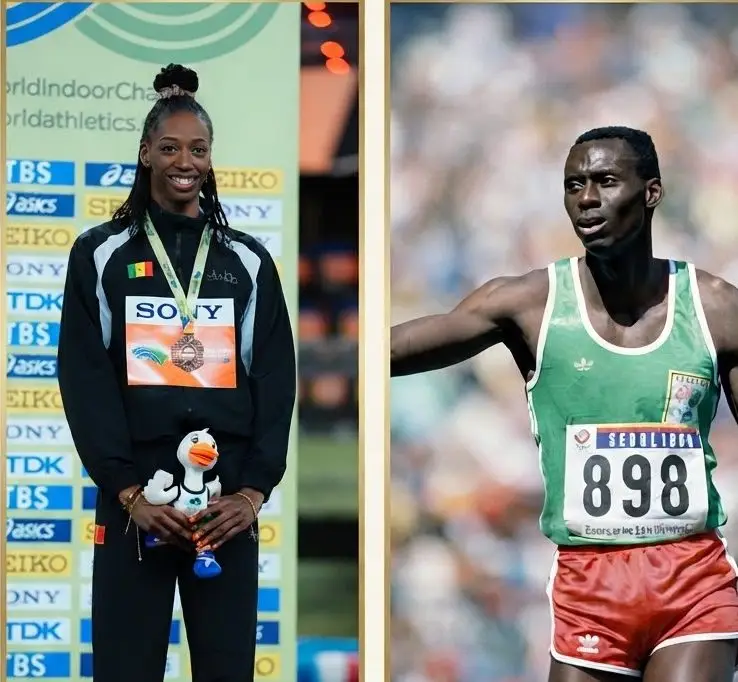
Athletics: 38 years after Dia Bâ’s silver, Saly Sarr, Senegal’s new Olympic hope September 25, 2026
On September 25, 1988, in Seoul, El Hadji Amadou Dia Bâ offered Senegal the first and, to date, the only Olympic medal in its history. Thirty-eight years after this feat, the country is still waiting for a new heir. Between the world titles of Amy Mbacké Thiam and the meteoric rise of Saly Sarr, the hope of a new Olympic podium seems to be emerging.
There are exploits whose brilliance and scope are not altered by time. The one made by El Hadji Amadou Dia Bâ, on September 25, 1988 at the Olympic stadium in Seoul, belongs to this category. At the age of 30, the 400m hurdles specialist made the history of Senegalese sport by winning the silver medal at the Olympic Games, offering Senegal its very first Olympic distinction.
In an exceptional final, the resident of US Gorée completed the 400 m hurdles in 47 s 23, just four hundredths behind the American André Phillips, gold medalist in 47 s 19. He notably beat a legend of the discipline, Edwin Moses, third in 47 s 56. Nearly four decades later, this performance remains a major reference in Senegalese athletics.
That day, Dia Bâ had not only won a medal. He had opened a breach and demonstrated that a Senegalese athlete could compete with the world elite. On the eve of the final, judge Kéba Mbaye allegedly told him: “Tomorrow, you are not running for yourself. You run for 6 million Senegalese. » A phrase that has become emblematic in the story of this exploit.
Atlanta 1996: the Senegalese relay at the foot of the podium
After Dia Bâ’s silver in Seoul, the Senegalese relay was the closest to a new Olympic podium. At the Atlanta Games in 1996, the 4 × 400 m team, made up of Ibou Faye, Moustapha Diarra, Aboubakry Dia and Hachim Ndiaye, finished in fourth place in the final, in 3:00.64. A performance which remains, to this day, the national record.
The four sprinters thus failed at the foot of the podium, a few hundredths from the bronze medal. A new missed opportunity for Senegal to extend the mark left eight years earlier by Dia Bâ.
Amy Mbacké Thiam, world gold without an Olympic medal
Over the years, other great figures have carried the colors of Senegal high on the international scene, without managing to get on an Olympic podium.
Amy Mbacké Thiam remains one of the most famous. In 2001, in Edmonton, Canada, she became world champion in the 400m. Two years later, at the World Championships in Paris, she confirmed her status among the best specialists in the discipline by winning the bronze medal.
His record could have been enriched with an Olympic distinction. But at the Athens Games in 2004, the Senegalese champion was unable to reach the semi-finals of the 400m. His journey alone sums up the paradox of Senegalese athletics since Seoul: leading performances on the world stage, but no new podium at the Games.
Saly Sarr, the hope of a new Olympic dream
Today, a new name is concentrating hopes: Saly Sarr. At 23, the triple jump specialist has gradually established herself among the international references in her discipline and is multiplying high-level performances.
On August 23, 2026, during the Diamond League in Silesia, Poland, the Senegalese jumped 15.08 m, establishing a new national record. She thus erased from the shelves the old mark of 15.00 m held by the late Kène Ndoye.
A few days later, on September 4, Saly Sarr reached a new milestone by winning the Diamond League final in Brussels, with a jump of 14.96 m. She thus became the first Senegalese athlete to win the prestigious circuit.
On September 13, she further confirmed her rise in power by winning the triple jump competition at the World Athletics Ultimate Championship, in Budapest, with a performance of 15.06 m.
These results demonstrate spectacular progress. African champion, world indoor medalist and now victorious in the biggest international competitions, Saly Sarr accumulates references that fuel Senegalese ambitions.
Los Angeles 2028 in sight
Saly Sarr now intends to write a new page in the history of the Senegalese triple jump, in the wake of Kène Ndoye. A specialist in the triple jump and long jump, the latter reached the final of the Athens Olympic Games in 2004, where she finished in 14th place. She previously won bronze at the 2003 World Indoor Championships.
In Paris, in 2024, Saly Sarr failed to qualify for the triple jump final. Two years later, however, its performances reflect a change in dimension. On the horizon now loom the Los Angeles Games in 2028.
Has the prospect of a second Senegalese Olympic medal become more concrete? Saly Sarr’s recent results in any case allow us to nourish this ambition, without prejudging the result of an Olympic competition where global competition remains particularly strong.
Thirty-eight years after Dia Bâ’s historic gesture in Seoul, Senegal is still waiting to see another of its athletes climb onto an Olympic podium. From the silver won in 1988 to the recent performances of Saly Sarr, the history of Senegalese athletics is written between heritage and hope. In Los Angeles, in 2028, a new page could open.
By Cheikh Gora DIOP
