
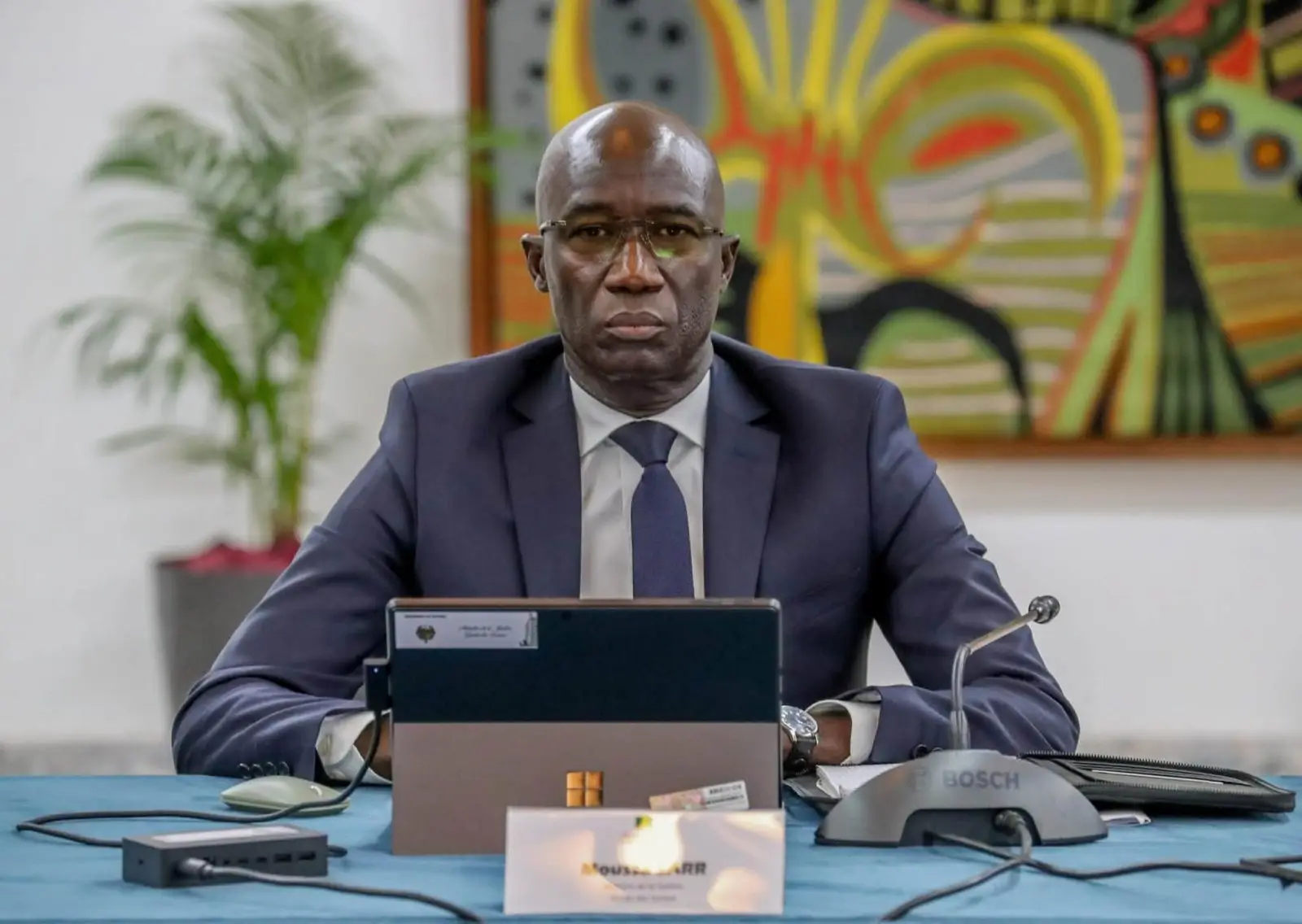
ECOWAS Court of Justice: Senegal reaffirms its commitment to strong community justice
Senegal reaffirms its commitment to strong, accessible and effective community justice. The assertion was made on Monday by the Minister of Justice, Me Moussa Sarr, during the 2026 International Conference of the ECOWAS Court of Justice, held in Dakar.
Senegal reiterates its commitment to promoting strong community justice. “Faithful to its attachment to the rule of law, the protection of human rights and regional judicial cooperation, Senegal reaffirms its commitment to strong, accessible and effective community justice,” said the Minister of Justice, Me Moussa Sarr, on Monday during the 2026 International Conference of the ECOWAS Court of Justice, held in Dakar.
According to him, this commitment is reflected in his constant support for the Court of Justice of the Economic Community of West African States (ECOWAS), as demonstrated among many other collaborations. These include the recent hosting in Dakar of the second edition of the moot court competition and the present conference.
Also read: Me Moussa Sarr: “The expectations of our fellow citizens with regard to justice have never been so strong”
“Our country remains fully available to support ECOWAS, with all the States and institutions of the community, in the construction of community justice that meets the aspirations of our people and the demands of our time,” he added.
On this, the Senegalese Minister of Justice launches an appeal to all stakeholders in community justice. He invites them to make the regional space a place where the law brings people together and where justice effectively protects rights and freedoms.
“Let us preserve the independence and authority of our courts. Let us strengthen the dialogue between national and community judges. And let’s make technological innovations, in particular artificial intelligence, a lever in the service of more efficient justice that is closer to the citizen,” he argued.
Making regional integration “a concrete reality”
Because, for the minister, it is on this condition that regional integration will cease to be an institutional project and become, for the people, “a concrete reality” of justice, protection and trust.
In reality, according to Me Moussa Diop, regional integration cannot be limited to the free movement of people, goods and capital. It presupposes a coherent legal space, strong institutions and accessible justice. The ECOWAS Court of Justice occupies an essential place in the consolidation of democracy, the rule of law and in the harmonization of the regional space.
“The dialogue between national and Community courts must be constantly strengthened, in order to promote a coherent interpretation and effective application of Community law. The effectiveness of the Court’s decisions and cooperation between jurisdictions constitute essential conditions for the credibility of regional integration,” recommended the minister.
Deepening integration, believes Moussa Diop, means consolidating a legal space in which citizens can have confidence; a space where justice brings people together and where community institutions remain at the service of their aspiration for peace, stability, development and prosperity.
Mariama DIEME
