
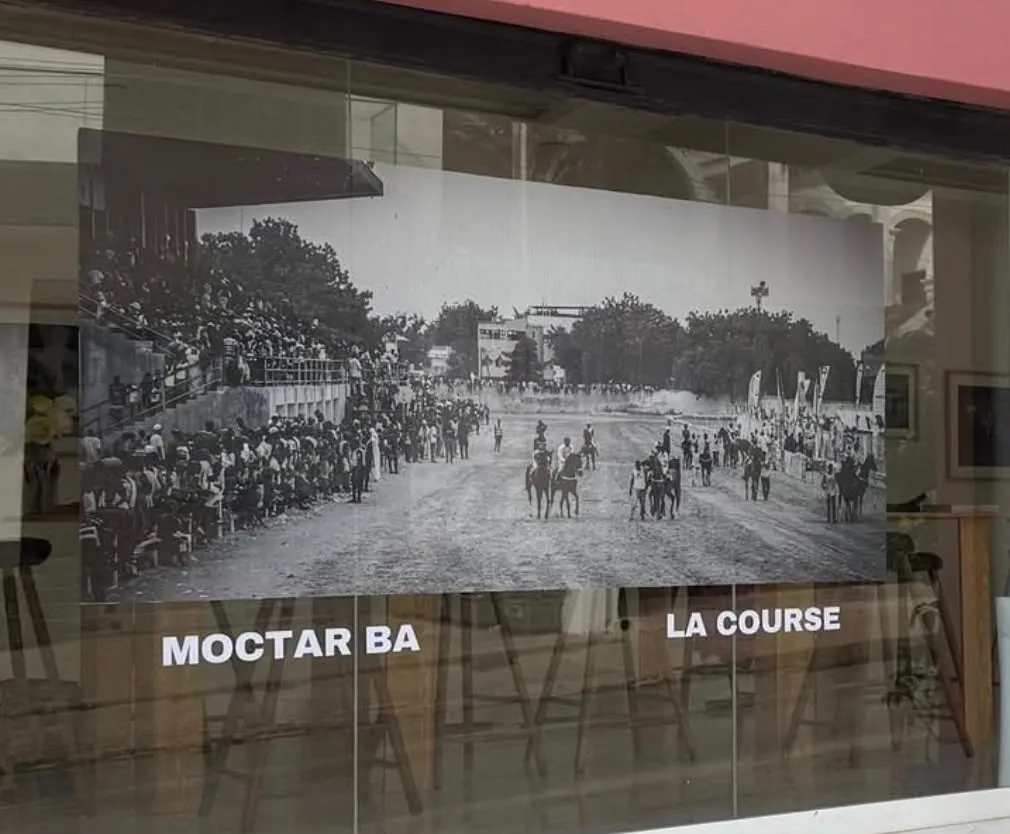
Moctar Ba makes memory gallop September 16, 2026
At Galerie36 in Dakar, from July 18 to November 13, 2026, Moctar Ba presents “La Course”, a photographic exhibition which takes the world of Senegalese racecourses as a starting point for a reflection on memory, transmission, lineages, power and cultural circulations, with black and white to capture the riders, the tracks, the crowds and the horses of the Ndiaw Macodou Diop racecourse in Thiès, before to broaden the view towards an equestrian history which crosses the Sahel, Africa and the territories of the diaspora.
At Galerie36 in Dakar, Moctar Ba’s photographs initially give the impression of a world caught in its own turbulence. Silhouettes stand out on the track, riders accompany their horses, bodies tense towards speed, eyes follow a trajectory whose outcome is decided in a few seconds. Black and white removes the immediate colors of the racecourse from the scenes and focuses attention on the shapes, contrasts, attitudes and relationships between men and space. The sporting image gives way to something larger, that is to say a reflection on what societies transmit, conserve and reinvent. The starting point is in Thiès, at the Ndiaw Macodou Diop racecourse, the central location of the photographic project. Moctar Ba observes the world of racing in all its diversity, from the excitement of the day of competition to the moments surrounding the track, with the riders, the breeders, the preparations and the patient relationships built around the animal. The race provides the visible action, while the photographer searches for what is happening around it. It is precisely this movement that gives the exhibition its interest. Photography looks at an environment, habits, knowledge and a culture which has an ancient history. In this case, the sporting spectacle is a gateway to the stories that preceded it. In the Sahel, equestrian history accompanies that of kingdoms and empires. The cavalries of Mali, Songhai or Kanem-Bornu participated in the military and political organization of large territorial groups. The rider represented mobility, authority and power. Mastery of horsemanship belonged to a culture of prestige and command. This ancient memory gives the images of Thiès additional depth. On a contemporary track, the issues have changed, the rules too, but certain representations remain. The competition still brings together a community of connoisseurs, breeders, riders and enthusiasts around the animal. The races are part of a culture which goes far beyond the result recorded at the end of the track. Senegal maintains a particularly vibrant equestrian tradition, with several traditionally identified breeds, including the Mbayar, the Foutanké and the Mpar. This culture accompanies different uses, from work to ceremonies, from travel to competitions. For Moctar Ba, this story has an intimate dimension.
Born in Dakar in 1989 in the Mounted Squadron of the Red Guard, he grew up in a family deeply linked to horse riding. His father was Senegal’s show jumping champion and captain of the military equestrian team. His apprenticeship was carried out in particular on Arab Barb horses offered by King Hassan II of Morocco. This connection gives “La Course” a particular resonance. The photographer knows his codes, his requirements and his family stories. Moctar Ba also knows what it means to grow up with people for whom horse riding represents a practice, a discipline and a way of inhabiting the world. Photography allows him to take up this story with another language.
Gallop!
The Atlas which accompanies “La Course” fully reflects this ambition. The project follows the traces of equestrian culture from the Sahel to different African and diasporic territories. Thiès, Louga and Saint-Louis rub shoulders with Dakar, northern Nigeria, the racecourses of Barbados and Jamaica, as well as equestrian areas in the United States, London and South Africa. Geography changes, practices take different forms, local histories intersect, but the same question remains, that of the circulation of men, animals, knowledge and heritage. This diasporic dimension is essential in the project to say that the history of the horse does not stop at the borders of Senegal. It accompanies ancient movements and joins the stories of the black diaspora, particularly in the Caribbean and the United States, where equestrian traditions have also been shaped by black populations and by stories of migration, domination and reappropriation. Moctar Ba’s Atlas connects these spaces and offers a transatlantic reading of this history. The city occupies a unique place in “La Course”. The racecourse is a social theater where several generations, several professions and several conceptions of the relationship with animals meet. With “La Course”, he returns to a territory he has known since childhood and gives it new depth. Black and white plays an essential role. It removes elements likely to distract the eye from images and brings out volumes, lines and contrasts. The photographs have an austere elegance that suits this world of tracks, dust, bodies and speed. The frame also gives the scenes a sculptural dimension. Photography then accomplishes a paradoxical operation. She captures a world based on movement and transforms it into a still image. The race takes place in a few seconds, while the visitor can stay for a long time in front of a photograph and observe what the eye of the spectator present at the racecourse would have captured in the speed of the event.
This slowness of gaze allows us to discover what competition usually leaves in the shadows. This all belongs to “The Race”. The title itself has a broader scope than that of the competition. A race involves a trajectory. It assumes an origin and a destination. It also evokes displacement, conquest, transmission and the passage from one generation to the next. This idea ties in with the photographer’s personal story. Moctar Ba now raises his own horses and has plans to enter them in races. Photography and breeding thus come together in the same approach. He observes this culture and himself participates in its continuity. The strength of the project lies precisely in this encounter between the intimate and the historical. A photograph can show a racing scene while raising a much broader question about African heritage and its future. Photography is also like an archive of the present. It preserves faces, bodies, places and practices that belong to a current reality. The photographer thus refuses to reduce heritage to objects kept in display cases. He seeks it in places where men continue to practice it.
Galerie36 offers another space for this memory. The visitor leaves Dakar, at least visually, to reach Thiès. He discovers the track, the riders and the horses, before following the historical ramifications of the project towards the Sahel and the territories of the diaspora. The exhibition thus constructs a geography that connects distant spaces and circulates the same question around heritage and transmission. The photographic project also acquires a cartographic dimension. This circulation crosses centuries, borders and generations. It connects the great empires of the Sahel to contemporary racecourses, Senegalese traditions to the equestrian cultures of the diaspora, the photographer’s family history to his artistic work. On the walls of Galerie36, speed is a photographic material. Black and white transforms scenes into fragments of memory. The bodies occupy the space, the tracks are actually lines, the silhouettes stand out and the eye searches for the relationships between the characters. The result has a particular beauty because Moctar Ba gives the images time to speak. And, in this economy of gaze, a considerable history finds its place. The horse obviously remains at the heart of the project, but it acts above all as a point of passage towards men. Through it, the stories of riders, families, breeders, territories, migrations, ancient powers and contemporary practices are told.
By Amadou KÉBÉ
