
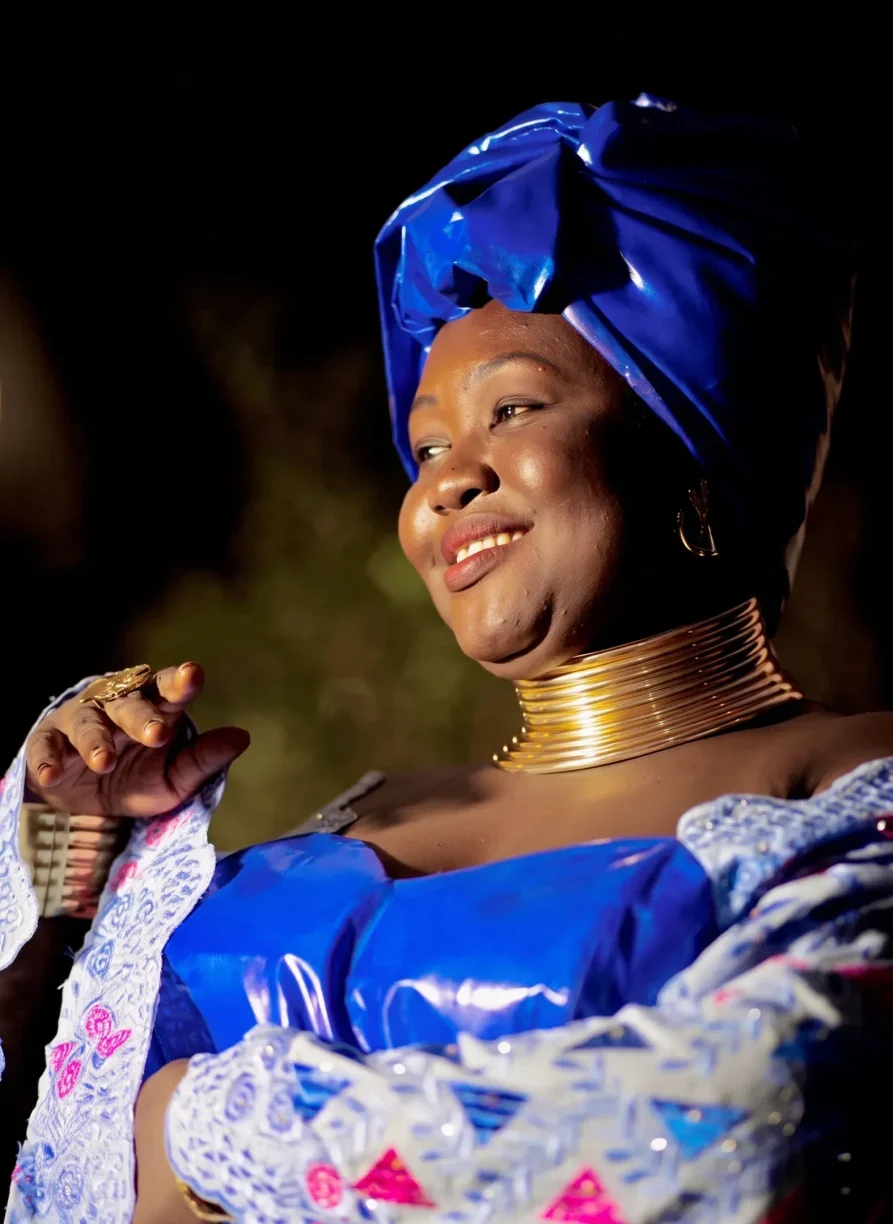
Oumou Diégane Niang, distributor: the architect of the invisible
She doesn’t film, doesn’t act, and almost never appears on screen. And yet, without it, certain Senegalese films would never reach their audience. At 30, Oumou Diégane Niang chose the shadow profession which decided to circulate the works. Portrait of a smuggler.
There is, in cinema, a tacit hierarchy of prestige. At the top, those who write, film, produce. Further down, those who make sure all that work doesn’t die on a hard drive. Oumou Diégane Niang chose this area, deliberately, and made it a profession, then a business, almost a doctrine. Distributor, international saleswoman, co-founder of Wawkumba Film, she belongs to this generation of African professionals who understood that a work that is not seen remains an unfinished story. It doesn’t matter what prizes are won abroad: without a circulation strategy, a film remains half-born.
It is the paradox that shaped his vocation. Senegalese films that win awards abroad sometimes remain unknown at home. “A price does not automatically guarantee an audience. A film can be artistically excellent and not find its audience if its release is not thought out, if its communication is insufficient or if its distribution strategy arrives too late,” she explains. For her, it is therefore not only a question of making Senegalese films travel, but also of bringing them back, of closing the loop between a work and its first audience. She carries this conviction as an almost militant charge. Distribution is the “last link” in the cinematographic chain, and its most fragile. After writing, filming and editing, it remains to make the film exist in the world. A courier, not just a seller “If this passage is poorly thought out, the entire chain can be weakened. The producer does not sufficiently recover his investment, the director does not meet his audience and the film does not generate the value that it could generate,” she says.
Ask her what she actually does, and Oumou Diégane Niang will almost prefer a more accurate image to the vocabulary of the profession: that of the ferryman. Distribution consists of thinking about the circulation of a film in a territory: theaters, festivals, televisions, platforms, schools. International sales, to represent its rights on a global scale and to find buyers, distributors and partners, market after market. It is this dual perspective that she is developing within Wawkumba, founded in 2023 with Sokhna Aïssatou Camara: distribution anchored in Africa, sales focused on the rest of the world, an approach that their mentor, the director and producer Rama Thiaw, helped them to refine. What fascinates her is finding the right door for each film. “Which festival, which venue, which territory, which audience, which campaign, which platform, which partner? » She does not distribute films, she insists. It creates encounters between stories and people.
After four years in the field, she understands that a more structured and ambitious tool is needed: a company capable of defending African films at home and abroad, and of controlling their circulation and marketing. Demba, a lesson in the field A conviction that guides Wawkumba: the continent must be able not only to tell its stories, but also to decide how they travel. From there is born an almost obvious formula: “selling the African dream”. She clarifies its meaning: “I want to sell our creativity, our complexity, our humor, our contradictions, our authenticity, our languages, our imaginations”. The comparison she assumes is that of the American dream, this cultural machine which has long sold the world a certain idea of itself. With an essential nuance: “this is not selling fakes, but authentic ones”.
If proof was needed that strategy counts as much as talent, Oumou Diégane Niang finds it in Demba’s experience. Rather than thinking about the theatrical release as an afterthought, the team organized a preview in Matam, where the film was shot, before a national release accompanied by screenings devoted to the different cinema professions. Result: nearly 1,000 entries in two weeks; a figure which, in the still fragile context of the Senegalese market, is worth demonstrating. Distribution, she repeats, is not added to the end of a project: it is thought out from its conception. It is also Demba who takes her to Qatar, to the Qumra program of the Doha Film Institute in 2025, after her selection, in 2024, at CannesMakers, dedicated to young professionals in distribution and international sales, where she was the only African representative in her promotion.
In 2019, her first experience as an official international salesperson, on the Senegalese-Belgian-French co-production Liti Liti, presented at Visions du Réel, had already marked a shift: she was no longer working only on circulating a film at home, but on finding a place for it on the international stage. “There was adrenaline, and also great challenges,” she summarizes. In 2026, Wawkumba takes a new step by becoming an exhibitor at the Cannes Film Market, with its own catalog: no longer just an African work present in these spaces, but an African structure which acts as an economic actor in its own right. Regarding the Senegalese distribution market, Oumou Diégane Niang gives in neither to superficial optimism nor to fatalism. A fragile market, which is trying to exist and evolve, but which still needs to be structured.
Beyond the lack of cinemas, limited purchasing power, piracy or insufficient financing, she points out an obstacle that her profession can directly correct: the absence of a distribution strategy thought out in advance, coupled with a promotion budget that is too often neglected. The reflex, she laments, is to think about the film until it is finalized before wondering, urgently, how to release it. However, this reflection should start from day one. A market that is still finding its shape Faced with competition, Oumou refuses the register of threat. Netflix and other services are also an opportunity: they allow African works to reach audiences that they would probably never have reached otherwise. But their economic and editorial logic requires learning to negotiate without losing control of the value of the works. “If more African companies specialize in international distribution and sales, that’s a good thing for our industry,” she says.
Competition is therefore not a problem: it is proof that a market is emerging. In Oumou Diégane Niang’s speech, a final movement goes beyond questions of circuits and contracts. Cinema can be, she notes, an instrument of cultural sovereignty, a tool of what theorists call soft power. The great powers have understood this for a long time: the seventh art sells much more than a film. “Why couldn’t Senegal do the same? » she asks. The question, posed by an assumed heiress of Sembène, Djibril Diop Mambéty, Safi Faye, Moussa Sène Absa and a whole new generation of filmmakers, sounds less like a provocation than like long-delayed evidence. His conclusion perhaps sums up his entire journey. Cultural sovereignty does not only consist of producing one’s own images, but also of deciding how they circulate and are valued. This is where Oumou Diégane Niang chose to work, in the shadows, between a work and its audience, as a discreet architect of an industry still to be built.
By Samba Oumar FALL
