
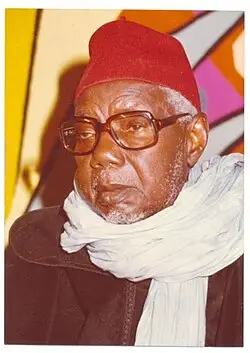
Good leaves I Dabakh, the pedagogy of kindness, by Sidy Diop (4/5: The interior garden of a man of peace) September 15, 2026
Exclusively in Le Soleil, the fourth part of the good leaves of Dabakh, the pedagogy of kindness, the new book by Sidy Diop, dives into the interior garden of El Hadj Abdou Aziz Sy Dabakh. Behind the Caliph, the scholar and tutelary figure of Senegal, reveals a man of deep humility, inhabited by self-control, concern for others and a visceral love for his country. Intimate scenes and testimonies thus shed light on a wisdom that was intended to be less dazzling than fruitful: to soothe hearts, to serve and to remind the powerful of their duty to the people.
The Inner Garden of a Man of Peace
Serigne Abdou Aziz Sy Dabakh belonged to those rare men whose greatness is measured by simplicity. Those who knew him never speak of him as a distant saint or an inaccessible guide. They say “he listened”, “he understood”, “he soothed”.
In a century where piety was often confused with prestige, where holiness was draped in halos, Dabakh chose simplicity as his coat. He fled praise as one flees traps. He kept silent about the miracles that were attributed to him; the honors offered to him he refused.
His only miracle, those close to him said, was to have kept a soul at peace in a turbulent world. This man’s greatest conquest never took place in the political field or the religious platform, but in the secret of his own heart. He had learned to tame this subtle beast that is the ego (nafs). He had observed her, fought her, tamed her, until she stopped wanting to shine.
His wisdom came from there, from an intimate knowledge of the human heart, from this lucidity that only those who have long dialogued with their own shadows acquire. He knew how to recognize the tricks of Satan under their modern masks: pride disguised as zeal, vanity disguised as devotion, anger pretending to defend God. And because he had overcome himself, he could speak to others without judging them. His words, always measured, nevertheless carried the quiet force of certainties.
In mosques, zawiyas and public squares, he preached without artifice, but his words touched the heart before the ear. He preached as one consoles, with authority, but without harshness. His eloquence was not that which inflames, but that which enlightens.
When he spoke of God, it was like a friend he had known forever. His message was not only addressed to scholars, but to all souls in search of guidance: the trader, the teacher, the farmer, the student. He also went to those in power, not to flatter but to remind them. He told them:
“Authority is only an honor if it protects the weak. » (…).
The humility of the scholar
One morning in Thiès, in the hushed murmur of the sandy streets, a man got out of his car. He was no ordinary man. It was Serigne Abdou Aziz Sy Dabakh, the Caliph of the Tidianes, the wise man whose voice subdued pride and raised consciences. However, that day, he was neither the guide nor the master. He simply came looking for a prayer.
He went to Serigne Mansour Borom Daara Ji, his trusted man and great scholar known for his piety. When he was told that Dabakh was coming, Serigne Mansour, moved, hurried outside. He almost ran, fearing that the exceptional visitor would get out of the car before him. Barely arrived, he saw the Caliph waiting for him, humble, patient, like a student before his master.
Dabakh slowly raised his hand and said in a soft voice, that of those who no longer have anything to prove:
“I came to ask for your prayers to soothe my headaches. »
Nothing else. Not another word. No order. No protocol. Just a request. Sincere. Crystal clear.
Serigne Mansour, seized by an emotion difficult to describe, placed his hands on the head of the holy man and prayed for a long time. The words rose like a gentle incantation, clear water washing away the pain. The silence in front of the stage became almost sacred. Then, after a while, Dabakh opened his eyes and breathed:
“The evil has calmed down. »
He thanked his host, blessed him in turn, and left with the quiet slowness of those who know that every gesture can be a prayer.
When his car moved away, Serigne Mansour remained motionless for a long time, his gaze lost in the wake. Then he whispered, his voice trembling:
“I swear by Allah that my father Abdou Aziz is of immeasurable kindness. »
And he added, as if to himself:
“How can a man whose knowledge and wisdom are unanimously recognized perform such an act of humility? »
Professor Madiama Fall, who reported this scene which he got from Serigne Habib Gaye de Thiès, replied:
“Because in you, Serigne Mansour, El Hadj Abdou sees Khalifa Ababacar Sy, and in the latter, he sees his father Cheikhal Hadj Malick.”
Everything was said. That day, humility became a lesson, a silent message transmitted through time. Dabakh, the master who healed hearts, had agreed to hand his heart to another so that he could be relieved. He thus recalled that true knowledge does not inflate the soul, it strips it.
Citizenship of the heart
A luminous gravity which disarms times and soothes people. Abdou Aziz Sy Dabakh knew how to inhabit citizenship as one inhabits faith, without making it a flag, but a daily breath, a sacred duty. He never held power, he never sought to exercise it, and yet he often seemed to be the one to whom power turned when it no longer knew where to go. His words, sober and sharp, served as a compass in times when the nation was rocking. He said he had no mandate, no title, no official authority, but he affirmed with the calmest conviction his right as a citizen to challenge those in power, to remind them that they had responsibility for souls before having responsibility for men.
The country knew him in his light as a religious guide, an eminent scholar, a poet, a fine connoisseur of Islam, but he was also, almost silently, a citizen of exemplary rigor. Dabakh was inhabited by the concern for Senegal, not a ceremonial concern, but that, intimate and burning, of a father who does not sleep as long as one of his children is awake in pain. His son Mame Alpha Sy says he prayed at dawn, whispering these words:
“Lord, make me alone bear any evil that could fall on the country and save Senegal. »
And he cried, alone, with his eyes turned to the sky, imploring for peace, for justice, for the dignity of his loved ones. This prayer, repeated in the solitude of his vigils, is perhaps the most apt summary of his mission, a man who wanted to spare his country suffering, even if it meant taking it upon himself.
He did not keep this concern in the silence of prayers. He kept himself informed, followed the progress of the world, challenged those in power, observed changes in society. One day, learning that national television was broadcasting images that he considered contrary to the values of the country, he called President Abdou Diouf to tell him that governing meant taking care of everything, even what seemed futile, because nothing is futile when the faith of a people is at stake. (…)
DIOP Sidy, Dabakh, the pedagogy of kindnessÉditions du Soleil, Dakar, 2026.
