
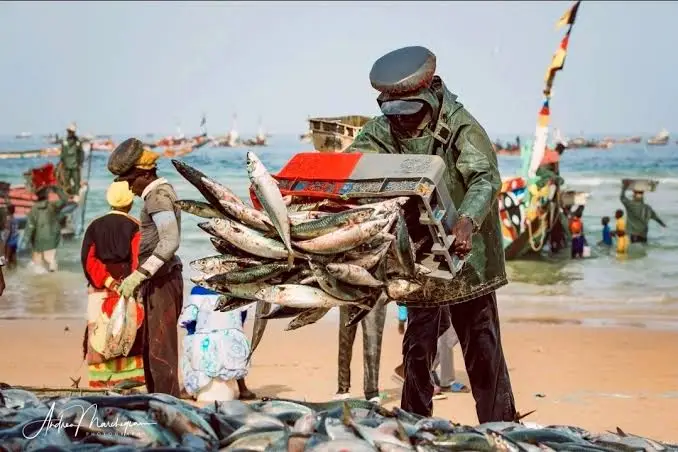
Fish prices: the ministry focuses on sustainable management of the resource
The Secretary General of the Ministry of Fisheries and Maritime Economy, Abibou Diagne, warns that the stabilization of fish prices cannot be achieved without sustainable management of the resource. It calls for controlling production costs, providing security for fishermen and improving marketing channels in order to reconcile household accessibility, fair income and food security.
Stabilization of fish prices will not be possible without sustainable management of the resource. This is the warning issued by Abibou Diagne, secretary general of the Ministry of Fisheries and Maritime Economy, during the meeting devoted to price regulation. While preserving the purchasing power of households constitutes, according to him, “an absolute priority of the government”, he recalled the central place of fish in the national diet, believing that it “contributes strongly to the food and nutritional security of our country”.
For Mr. Diagne, the evolution of the price of fish must be analyzed taking into account the availability of the resource, but also the conditions in which the products are caught, preserved, processed and marketed. “It is necessary to remember that fish is a highly perishable product,” he explained, recalling that once caught, it requires “a cold chain and strict sanitary conditions” to preserve its quality and guarantee food safety for consumers.
However, these requirements combine with numerous factors. The cost of fuel, weather conditions, the price of ice, transport and accidents at sea weigh on the activity of fishermen. “Day after day, our services measure the seriousness of the accidents at sea which strike the fishing industry, a daily human and economic drama,” he noted, stressing that each outing exposes professionals to risks. The safety of the players, he insists, must be taken into account in the same way as the availability of the offer.
Thus, to sustainably stabilize the price of fish, the ministry calls for control of production factors and sustainable management of the resource. “The search for immediate solutions must not be to the detriment of the sustainability of the resource,” he warned. The department intends to promote the restoration and sustainable development of resources, the improvement of marketing circuits and the reduction of post-harvest losses.
The objective, according to the Secretary General, is to “guarantee fair incomes for fishermen while preserving regular accessibility for consumers”. An equation that is social, economic and environmental.
For Mr. Diagne, this equation does not only concern fishermen. “All the players, from universities to researchers, from workers to infrastructure, including manufacturers and transporters,” participate, according to him, in the fisheries value chain.
The secretary general therefore invites us not to pit different interests against each other. “The availability of supply is a reality, just like demand, but we must also question the origin of this supply,” he observed. In other words, the question of price cannot be addressed without looking at the upstream side of the sector.
The Ministry of Fisheries and Maritime Economy intends to act on several levers. “For the fishing sector, we have identified a fundamental lever, which is the restoration and sustainable development of resources,” said Mr. Diagne. Added to this is the improvement of marketing channels and the reduction of post-harvest losses.
For him, the quest for quality remains inseparable from this strategy. “Beyond the supply, we must seek the best level of quality in order to guarantee fair remuneration for fishermen,” he maintained.
Pathé NIANG
