
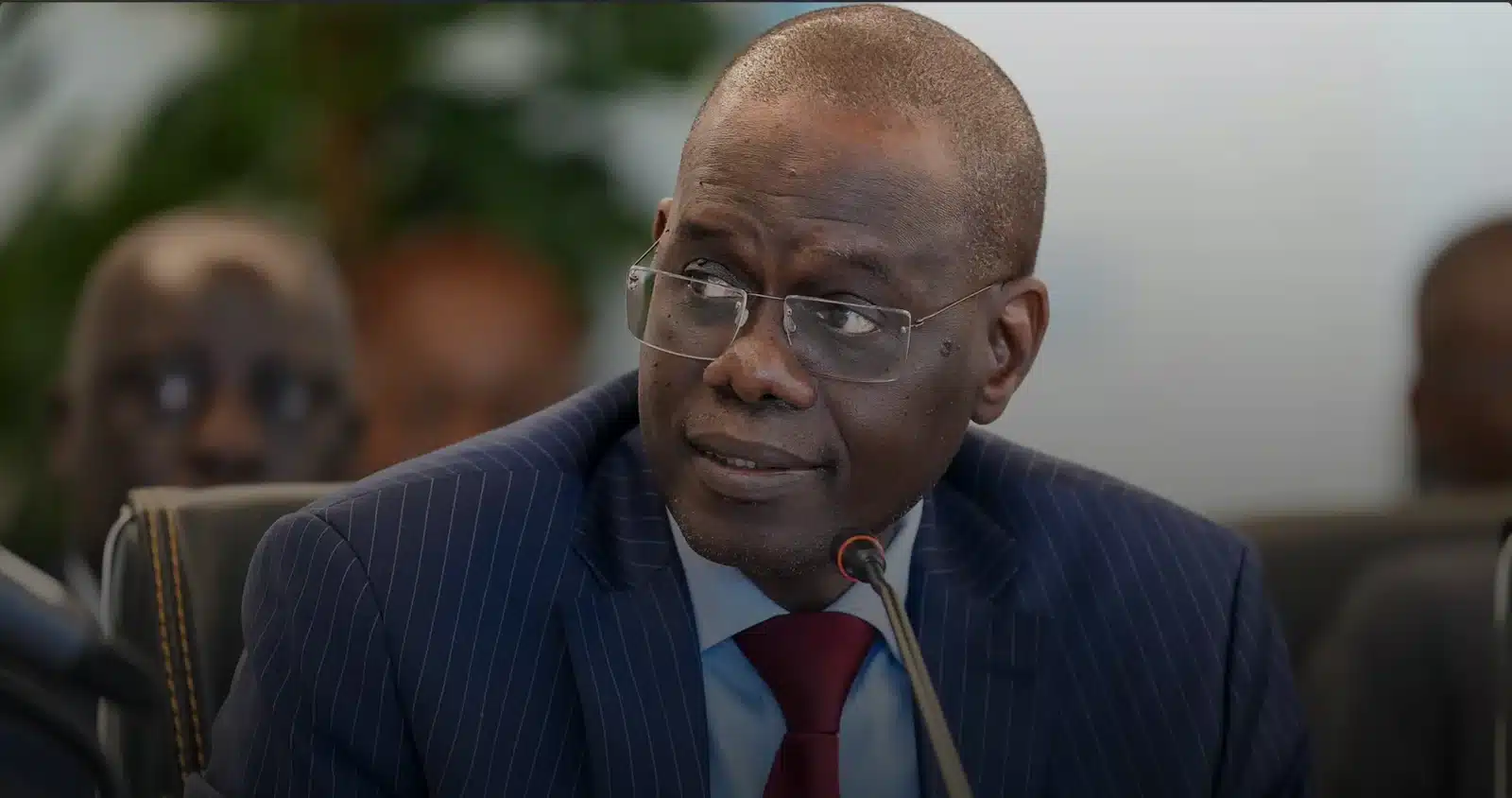
Ahmadou Alhaminou Mohamed LO: The challenge of measurement and government efficiency
Little known to the general public, his meteoric rise led him to head of government in the space of two years. A man of files, with a salutary career, this “child of the troop” gives content to the vision of the President of the Republic, Bassirou Diomaye Faye.
May 25, 2026. A silhouette slowly advances towards the desk installed at the bottom of the steps of the Palace. This is the Secretary General of the Presidency of the Republic, Oumar Samba Ba. In his hand, a sheaf of documents. Measured gesture, impassive face. The wait will have been long. For days, speculation fueled conversations, predictions multiplied, names circulated in political circles and beyond. But now the time has come to put an end to the uncertainty. This involves announcing the name of the new Prime Minister of Senegal.
A few steps from the lectern, alongside the Secretary General of the Presidency, stands a man in his sixties. Sober attitude. No sign of impatience, no manifestation of excitement. He remains perfectly calm. He knows. He already knows the name that will be spoken in a few moments. Above all, he is aware that in a few minutes, his will no longer belong to him alone: it will also become that of the new Prime Minister of Senegal.
The Secretary General of the Presidency, Oumar Samba Ba announces. Ahmadou Alhaminou Mohamed LO is appointed Prime Minister of the Republic of Senegal. He becomes the 17th head of government since independence.
Ahmadou Alhaminou Mohamed LO previously held the position of Minister Secretary General of the Government, from April 5, 2024. On April 30, 2025, he was promoted to Minister of State to the President of the Republic, responsible for monitoring, steering and evaluating the National Transformation Agenda “Senegal 2050”. In May 2026, he became Prime Minister of Senegal.
An economist by training, the appointment of this specialist in macroeconomics, banking regulation and financial markets surprises more than one person. For many analysts, the predicted scenario was quite different. Many expected to see the emergence of a political profile, a party man, experienced in electoral contests and the balance of power that traditionally structure the exercise of power. The head of state decided otherwise. He is banking on a technocrat, a man of experience, familiar with the mechanisms and subtleties of administration. A less political profile, perhaps, but whose long practice of institutional workings could precisely constitute the main strength.
Behind the surprise, a consistency
In a political environment where there are many sensitivities and fragile balances, each appointment can be interpreted as a signal addressed to one camp, the choice of a seasoned senior is not insignificant. It can also reflect the presidential desire to favor experience, restraint and the ability to deal with the different centers of power.
And, for this, what is more valuable than a man who knows the administrative mysteries, the subtleties of institutional balances and the sometimes invisible springs of public decision-making? But the choice can also respond to another, much more prosaic, emergency: the state of public finances. Alamine Lo spent most of his career within the Central Bank of West African States (BCEAO), which he joined in 1987, before gradually climbing the various levels of responsibility.
In a particularly constrained budgetary context, marked by the need to restore confidence, control financial balances and restore credibility to the country’s economic trajectory, the use of a finance technician appears to be a response. The President, beyond the profile of a Prime Minister, seems to have put forward a “typical” profile.
Less posture, more results
When the newly appointed Prime Minister speaks, he greets with deference. The gesture is sober. The voice is nonchalant, but perfectly clear. The sentences are calm, precise, carefully chosen. They embrace the moment, take the measure of the circumstances and already seem to be turning to the challenges that lie before them. The posture is imbued with serenity. But basically nothing is really surprising for anyone who knows, even a little, the journey of the new strong man in the Prime Minister’s office.
“My approach is not a change of direction in Senegal’s systemic transformation commitments, it is rather a change of method in institutional coherence and government action, desired by the Head of State,” he will say.
This statement is particularly revealing of the direction he intends to give to his action. It seems to exclude, at this stage, any desire for a radical break with the mechanisms already in place. It is more of an approach based on continuity, but accompanied by a process of strategic readjustment, intended to correct inadequacies, improve the effectiveness of existing systems and optimize the results obtained.
Troop child
Coming from the Charles N’Tchoréré military Prytanée in Saint-Louis, Ahmadou Alhaminou Mohamed LO obtained a scientific baccalaureate in 1985. He then continued his studies at the Cheikh Anta Diop University of Dakar (UCAD), where he obtained a master’s degree in economics. Mr. Lo speaks and writes French, English and Arabic.
“A troop child”, the current Prime Minister of Senegal was very early confronted with a school of life where discipline is a daily rule. Organization, respect for hierarchy, a sense of duty and the ability to comply with collective demands are learned very early, sometimes with difficulty. Among the brightest in his class, he has clearly retained the reflexes: method, self-control, taste for effort and the ability to remain calm when circumstances require that nothing be revealed.
His career thus bears the imprint of this first school. But he wears another, that of the Daara. In this other universe of training, based on endurance and elevation through effort, he learned other virtues: self-sacrifice, humility and this essential ability to adapt to circumstances, without renouncing the essential. Two schools, two demanding cultures. One taught him discipline, a sense of hierarchy and the rigor of organization. The other, patience, surpassing oneself and the ability to deal with the realities of one’s environment. From this dual training seems to have been born a singular personality: a man of method, but also a man of endurance trained to rigor, shaped by a culture of sacrifice.
As he addresses the country, for the first time as Prime Minister, Senegal discovers a “troop child” who has become a servant of the State. He is also the incarnation of the technocrat now called upon to transform personal rigor into governmental discipline.
O.BA
